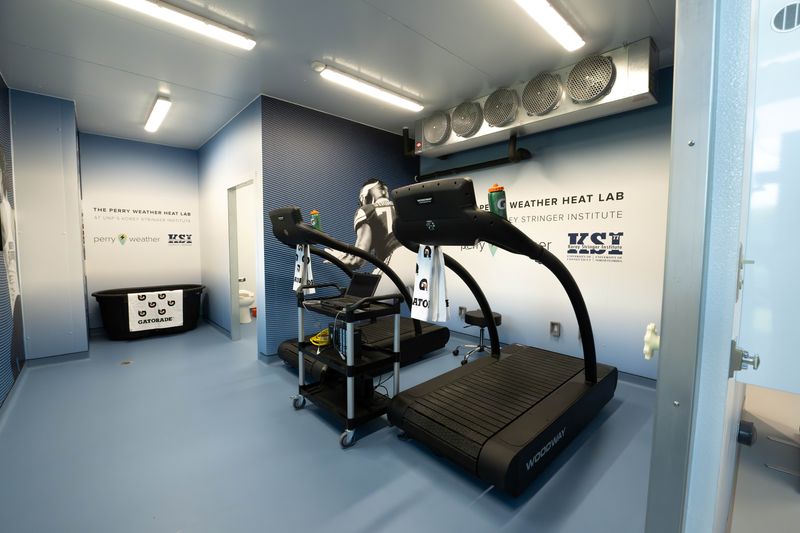
University of North Florida administrators are aiming to help athletes, people working outdoors and Jacksonville’s military community manage heat safely through research at a heat lab that opened May 18.
“No one should die from the heat with all the technology we have,” Kelci Stringer told people gathered to open the lab at the Korey Stringer Institute, which she founded in honor of her late husband, a Pro Bowl football player who died from heat stroke during a 2001 Minnesota Vikings training camp.

The lab is part of a satellite facility for the institute, which is based at the University of Connecticut but expanded to UNF because of Northeast Florida’s regular exposure to heat and humidity.
The expansion “is a defining moment for the Korey Stringer Institute and for the future of heat safety,” said Douglas Casa, the institute’s CEO and a kinesiology professor at UConn.
Jacksonville is among a number of Florida communities where researchers have projected an “extreme heat belt” intensifying between now and the 2050s, increasing the importance locally of understanding ways to cope with sweltering temperatures.
The UNF heat lab has a “climate chamber” where temperatures can be adjusted from 32 degrees Fahrenheit to about 120 degrees, and humidity raised or lowered, while researchers track bodily changes on test subjects inside.
Researchers at the lab see their work having value for a wide range of Northeast Florida residents.
Coaches, trainers and student-athletes, for example, can get guidance on mitigating impacts of heat and humidity while UNF’s Army ROTC cadets get support for safely maintaining readiness standards during demanding training.
UNF assistant professor of kinesiology Michael Szymanski, director of the institute’s UNF satellite, said he and Gabrielle Brewer, a post-doctoral associate, are also working with City Hall on safety protocols for outdoors workers as well as steps for acclimatizing workers relocating from other parts of the country.
The institute’s research can be applied to private employers as well, Szymanski said.
“Heat-related illness is one of the most preventable risks facing athletes and outdoor workers today,” Colin Perry, CEO and founder of Perry Weather, which was involved with the institute in launching the climate chamber, said in release from UNF about the opening.
Earlier work at UConn has included research on wearable technology’s uses for preventing damage from extreme heat, and testing with products that are already commercially available is expected to be part of the UNF satellite’s tasks too.
UNF hopes to have more heat lab facilities in coming years, said Brooks College of Health Dean Mei Zhao. She said those facilities, if they materialize, would be part of a plan to boost both sports training and academic work in health and fitness, but that achieving those hopes will depend on action by the Florida Legislature.
This article originally appeared on Florida Times-Union: Heat lab named for NFL player killed by heat stroke opens at UNF
Reporting by Steve Patterson, Jacksonville Florida Times-Union / Florida Times-Union
USA TODAY Network via Reuters Connect