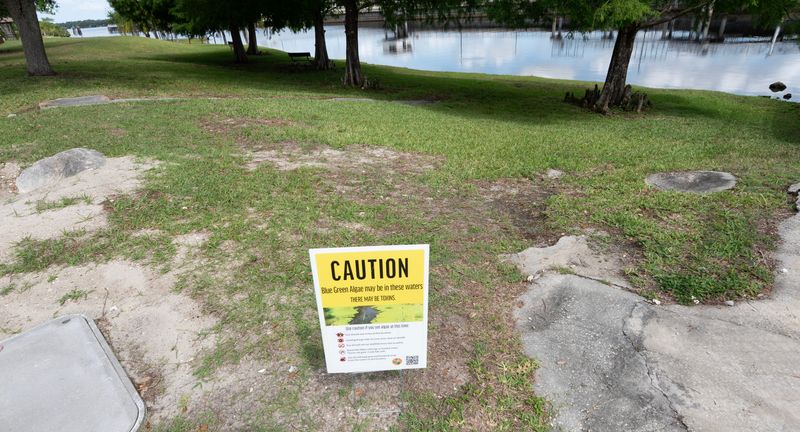
Boaters beware of blue-green algae that’s been found in the Caloosahatchee River at the Sebastian Canal, according to public health authorities.
The Florida Department of Health in Lee County has issued a health alert for the presence of harmful blue-green algae toxins in the region of the Caloosahatchee at the Sebastian Canal.

The public should exercise caution in and around that area.
The alert is in response to a water sample taken May 5.
Water where algae blooms are present is not safe for humans, pets and livestock.
What is blue-green algae?
Blue-green algae are a type of bacteria that is common in Florida’s freshwater environments.
A bloom occurs when rapid growth of algae leads to an accumulation of individual cells that discolor water and often produce floating mats that emit unpleasant odors.
Blue-green algae blooms can also appear as scum, foam, or paint on the surface of the water in various colors. To learn more about the appearance of algae blooms, visit Protecting Florida Together.
Some environmental factors that contribute to blue-green algae blooms are sunny days, warm water temperatures, still water conditions, and excess nutrients.
Blooms can appear year-round but are more frequent in summer and fall. Blue-green algae may not always be visible as a bloom, but it can still be present in the water
Is blue-green algae harmful?
It can produce toxins, which can be harmful to human and pets as well as ecosystems, including fish and other aquatic animals.
Anyone who is immunocompromised, such as children, the elderly or who have respiratory conditions, may still be at risk even at low concentrations and should avoid any exposure.
Here’s what to do to be safe
• Do not drink, swim, wade, use personal watercrafts, or come into contact with waters where there is a visible bloom.
• Wash your skin and clothing with soap and water if you have any contact with algae, or discolored or water that smells unpleasant.
• Keep pets and livestock away from the area to avoid any contact with water.
• Do not cook or clean dishes with water contaminated by algae blooms. Boiling the water will not eliminate toxins.
• Eating fillets from healthy fish caught in freshwater lakes experiencing blooms is safe. Rinse fish fillets with tap or bottled water, throw out the guts, and cook fish thoroughly.
• Do not eat shellfish in waters with algae blooms.
Report a bloom where?
• Algae Blooms: The state Department of Environmental Protection monitors algae blooms and collects samples for analysis. Blooms can be reported to DEP online or by calling toll-free at 1-855-305-3903.
• Human Health: Report symptoms from exposure to a harmful algae bloom or any aquatic toxin to the Florida Poison Information Center by calling 800-222-1222 to speak to a poison specialist.
If you have other health questions or concerns about blue-green algae, please call DOH-Lee at 239-690-2100.
Do you have an opinion about this topic? Write a letter to the editor and send it to letters@naplesnews.com and/or mailbag@news-press.com. Keep it to 250 words or fewer and include your contact info. Have more to say: Send a guest column of no more than 600 words.
Liz Freeman is a health care reporter. Reach her by emailing lfreeman@naplesnews.com
Please support local community journalism and stay informed about Southwest Florida news by subscribing to The News-Press and Naples Daily News; download the free News-Press or Naples Daily News app, and sign up for daily briefing email newsletter, food & dining and growth & development newsletters here and here.
This article originally appeared on Naples Daily News: Health alert issued for blue-green algae in Caloosahatchee River
Reporting by Liz Freeman, Fort Myers News-Press & Naples Daily News / Naples Daily News
USA TODAY Network via Reuters Connect