Any new oil and gas exploration in the Gulf could cause the extinction of the Rice’s whale, and bypassing the Endangered Species Act may also impact sea turtles, dolphins and manatees, critics say.
The criticism comes after the Trump administration called for a meeting of the so-called “God Squad,” a group that hasn’t met since 1991.

“They want unlimited, uninhibited oil exploration,” said Susan Holmes, executive director of the Endangered Species Coalition. “They don’t want any restrictions.”
Holmes is leading the charge to stop a March 31 meeting called by Secretary of the Interior Doug Burgum after Secretary of Defense Pete Hegseth declared a national security issue related to energy production.
Declaring a national emergency is one of the few ways an administration can bypass the Endangered Species Act.
Environmental groups like the Center for Biological Diversity filed a lawsuit March 27 against Burgum in federal district court in Washington, D.C., with the hope of preventing the group, officially known as the Endangered Species Committee, from meeting March. 31.
Burgum said in a court memo that these groups are overacting.
“The meeting will be open to the public via live video. Rather than watch the livestream, Plaintiff rushed to court, speculating about the Committee’s future action, speculating about future injury to animals, and asking this Court to step in before any Committee action and prevent the Committee from ever meeting,” the memo from Burgum’s office reads. “The request to enjoin the meeting is baseless. Holding a meeting is not final agency action, the statute vests exclusive jurisdiction over Committee decisions in the courts of appeals.”
“Burgum’s extinction committee is immoral, illegal and unnecessary,” said Kierán Suckling, executive director of the Center for Biological Diversity. “There’s no emergency, no legal basis to convene the committee, and no legal way to approve the extinction of Rice’s whales. This sham is nothing more than Burgum posturing for Trump and saving the fossil fuel industry a few dollars by allowing its boats to drive faster and more recklessly.”
One fear is that the Rice’s whale will be declared extinct by the administration, which has used a vastly different set of criteria recently to delist animals like the beloved wood stork.
Holmes says any decision from the so-called “God Squad” could also lead to impacts for other marine animals, like dolphins, manatees and sea turtles.
“The endangered sawfish, manatees and loggerhead turtles, protections for those species may be on the list as well,” Holmes said. “It doesn’t’ necessarily just pertain to Rice’s whale. This puts Southwest Florida’s extraordinary wildlife at risk through further oil and gas exploration.”
Another fear is the further oil and gas exploration will impact protected sea turtles.
“The Rice’s whale is one of the most endangered species in the world, with only 51 individuals, all in the Gulf,” said Susan Holmes, executive director of the “President Trump is seeking to play God with the Rice’s whale and other endangered species in the name of expanding oil and gas development.”
Holmes said the move is unprecedented, and that there has never been such a strong attack on the Endangered Species Act, which was approved under a Republican administration.
That foundational ecological protection law was signed by Richard Nixon on Dec. 28, 1973. That administration admitted that many species once found here had become extinct due to commercial industries, development and growth, and the Endangered Species Act was meant to ensure that no more extinctions occurred here.
“No administration, Republican or Democrat, has ever sought such a sweeping exemption from the Endangered Species Act,” Holmes said.
Critics: God Squad meeting a political sham, not a replacement for science
The meeting, Holmes said, is sham of a process that does not reflect the spirit of the Endangered Species Act or science in general.
“This closed-door effort to weaken protections for whales, sea turtles, and the Gulf ecosystem is a direct threat to wildlife already struggling to survive,” she said. “Decisions about endangered species must be guided by science, not politics or corporate pressure.”
Burgum said the public would be able to view the meeting by livestream.
Rice’s whale is one of the rarest whales in the world, with fewer than 100 thought to be in the Gulf, according to the National Oceanic and Atmospheric Administration, or NOAA.
“They are the only species of baleen whale that regularly occurs in the Gulf,” a NOAA website reads. “Most sightings of Rice’s whales have been concentrated in 100– to 400-meter water depths in the northeastern Gulf.”
Rice’s whales are closely related to Bryde’s whales, and the two were thought to be the same species until a Rice’s whale washed up dead in Everglades National Park in 2021.
“Their body is sleek, and their pectoral fins are slender and pointed,” a NOAA website reads. “Rice’s whales are uniformly dark gray on top with a pale to pink belly. The head of a Rice’s whale makes up about one quarter of its entire body length. The whale has a broad fluke, or tail, and a pointed and strongly hooked dorsal fin located about two-thirds of the way back on its body.”
All whales are protected under the Marine Mammal Protection Act.
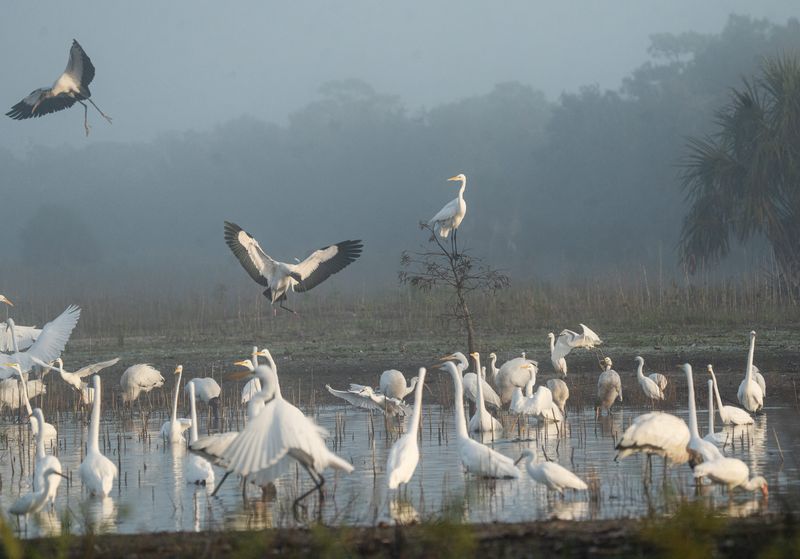
What happened to the wood stork?
The Naples area was once home to the nation’s largest wood stork nesting colony, but the bird barely nests there today.
With virtually zero breeding activity in its historic stronghold, it might seem like the wood stork is it trouble, and advocates say it is.
But the U.S. Fish and Wildlife Service on March 12 delisted the species, saying it has adapted to manmade landscapes in other states.
“They have adapted to new nesting areas, moving north into coastal salt marshes, flooded rice fields, floodplain forest wetlands and human-created wetlands,” the agency said in a Feb. 9 press release.
But those rice fields and created wetlands may not stay in their current state for the long-term future, Audubon and others pointed out.
Audubon says the species doesn’t meet even half of the FWS criteria need to delist the bird.
Chad Gillis is an environment reporter and can be reached by email at cgillis@news-press.com.
Please support local community journalism and stay informed about Southwest Florida news by subscribing to The News-Press and Naples Daily News; download the free News-Press or Naples Daily News app, and sign up for daily briefing email newsletter, food & dining and growth & development newsletters here and here.
This article originally appeared on Fort Myers News-Press: ‘God Squad’ hasn’t met since 1991: Is rare whale in the Gulf in danger?
Reporting by Chad Gillis, Fort Myers News-Press & Naples Daily News / Fort Myers News-Press
USA TODAY Network via Reuters Connect