Florida State University’s efforts to address pediatric rare diseases have reached greater heights.
Gov. Ron DeSantis recently signed HB 907 – the Sunshine Genetics Act – which establishes a pilot program for newborns through FSU’s Institute for Pediatric Rare Diseases. And with the initiative, families can have their baby’s full genetic code sequenced at no cost to identify potentially serious conditions.

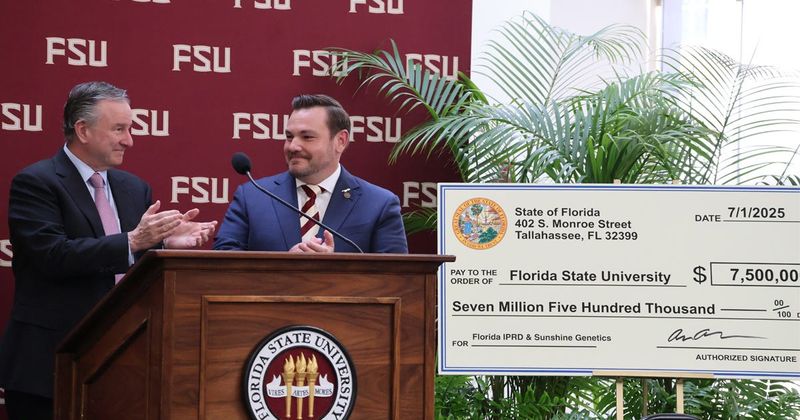
“This not only marks the beginning of the next generation of healthcare for Floridians, but it also ensures that IPRD (Institute for Pediatric Rare Diseases) will go on to live longer than anybody here in this room,” Rep. Adam Anderson, R-Palm Harbor – whose son Andrew died from Tay-Sachs disease – said July 9 at a ceremonial check presentation at the FSU College of Medicine.
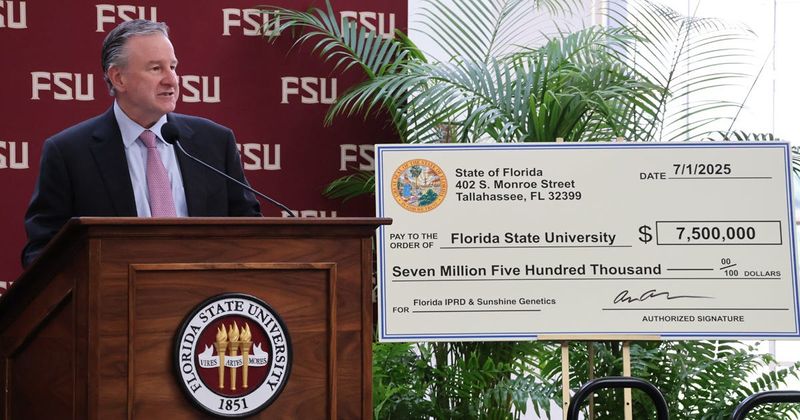
As the new Sunshine Genetics law was made effective July 1 and kicks off the pilot program with $3 million, the Institute for Pediatric Rare Diseases at FSU – launched in February 2024 – has received an additional $4.5 million from Florida’s 2025-2026 budget to boost research, which totals the state’s allocation toward the overall initiative to $7.5 million.
The signed act was championed by Anderson and establishes the Florida Institute for Pediatric Rare Diseases within the FSU College of Medicine in state law.
The pediatric institute at FSU is also a significant result of Anderson’s advocacy, with the goal of driving interdisciplinary research and leveraging gene therapy to improve outcomes for millions of children across the country who are affected by rare diseases.
While speaking at the July 9 event, Anderson thanked DeSantis as well as FSU administrators for their support. “Your work today is providing hope to countless families, but it’s just a matter of time before that hope is transformed into cures for rare diseases,” he said.
Anderson also highlighted how the new act creates the Sunshine Genetics Consortium, which unites Florida’s top researchers, clinicians and biotech innovators from FSU, the University of Florida, the University of Miami, the University of South Florida, Florida International University and Nicklaus Children’s Hospital.
“Through our universities, Florida will lead the future of medicine,” Anderson said.
Identifying potentially serious but treatable conditions early on through the new pilot program will allow doctors to begin care before symptoms appear – making Florida the first and only state in the nation to offer a comprehensive newborn screening program.
With the state funding, the FSU institute will work toward ending the previously lengthy search for a diagnosis by families battling rare diseases.
In addition to the $7.5 million from the state, FSU President Richard McCullough committed $2 million from the university’s budget to support the Sunshine Genetics Pilot Program, which is a five-year genetic sequencing initiative.
“Rep. Anderson’s vision to impact lives in this area is unparalleled, and we are grateful to be his partner,” McCullough said.
With the Sunshine Genetics Pilot Program being launched, FSU’s Institute for Pediatric Rare Diseases Director Pradeep Bhide says the institute at the university will be “the heart, the hub and the core” of the new public health initiative.
“The vision is to make Florida a leader in pediatric precision medicine, where care is personalized, preventing and proactive so that every child in Florida will have access to the best.”
Tarah Jean is the higher education reporter for the Tallahassee Democrat, a member of the USA TODAY Network – Florida. She can be reached at tjean@tallahassee.com. Follow her on X: @tarahjean_.
This article originally appeared on Tallahassee Democrat: FSU, Florida Institute for Pediatric Rare Diseases launch new ‘Sunshine Genetics’ program
Reporting by Tarah Jean, Tallahassee Democrat / Tallahassee Democrat
USA TODAY Network via Reuters Connect