

The following contains excerpts from a March 31, 2012, article in the Naples Daily News entitled “The early locals in SW Florida.”
Led by legendary explorer Juan Ponce de León in the winter of 1521, two Spanish ships carrying 200 men sailed onto the Southwest Florida coast where a deadly ambush awaited.

The Spaniards had made landfall here before in 1513. They stayed for three weeks, exploring the land and occasionally sparring with the mysterious Calusa tribe, a centuries-old people of La Florida.
Eight years later, it was now time to colonize.
But before the Spanish could disembark, Calusa oars hit the saltwater. Eighty canoes rushed toward the Spanish, powered by screaming men armed with poison-laden arrows and spears pointed with sharpened bones. In the fierce battles that followed, dozens of men from both sides were killed. But the invaders were repelled.
De León, the man mythically known for searching for immortality at the fabled Fountain of Youth, was mortally wounded in the thigh by a Calusa arrow, one slathered with sap from the manchineel tree – bearer of the “death apple.”
As Calusa scholar John Worth said, de León should have known better.
“He had every reason to believe the Calusa were going to be hostile to him, and yet the place where he met the most resistance is where he brought back two ships,” Worth said. “My only theory – other than pure insanity – is he went to the place that had the greatest potential for human labor.”
In this area’s earliest days, nobody – not de León, not the Spanish politicians, not the religious zealots – could compete with the Calusa, Southwest Florida’s greatest chiefdom.
‘They found a paradise’
History enthusiast John Paeno knows the story of the Calusa Indians – how a capital was established on Mound Key in present-day Estero Bay; how royal infighting and incest bred jealousies; how gun-toting North Florida Indians and European disease became their demise.
The Calusa were a great people, Paeno said, building a civilization they valiantly fought to keep in the days before Barron Collier and the building boom and tourist rush.
“They battled everybody and drove everybody out,” said Paeno. “They found a paradise and they defended it.”
No written documentation from before the early 1500s exists about Calusa life, but artifacts offer clues.
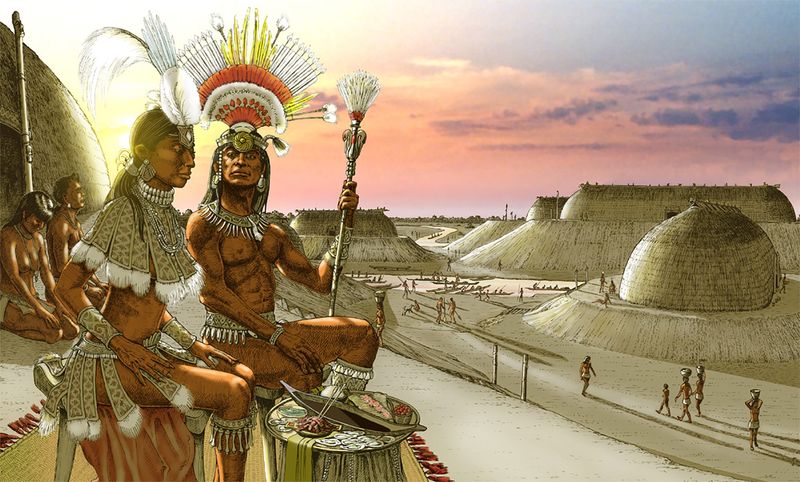
The Calusa tended to live close to the coast, where fish and crustaceans were plentiful. They fashioned tools out of shells and were proficient wood carvers. Shell mounds, which can still be found today, piled up along the water. The remnants would form some of the coastal topography and development sites still in use today.
“It’s a thriving area of Florida, and the landscape and climate that everybody goes to now – it gives people a connection to the Calusa,” said Worth, a professor at the University of West Florida in Pensacola. “Right now, we’re eating those very same fish and wading in those very same waters.”
Reaching at least 20,000 in population, with a realm stretching north to Lake Okeechobee, east to Miami and south to the Keys, the Calusa controlled a large part of the state until the early 1700s.
While researchers debate the length of the Calusa reign, historians agree the tribe was organized by 500 A.D. at the latest.
Two differing theories explain how the Calusa established their dominance. One suggests it was a natural evolution.
“I think the Calusa developed this system over hundreds of years, maybe around 800 A.D.,” Calusa researcher and anthropologist Jerald Milanich said. “When the Spanish show up, I think certainly the social complexity was already there.”
William Marquardt, director of the Randell Research Center in Pineland, which documents Calusa heritage, offers another theory, albeit a less popular one: The Spanish had landed in Florida earlier than de León’s first voyage, whipping the Calusa into action.
“I think they knew exactly who the Spaniards were,” Marquardt said. “Very shortly after that, they figured if they were going to compete with the Spaniards, they would have to develop an enhanced organization.”
Regardless of theory, this much is known: The Calusa were a headstrong, isolated people entrenched in their home and beliefs.
Source: Naples Daily News online archive.
This article originally appeared on Naples Daily News: From the Archives: Spanish and Calusa collide in Southwest Florida
Reporting by Naples Daily News / Naples Daily News
USA TODAY Network via Reuters Connect
By Naples Daily News | USA TODAY Network
