(This story has been updated with additional information.)
Hours after Miami-Dade County announced a proposal to turn Alligator Alcatraz into a permanent environmental preserve, Gov. Ron DeSantis stood on the remote airstrip in the middle of the Everglades Thursday, June 25, to declare the mission of the detention center complete.

Joined by White House Border Czar Tom Homan and state immigration officials in 90-degree heat, DeSantis characterized the year-long operation as an emergency situation that served its purpose while federal resources were strained. The facility will be broken down in seven to 14 days, DeSantis said while looking over at Kevin Guthrie, the executive director of the Florida Division of Emergency Management, for confirmation.
DeSantis and Anthony Coker, the executive director of the Florida State Board of Immigration Enforcement, reported that the facility currently holds no detainees. “As Gov. DeSantis has said, Alligator Alcatraz today has zero detainees, which means mission success for Florida,” Coker said.
Alligator Alcatraz land eyed for conservation
The announcement of the facility’s wind-down clears the way for a proposal to conserve the land. Miami-Dade County Mayor Daniella Levine Cava announced her desire Thursday, June 25, to evaluate selling the 17,000-acre site to the National Park Service.
The proposal seeks to ensure the acreage is “dedicated in perpetuity to ecological restoration” and incorporated into the Comprehensive Everglades Restoration Plan, one of the largest environmental restoration efforts in the United States, Cava’s statement said.
The jetport turned detention center is in Big Cypress National Preserve, part of the Florida Everglades.
The transition is not guaranteed. While Florida Attorney General James Uthmeier noted general support for returning the land to a protected status earlier this week, DeSantis said during the press conference that he was “not sure” whether removing all infrastructure would “meaningfully aid” restoration, suggesting the site was “fine the way it was.”
The Miami-Dade County administration determined that the remote location, limited aviation utility and significant maintenance obligations mean an airport is no longer the best long-term use for the property, the Cava administration said in a statement.
“From the very beginning, I have raised serious concerns about the ‘Alligator Alcatraz’ detention facility because people have been held there in inhumane conditions without meaningful due process, while occupying land alongside one of the world’s most precious natural ecosystems,” Cava said in a statement. “Once this facility is decommissioned, we have an opportunity to permanently protect these lands for Everglades restoration and ensure they remain protected for generations to come. That is the legacy we should leave.”
What happened at the governor’s press conference in Ochopee?
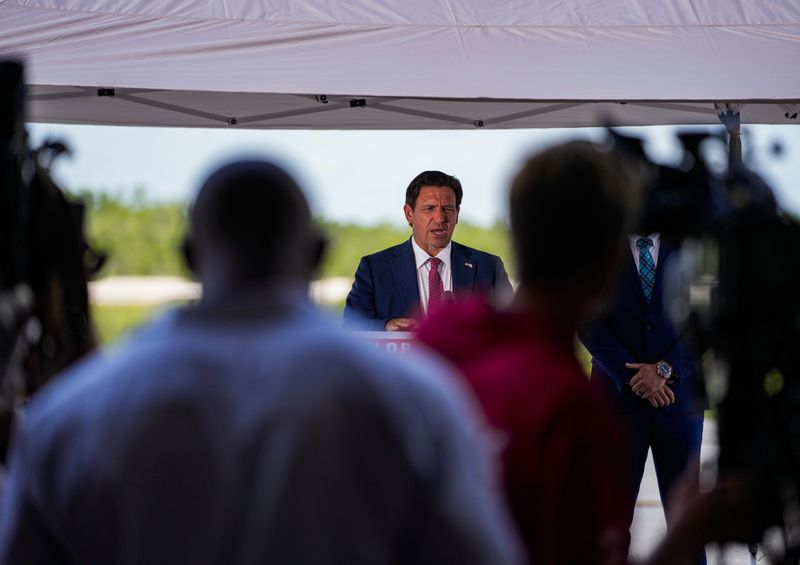
Standing on the airstrip under a beige pop-up canopy tent that visibly shook and swayed in the wind, DeSantis described Alligator Alcatraz as a temporary emergency measure that served its purpose while the federal government lacked the resources to process arrivals.
The setting provided The News-Press & Naples Daily News a firsthand look at the “soft-sided” nature of the facility that had previously only been shared during official and detainee testimony in court hearings, or during President Donald Trump’s visit with a pre-selected press pool in July 2025. Surrounded by a group of Secret Service agents donning full suits and sweating profusely, media gathered under a heavy-duty aluminum-framed tent similar to those that housed detainees, though it featured an open wall panel and was situated directly on the airstrip. Despite state claims that these structures are built to withstand Category 2 winds, the frames of the tent audibly creaked in the wind, similar to the sound of an old metal boxspring, during the press conference.
DeSantis, wearing a suit paired with black cowboy boots, praised state leadership and agencies for helping transform the remote Dade-Collier Training and Transition Airport into a fully operational detention facility in about 10 days after the federal government requested assistance.
The site was taken over in summer 2025 by the state of Florida under emergency orders from the governor after Miami-Dade balked at the state’s original offer price to buy it.
“This was an emergency situation,” DeSantis said. “DHS did not have resources. The funding they got last summer had not passed yet. And they were in a situation where they could not keep these people. They didn’t know what to do with them. They didn’t have the space, so we did this.”
The governor noted Florida’s role in national immigration enforcement, saying the state now accounts for 40% of all 287(g) immigration arrests across the country. Florida has entered into 80% more 287(g) law enforcement agreements than the next closest state, he said, adding that it positions Florida as the “gold standard” for state-led enforcement.
DeSantis said that more than 22,000 people were processed and staged for deportation from the site since it opened in July 2025. He argued that without this facility, these individuals, whom he described as vicious and possessing massive rap sheets, would have been released back into Florida communities due to a lack of DHS bed space. DeSantis held up a stack of papers and shook them, then read aloud the criminal histories of several former detainees, citing offenses ranging from armed sexual battery and kidnapping to trafficking over 200 grams of fentanyl.
He continued, “I think it’s been 22, 23, 24,000 maybe 25,000 who would have been released into Florida communities, but instead were processed and deported from there, and there’s no question that that saved lives, no question that’s been good for public safety.”
Addressing the fiscal weight of the project, DeSantis appeared unconcerned by the hundreds of millions in outstanding federal reimbursements.
“The good thing about Florida is we’ve got a big budget surplus. We’ve got a maxed-out rainy day fund,” DeSantis said. “We got to do what it takes to keep people safe. And there’s no question that people are safe as a result of that. We prevented preventable crimes.”
What led to the sudden change toward possible ‘conservation’?
The announcement follows a week of reports that the immigration detention facility in Ochopee is permanently winding down operations. While the U.S. Department of Homeland Security maintained as recently as June 17 that detainees were moved only for “their safety during hurricane season,” a Florida congresswoman confirmed that on-site vendors received orders to begin “full demobilization.”
In a press conference about a different topic Monday, June 23, Uthmeier voiced support for transitioning back to protected land. “The plan has always been to protect the Everglades and take it back to a protected area where it’s not a commercial business, an airport,” he said. “I will say it was never expected to be a long-term thing.”
Despite these comments, Collier County government told The News-Press & Naples Daily News June 22 that it was not notified of any changes to the operational status of the immigrant detention facility. Miami-Dade County also said it has not received any formal communication from the state regarding any change to the facility’s operational status.
The indigenous community in South Florida had also not had contact with officials at the state or federal level as to when the facility may shut down. The Miccosukee Tribe of Indians of Florida joined a lawsuit last year that sought to close the facility and remove the equipment, rocks, tents, pavement and people. That suit is still active, said influential Miccosukee tribal member Betty Osceola.
How have the environmental battles shaped Alligator Alcatraz?
Advocacy groups like Friends of the Everglades have long criticized the detention facility’s impacts on the fragile Everglades ecosystem.
Friends of the Everglades has launched several lawsuits against the state alleging it didn’t follow environmental laws requiring environmental impact reviews before construction starts. The group also sued the state for denying public records requests regarding state spending on the facility.
“‘Alligator Alcatraz’ will go down as one of the biggest failures in American history,” said Eve Samples, executive director of Friends of the Everglades. “Our government failed to protect the Everglades and failed to follow basic environmental laws — while racking up a $1 billion tab paid by taxpayers. We sued to stop the harm, our case continues, and we will not let up until this makeshift prison permanently closes and all the damage is undone.”
Samples continued, “That harm includes 20 acres of new pavement, removal of habitat for the endangered Florida panther, and high-intensity lighting installed in a renowned dark-sky area.”
How are advocates and attorneys reacting?
“Alligator Alcatraz is a failed experiment in cruelty by the Trump and DeSantis administrations,” said Noelle Damico, director of social justice at The Workers Circle — a national secular Jewish social justice group.
She said that the administrations attempted to convince Americans to hate and fear immigrants but failed because ordinary people resisted the policy. She attributed the wind-down to 47 consecutive weeks of vigils held outside the facility that made it “politically toxic” to continue operations.
“We denounced the brutality, lawlessness, chaos, and corruption that was Alligator Alcatraz. We, the people, made it politically toxic. We brought it to an end here and we will bring it to an end everywhere,” Damico wrote in a statement. “We’re sharing these lessons across the nation. And we will hold all who designed, carried out, or profited off this brutal experiment accountable.”
Immigration attorneys warned that the closure creates new hardships for those formerly held at the site.
Hector Diaz, managing partner of Your Immigration Attorney, described the process as a game of logistics that often results in detainees being moved anywhere in the United States. He noted that mass transfers cause court cases to be pushed back, leading to longer detention periods. Diaz stated that the closure places detainees between “rock and a hard place” because they must choose between immediate deportation and continuing a legal fight during a protracted stay in a new facility.
“Although it’s a great publicity stunt, there are many different things that can go wrong with detaining so many people in such a rudimentary camp, as the state of Florida has found out the hard way,” Diaz said. “It’s a very difficult endeavor, not only the human part, the legal part, the environmental part, there are so many moving obstacles that it’s turned out to be a costly endeavor.”
Mickenzie Hannon is a watchdog reporter for The News-Press and Naples Daily News, covering Collier and Lee counties. Contact her at 239-435-3423 or mhannon@gannett.com.
Alexa Ryan is a reporter for Naples Daily News. You can reach her by emailing Alexa.Ryan@naplesnews.com.
Please support local community journalism and stay informed about Southwest Florida news by subscribing to The News-Press and Naples Daily News; download the free News-Press or Naples Daily News app, and sign up for the Daily Briefing email newsletter, food & dining and growth & development newsletters here and here.
This article originally appeared on Naples Daily News: From prison to preserve? Alligator Alcatraz closed, land eyed for protection
Reporting by Mickenzie Hannon and Alexa Ryan, Fort Myers News-Press & Naples Daily News / Naples Daily News
USA TODAY Network via Reuters Connect

By Mickenzie Hannon and Alexa Ryan, Fort Myers News-Press & Naples Daily News | USA TODAY Network