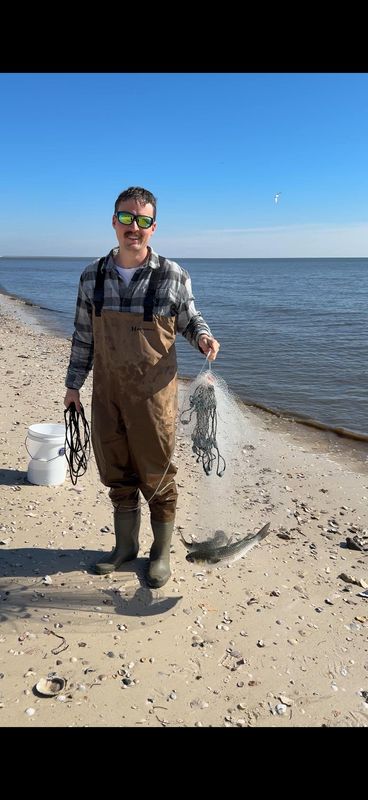
On a breezy, overcast day in June, I drove down to Alligator Point to chat with John Gholston Moran to chat about his new publication, The Panacea Review.
Moran’s home on the Gulf side of the Point is a gallery of odd art and old Florida kitsch; the kind of place where you would expect to find someone who loves the Sunshine State as much as this native son, and who has produced two issues of a journal “with an interest in literary ephemera.”

We started with a rooftop tour, a vantage point from which the Gulf of Mexico stretches out to the south, east, and west. A squadron of pelicans performed a fly-by, silently gliding on the air currents instead of creating a mechanical roar and jet-washed chaos among beachgoers.
Back downstairs, we sat on the porch to take advantage of the breeze. Moran prepared a snack of toasty, gooey brie with a perfect complement of blueberries. He explained why he decided to start a literary journal on Florida’s Forgotten Coast.
“There are so many wonderful nature writers in this region, and there are so many natural and cultural riches to write about, that it’s exciting to have that in the pages of the journal, and also, for it to have a foot in this region, but also to try to be a national or global journal.”
Global impact with a Florida slant
The first two issues of The Panacea Review are a cornucopia of contributors, from local writers like Susan Cerulean and Don Morrow to international voices such as Grace H. Zhou (Scotland) and Arthur Thuot (Canada). Some names are familiar, although their contributions might be more ephemeral.
For example, Issue 2 includes a poem by George Patton. True, you might know Patton more for his military prowess than for his poetry, but thanks to John Moran and The Panacea Review, you will forever think of “The Fly” when the name of General Patton is invoked, and vice versa. This bit of off-colored humor, included in a letter from Patton to his wife, was truly ephemeral — not meant for public consumption or permanence.
The Library of Congress defines ephemera as “non-commercial, non-book publications in the form of pamphlets, handbills, leaflets, broadsides, position papers, minutes of meetings, information sheets, bulletins, newsletters, posters, moving images and photographic documentation.”
Moran synthesizes this into a more distinct, and coastally appropriate term: “flotsam and jetsam that rarely leaves the drawer.”
Moran’s journal presents flotsam and jetsam that you might never have thought would strike your interest; but one might find, as I did, that glancing through the journal can turn into a rabbit hole down which one enjoys falling. The meta of ephemera is here.
In “Parvati’s Bathtub” by Amrapali Maitra, the main character carries with her a virtual museum of ephemera: ticket stubs, recipes torn out of magazines, museum guides “with scribbles in the margin,” and other items comprising a “paper trail [that] was an attempt to fashion a sense of home, the way birds nested.”
Lance Legel lists over 6,000 web domains. Will you read the entire list? Or will the compilation remind you (as it did me) of days gone past when one would read the white pages of the phone book and wonder at all the names, addresses, and telephone numbers?
Perhaps it will take you on your own hunt for the literary ephemera of your youth: “Where is that Tom Petty poster from the 1981 concert in Gainesville? What about the playbill from the performance of Jesus Christ Superstar that Mom and Dad went to back in the early ’70s?”
The South, satire and cross-genre art
To complete the second volume of the journal, Moran dug deep in the back of that kitchen junk drawer for works that fit the parameters of special interests; not just literary ephemera, but also environmental themes, regional settings (especially the “Global South and U.S. South”), satire and postmodernism, men’s experiences, cross-genre art, and documentary work.
“The further back in time you go, the closer you get to this sort of postmodern style where there’s multiple voices and a lot of irony,” Moran said. He recalled professors and courses he took that made a big impact on him.
One of these was a class at Brown that he described as “probably the course that influenced me the most in my education, which was narrative before Don Quixote. It was basically an ancient and medieval fiction class.” Moran noted, “I was finally old enough and mature enough to appreciate work across the depth of time. Now I can read things from centuries past. And I’ve tried to pull them into the journal some.”
A piece of medieval literature that Moran selected for The Panacea Review is “Two Shadows Pale and Naked,” from Dante’s Inferno. The piece describes an attack by Schicchi on Capocchio in the Eighth Circle of Hell. Moran’s flawless sense of bridging the “depth of time” is revealed by his inclusion of other works which harken back over the centuries to Dante.
Let’s start with the reason for Schicchi’s presence in hell: impersonating a dead man in order to rewrite his will — to his own benefit, while he was at it. Schicchi’s gruesome reward was adapted centuries later, in Puccini’s comic opera, Gianni Schicchi. Moran juxtaposed Dante’s version of events with Puccini’s aria, under the title “Another Voice, Another Shape,” told from Schicchi’s point of view.
Time traveling
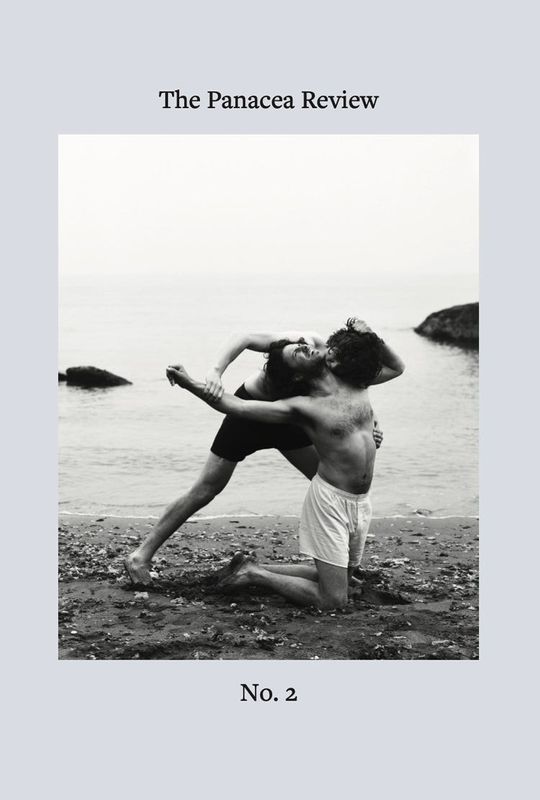
Further, the cover of Issue 2 features a 2024 photogravure by Owen McCarter, Schicchi and Capocchio. The photo recreates a scene from an 1850 oil-on-canvas by William-Adolphe Bouguereau, Dante and Virgil (in Hell), that illustrates Schicchi’s attack on Capocchio. You see what I mean about the rewards of falling into rabbit holes!
We are also treated to pieces by Henry James and Oscar Wilde, who both wrote letters to Violet Hunt (James’s letter questioning Shakespearean authorship). This leads to works by Shakespeare, Philip Sidney, Edward de Vere, and Charles Arundell. One could spend eternity figuring out the puzzles that Moran enticingly laid out for readers.
The Panacea Review is not simply a re-discovery of centuries-old literature. It showcases many modern authors: Cerulean, Morrow, and Kevin Winker with their environmental themes; Padgett Powell (one of Moran’s influential professors at University of Florida) with a snarky response to a publisher’s suggested manuscript revisions; and so much more.
I hope readers will feast on the first two issues of The Panacea Review, and whet their appetite for the third volume, due out later in August. In the meantime, I suggest we all follow Cerulean’s advice in “Plover Speaks Her Mind,” from the first issue of The Panacea Review: “Be still and simply observe.”
M.R. Street, MPH, MSI (she/her) is a past president of the Tallahassee Writers Association and an award-winning author of middle-grade and young adult fantasy novels.
About the journal
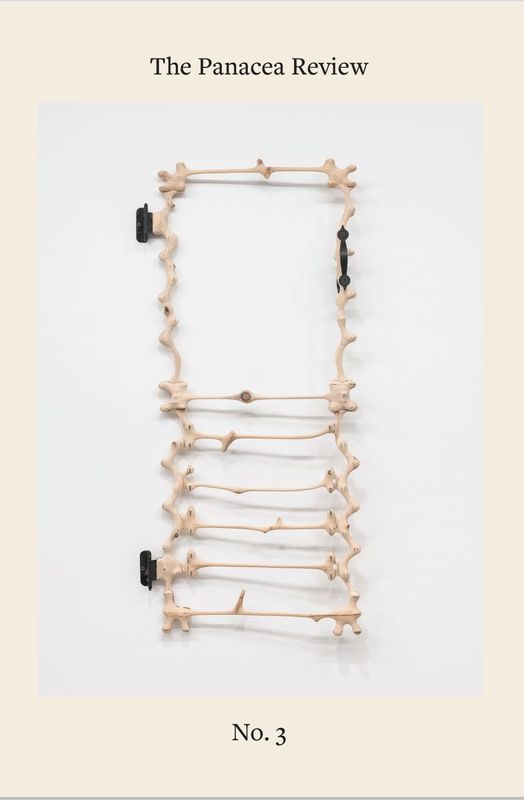
The third issue of The Panacea Review ($22) features work from Rick Moody, Philip Traylen, Joy Williams, Myles Zavelo, Keri Miller, Corey Miller, Matthew Gasda, Albertine Clarke, Jack Cuthbertson, Julia Brennan, Sandra Simonds, Evan Grillon, Aaron Barry, Quinn Adikes, Victor Florence, Danny Duffy, Sam Shopp, and more.
Subscribers ($44) receive two issues a year; new subscribers will receive Issue Three (Autumn 2026) and Issue Four (Spring 2027).
Order The Panacea Review at panaceareview.com/shop
This article originally appeared on Tallahassee Democrat: From Alligator Point to Dante, dive into world of literary ephemera
Reporting by M.R. Street, Special to the Tallahassee Democrat / Tallahassee Democrat
USA TODAY Network via Reuters Connect
By M.R. Street, Special to the Tallahassee Democrat | USA TODAY Network