(This article was revised to fix wording in a citizen’s quote and add video.)
FORT MEADE — A property on the north side of Fort Meade is the ideal location for a data center, two leaders of the company proposing to build the facility told residents.

Representatives from Stonebridge, a Maryland company, cited such factors as the proximity to electrical power transmitters, fiber-line connections to overseas users and the relatively low risk of major storm damage.
During a community town hall the evening of Jan. 29, though, it became obvious that one factor could hamper the project’s prospects: the attitudes of those who would be living near the data center.
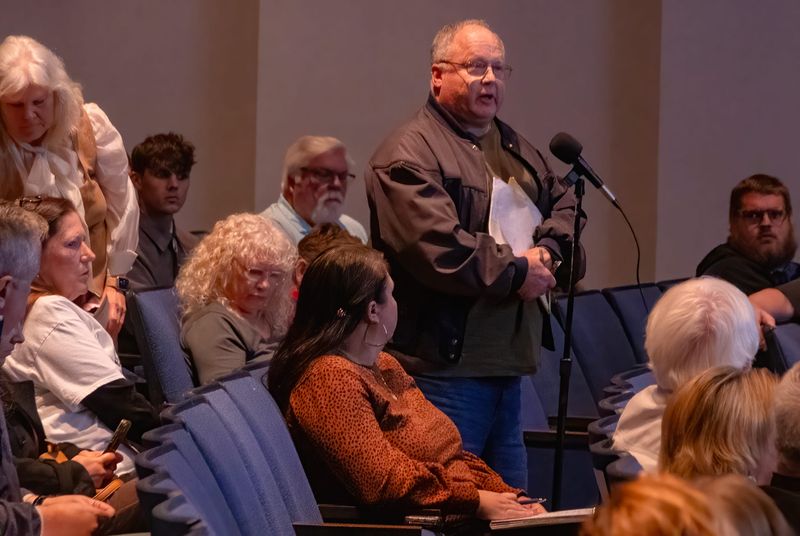
About 250 residents attended the meeting in the auditorium at Fort Meade Middle-Senior High, and none who spoke expressed support for the proposed facility. In questions and statements, local residents’ views ranged from concerned and skeptical to downright hostile.
“As far as I’m concerned, I’m dead set against this,” an unidentified speaker said. “We’re a small town. We don’t want you here. Go somewhere else.”
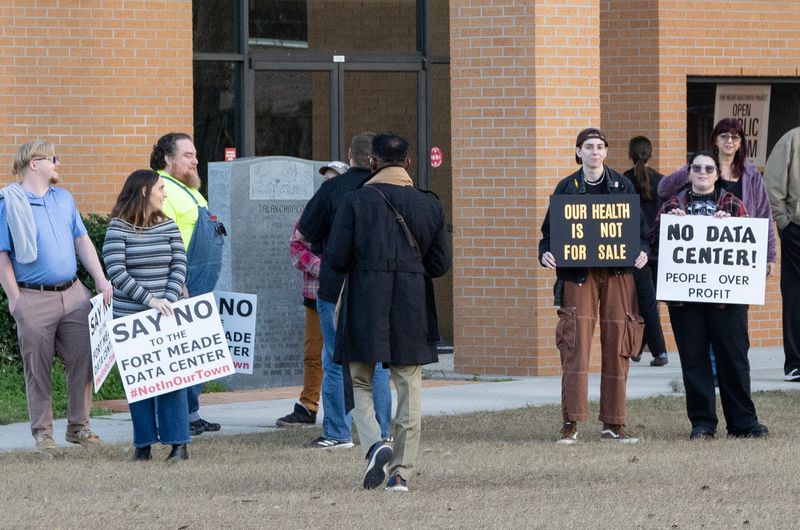
That declaration was the first of many to provoke hearty applause from the audience, some of whom held signs reading, “SAY NO TO THE FORT MEADE DATA CENTER #NOT IN OUR TOWN.”
The Fort Meade City Commission voted 5-0 in June 2025 to approve land-use and zoning changes on 1,164 acres to accommodate the proposed data center. The entire property for the planned facility covers more than 1,300 acres of reclaimed phosphate mines in northwest Fort Meade
Since then, residents have regularly spoken against the project during public comments at city commission meetings. Citizens have raised various objections, many centering on concerns about adverse effects for the environment and their health.
Seemingly in response to those comments, Stonebridge scheduled the meeting and invited residents to ask questions of Douglas M. Firstenberg, Stonebridge’s owner, and Christopher J. Smith, its managing director for development.
Assurances on water, power use
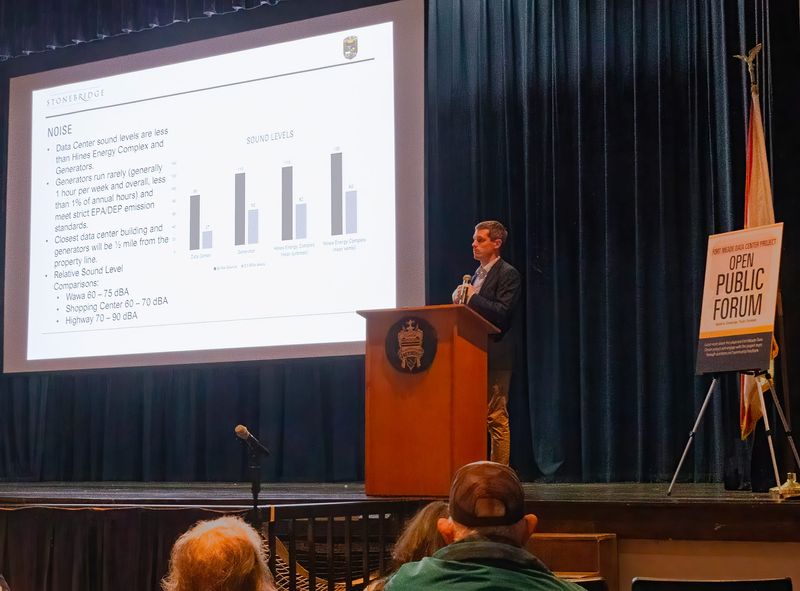
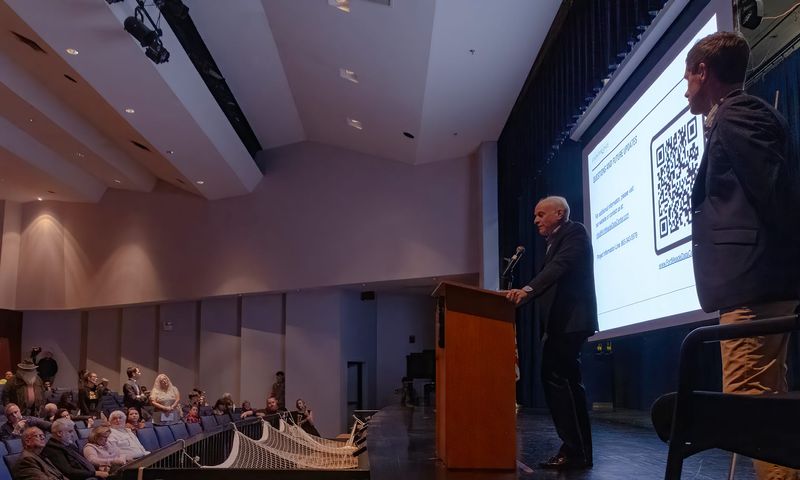
Standing on the stage of the auditorium, Firstenberg and Smith opened with a presentation summarizing the project and addressing objections. Using projections on a large screen, the duo said the data center would consist of eight buildings totaling 4.4 million square feet.
Even before audience questions began, the Stonebridge representatives addressed some of the main criticisms of data centers: energy and water consumption and potential pollution. The center would draw power from Duke Energy, rather than Fort Meade’s electrical utility.
The tract abuts property owned by Duke Energy, which operates the Hines Energy Complex, just to the west. The facility would not strain Fort Meade’s power capacity or affect rates paid by residents, the Stonebridge leaders said.
Data centers have drawn criticism over their need for massive supplies of water to cool equipment. But the Stonebridge project would employ a “closed-loop” system and have a relatively small demand for water, Firstenberg and Smith said.
Some data centers use evaporative cooling systems, sometimes called “swamp cooling,” in which heat from computer equipment is transferred into water, which is then moved outside and allowed to evaporate. It is an efficient method but “a very heavy consumer of water,” Smith said.
In a closed-loop system, water used to cool equipment remains within a pipe system and is continually reused, Smith said.
Stonebridge’s planned unit development proposal initially requested 140,000 gallons a day for the project, but that has been revised to 50,000 gallons a day, Firstenberg said. That is about 6.5% of Fort Meade’s current water capacity.
“We’re taking a lot less water than a grocery store,” he said. “We’re taking a lot less water than a typical industrial building.”
Stonebridge is also open to using Fort Meade’s “greywater,” or untreated wastewater from sources other than toilets and kitchen sinks, to use in the facility, Firstenberg said.
The Stonebridge officials also sought to reassure Fort Meade residents that the data center will not create overwhelming noise. The buildings will be clustered at the interior of the property, putting them about 1½ miles from the nearest residences, Smith said.
The equipment will generate mechanical noise of about 85 decibels, Smith said, and the sound level will be much lower beyond the property. The data center will be equipped with diesel-powered emergency generators, but those will only be run about an hour a week, unless the main power supply fails, he said.
Developer promises economic boon
While seeking to reassure Fort Meade residents worried about negative environmental impacts, the Stonebridge representatives also asserted that the data center would yield economic benefits.
Firstenberg shared a graphic listing projected jobs to be created through construction and operations. Construction jobs would peak at 3,960 in 2028, he said, while direct operational jobs would emerge in 2028 and rise to at least 456 by the year 2031. Salaries will average above $100,000, Firstenberg said.
When the project is completed, the facility would generate about $100 million a year in property taxes to Fort Meade, Firstenberg declared. The city would also receive $13 million a year in municipal public service taxes and about $7 million in franchise taxes through Duke Energy, he said.
The facility would also yield $85 million a year in taxes for Polk County’s school system, Firstenberg said.
The company’s typical production timeline includes one year of planning and two years of construction, Firstenberg said. Stonebridge seeks to begin construction this year and have the first building operating in early 2028.
Stonebridge has not yet purchased the property, which is owned by Florida Ecopark LLC of Jupiter. The company has not revealed who the final operator of the data center would be. The best-known operators of data centers include Amazon, Microsoft and Google.
Stonebridge is in discussions with two “hyperscalers,” Firstenberg said in response to an audience question.
“So we will help them get it built, and then they will be the occupant,” he said.
The operator will be revealed before construction begins, Firstenberg said.
Facing negative perceptions
Even as Firstenberg and Smith pitched the benefits of their project, they had to contend with negative perceptions of data centers in general, amid a nationwide backlash against the fast-expanding industry.
“Without question, today there’s skepticism about data centers,” Firstenberg said in an interview the following day. “What we’re trying to do is help people understand what the issues and opportunities are and then translate them into our Fort Meade project, so people can digest and see how it’s going to impact them. We think, overall, it’s a real positive opportunity for Fort Meade.”
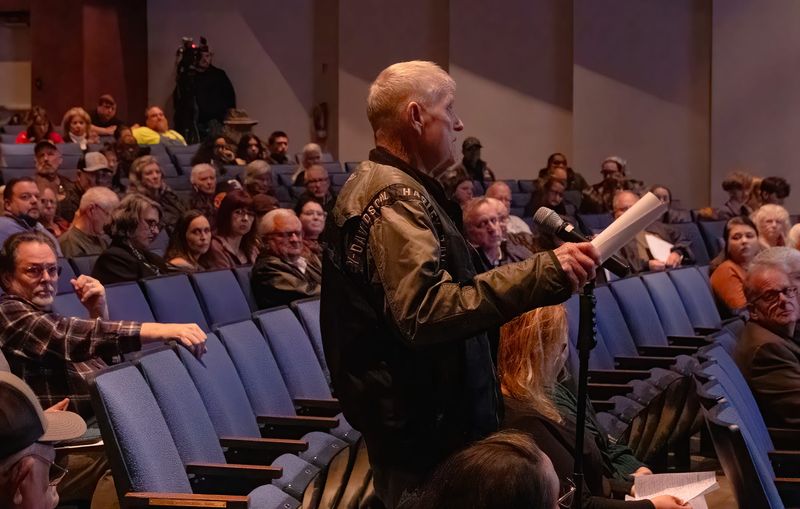
After the Stonebridge officials finished their presentation, audience members lined up in aisles behind two microphones to ask questions — or, in some cases, to make statements.
“What assurance do we have that it’s actually going to happen?” asked Herman Fisher, prompting applause. “Will you put up a bond or anything, guaranteeing that you’re not going to deviate from that plan, that that’s exactly what’s going to happen?”
Stonebridge and the ultimate operator will be bound by details in development plans that the city approves.
Some residents mentioned reports of water contamination near an Amazon data center operated in Oregon. The large withdrawal of groundwater has worsened existing concentrations of nitrates in the area’s water supply, according to news reports.
Firstenberg emphasized that the Fort Meade facility will not require the pumping of water and will receive its water supplies from the city. But that did not seem to quell some citizens’ concerns.
“High nitrate levels cause miscarriages at a rate three times our national average,” said Kiann Crume, a young mother. “I know you’re from up north. Down here, we are pro-life. We like to save babies, and so I don’t want to take a risk on this being right or on this being wrong. I don’t want to take a risk that the data center is the cause of those miscarriages, and I don’t want babies dying in our community, because we took a chance, because we wanted to line our pockets.”
Connor Jack questioned whether many of the 456 operational jobs will go to people in Fort Meade. Noting that a low percentage hold college degrees, he asked what proportion of jobs would require advanced degrees or specialization in science, technology, engineering and math.
About one-third of the positions will require advanced degrees, Firstenberg said. Stonebridge intends to work with Polk State College and local schools on training programs, and some positions might only require certifications that could be earned in 90 days, he said.
What about ‘forever chemicals’?
Christina Reichert of the conservation group Earthjustice appeared on behalf of the Environmental Confederacy of Southwest Florida. She complained that many of the details the Stonebridge officials shared had not been revealed in earlier stages of the planning process, before the Fort Meade City Commission gave its approval.
“The other thing I want to talk about is potential pollution that can come from a data center, because I’ve heard a lot of things stated tonight, and what we know is that closed-loop (cooling) systems, they do require chemicals to be used, and there are leaks, and there is blow-down that occurs,” she said.
So-called “forever chemicals” are often used in closed-loop systems, and those chemicals are not regulated by federal or state agencies, Reichert said.
Ken Webb, director of the Imperial Polk Astronomical Society, raised concerns about potential light pollution from the facility. Fort Meade is an unusual dark location in Florida, making it a prime spot for using telescopes.
Webb and others also mentioned the proximity of the site to the Florida Wildlife Corridor, a network of connected green spaces that give the state’s largest mammals crucial roaming habitat.
Speaking before the meeting, Tyler Hancock expressed doubts that Fort Meade would gain economically from the data center.
“They don’t sell a product to the community,” he said. “There’s nothing that benefits us other than potential tax dollars, which are just a promise in the air, and who’s to say that they’ll deliver on that promise? But I don’t believe that that promise is big enough to give away our quality (of life), the way that we live.”
Raul Alfonso cited the Polk County Commission’s vote in November to grant the developer a 10-year abatement on property taxes totaling $140 million.
“Ten years of discount will pay for 12½ years of those employees,” Alfonso said. “They get free employees. They get to use our resources. They get to pollute our environment.”
Some audience members expressed non-specific antipathy toward data centers.
“Assuming everything you say is true — which I don’t, again, we don’t have a reason to believe one way or another — but assuming everything you just said is true, the PR (public relations) of data centers is extremely negative,” Crume said. “So, regardless of whether this is all true or not, this is going to drop our property values. Like, people do not want to live near a data center.”
Others worried that the facility would alter Fort Meade’s rural atmosphere.
“There’s an old saying, ‘Don’t California my Florida. Don’t New York my Florida,’” one resident said. “Go back to Washington, D.C. Don’t Washington, D.C., my Florida.”
Three city commissioners sat in the front row at the Jan. 29 meeting — James Watts, Candice Lott and Matthew Taylor. Commissioners Petrina McCutchen and Jaret Williams apparently did not attend.
The Stonebridge leaders invited Fort Meade residents to submit additional questions to them, providing a website (www.fortmeadedatacenter.com) and contact information: info@fortmeadedatacenter.com and 863-343-5579.
Gary White can be reached at gary.white@theledger.com or 863-802-7518. Follow on X @garywhite13.
This article originally appeared on The Ledger: Fort Meade residents hurl skepticism at massive data center during forum
Reporting by Gary White, Lakeland Ledger / The Ledger
USA TODAY Network via Reuters Connect