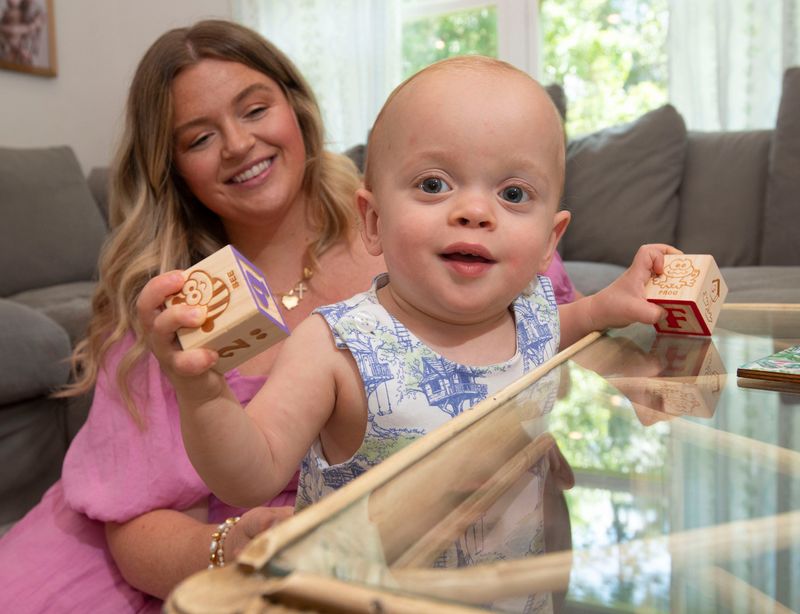
What expectant mom Candice Davis initially mistook for a bad case of indigestion turned out to be a potentially life-threatening disorder.
The same thing happened to Madison Setliff, another healthy, first-time pregnant woman who experienced abdominal pain that she thought was heartburn.

The discomforts felt by the women were actually preeclampsia, a life-threatening hypertensive disorder that can affect any expectant mother.
May is Preeclampsia Awareness Month and observed to raise awareness of the disorder that can cause severe maternal and infant illness and even death. Friday, May 22, has also been designated as World Preeclampsia Day.
Both Davis and Setliff also survived HELLP syndrome, a rare and more severe form of preeclampsia. HELLP is the acronym for Hemolysis (the breakdown of red blood cells), Elevated Liver enzymes (which indicates liver dysfunction) and Low Platelet count (which affects blood clotting).
At 38 weeks pregnant, Davis was feeling fine the morning of June 14, 2025.
“I didn’t have any pain or anything like that. But as the day progressed, I started having upper abdominal pain,” the Pensacola Beach resident said of the Saturday morning.
“We were actually sitting by the pool for a while, and I said I needed to go lay down. I was having upper abdominal pain, and I just thought it was just indigestion, considering I was 38 weeks pregnant.”
Davis said she had just seen her doctor the week before and everything was fine. Her pregnancy had been uneventful—no hypertension or other health problems.
But as the afternoon progressed, the pain intensified and Davis ended up going to the Baptist Hospital’s emergency room that Saturday night at the urging of her husband, Jordan, and a coworker and friend who is an OB-Gyn.
After tests revealed an elevated and steadily rising blood pressure along with increased liver enzymes, Davis said it was decided to induce labor and perform a C-section the next morning.
On June 15, her healthy 6-pound, 7-ounce son, Candan, was delivered at 8:43 a.m. at Baptist Hospital.
However, Davis developed even more serious complications. Her medical team discovered she had a life-threatening liver hematoma, and just after Candon was delivered, her liver ruptured.
“They were getting my son out, and at first, my husband and I hear them say, ‘Oh, there’s no blood,’ and then about five seconds later, they say, ‘Oh, there’s blood. There’s a lot of blood,’” Davis recalled of the harrowing experience.
In a matter of about two days, Davis had gone from no pregnancy complications to preeclampsia to eclampsia with a seizure to HELLP syndrome with a liver rupture. After emergency surgery to cauterize her liver, Davis did not hold her son until Monday.
She also had other complications that led to the later loss of her left thumb and having the four other fingers on that hand shortened.
Today, Candan is nearly 1 year old and thriving, and so is Davis, who spent 10 days in the hospital. She said she’s doing really well.
“I am very grateful for where I am. I am very grateful for the care I received. I do believe they saved my life; I think that’s very clear what happened. … I’m here to watch my son grow up, so I can’t be too upset about it,” she said, admitting it was difficult right after the medical ordeal but is thankful for the Baptist Hospital team and her employer, OB Hospitalist Group, which were instrumental in the care she and Candon received.
Sudden symptoms of preeclampsia
Setliff’s symptoms came on just as suddenly as Davis. For Setliff it was on Jan. 19, 2025, the Sunday just before Escambia and Santa Rosa counties experienced record snowfall.
“The week of the snowstorm I was having pain in my stomach, and I just thought it was heartburn. So I went to an ER at a different hospital. They did a couple of tests, said it was heartburn and sent me home,” said Pace resident Setliff of the Monday she first sought medical assistance.
“But the pain never went away and I was nauseous, and then the snow happened. The next day after the snow, I told my husband, Justin, I was going to wait one more day to see if it goes away.”
Setliff said Justin encouraged her to go back to the hospital but she was hopeful the symptoms would ease up. That didn’t happen. On Thursday, she went back to the ER with more intense symptoms including a persistent headache, vomiting and back pain.
“At the ER, they ran a couple more tests and said I had HELLP syndrome. I was transferred that Thursday by ambulance here (Ascension Sacred Heart Perinatal Specialty Unit),” said Setliff, who was 28 weeks pregnant.
Setliff was hospitalized and her “snowstorm baby,” Chase, was delivered via C-section on Jan. 25. He weighed 2 pounds, 3 ounces, and spent 78 days in the Studer Family Children’s Hospital NICU. He was released from the hospital on his original due date of April 13.
Risk factors for preeclampsia
Janette Brenneman, a nurse practitioner at Sacred Heart’s Maternal-Fetal Medicine, said preeclampsia usually occurs after 20 weeks of pregnancy but can present even up to six weeks after delivery.
“It is a sudden increase in your blood pressure, which can cause multiple organ damage, primarily liver and kidneys. In some severe cases, it increases the woman’s risk of seizure or stroke, which can have long-lasting effects. In some of the rare cases, (it) can even cause maternal death and stillbirth,” Brenneman said, noting the condition can affect any woman.
“Even in a very healthy woman, every single pregnant woman is at risk for preeclampsia. There are risk factors. Some of them are preeclampsia in a previous pregnancy, hypertension outside of pregnancy, diabetes, autoimmune disorders, obesity. Even being a first time mom increases your risk.”
Brenneman said identifying the risk factors early can help mitigate the disorder, noting that a daily low-dose aspirin—between 12 weeks and 16 weeks of pregnancy—can decrease the risk or severity of preeclampsia.
Major warning signs of preeclampsia, Brenneman said, include:
She said the condition occurs in 5% to 7% of pregnancies worldwide.
“That means 10 million pregnancies a year, so it is very prevalent,” she added. “And with the some of the outcomes being so serious, it’s important for people to know about it,” she said, adding the treatment for preeclampsia is delivery of the baby.
“Sometimes we need to deliver the baby early, so prematurity and everything that goes along with that and low birth weight. Babies can be smaller in preeclampsia because of the prematurity and the effects of the placenta.”
According to the Preeclampsia Foundation, the disorder is a leading cause of maternal and infant death in the U.S., with Black women experiencing severe maternal morbidity at 2.1 times the rate of white women.
Globally, hypertensive disorders of pregnancy cause about 76,000 maternal and 500,000 neonatal deaths annually, the foundation also reported.
Locally, Brenneman said the Perinatal Specialty Unit sees a lot cases of preeclampsia.
“There are a lot of pregnancies without it too,” she said, adding that a pregnant woman with any of the symptoms should immediately call their OB-Gyn.
“That’s the complex part of preeclampsia, not every woman will present with the same symptoms. Some women get diagnosed with it and then can remain pregnant for weeks, months. Other women can get diagnosed with it and become very ill, requiring delivery in an eight-hour period,” Brenneman said.
Davis and Setliff urge expectant mothers to listen to their bodies.
“If something doesn’t feel right, then it’s not right. You need to seek immediate care, even if it comes back to not being anything serious or it comes back to being indigestion, just go and get looked at and make sure it’s not anything more than that,” Davis advises. “Don’t write it off as being a pregnancy symptom like I did because if I had not listened to my husband and the doctor who told me to go, I could have very well lost not just my life, but potentially my son too.”
Setliff echoes Davis’s sentiments and said expectant mothers should trust their instincts.
“It’s OK to get checked out even if you’re not sure (you’re really sick). It doesn’t hurt to be sure. My mom and my husband had to force me to go to the ER the second time, and if I had not, it probably would have gotten worse,” Setliff said, adding she normally has a high pain tolerance. “But I kept feeling like something was off and it wouldn’t go away with anything I did.”
What is Preeclampsia?
Preeclampsia is a high blood pressure disorder specific to pregnancy that can develop after 20 weeks. It is defined by elevated blood pressure and often includes protein in the urine or signs of organ damage. It can affect the kidneys, heart, lungs, and brain, and untreated preeclampsia can lead to seizures (eclampsia), stroke, heart attack, or death of the mother or baby, according to The Society for Maternal-Fetal Medicine.
Symptoms of Preeclampsia
Preeclampsia Risk Factors
This article originally appeared on Pensacola News Journal: For expectant moms, heartburn, indigestion may signal life-threatening disorder
Reporting by Mary Lett, Pensacola News Journal / Pensacola News Journal
USA TODAY Network via Reuters Connect