State wildlife officials are advising the public to be on the lookout for venomous snakes in Florida this spring as those potentially dangerous species become more active as temperatures rise.
Warmer spring conditions and longer days mean more people will be out longer due to the mild, summer-like conditions.

This is also the time of year, wildlife experts warn, that venomous snakes become more active.
“There are about 300 bites from venomous snakes each year in Florida,” said Steve Johnson, a biologist at the University of Florida. “I suspect this is a minimum estimate because some bites certainly go unreported. But if you consider the number of people hiking, gardening, swimming and just spending time outdoors in the state each year the chance of getting bitten a really low, especially if you don’t mess with snakes.”
Florida is home to nearly 50 species of native snakes, with six of those being venomous (and five of those being pit vipers).
So, what do you do if you think you’ve been bitten by a venomous snake?
“They should not wait for symptoms to develop before seeking medical treatment; they should not apply ice, heat, or a tourniquet; they should not cut the puncture site of the fangs and/or attempt to suck out the venom; and they should not try to catch or kill the snake (medical professional will know how to treat the bite without the snake responsible),” Johnson said in an email.
FWC says venomous snakes are not dangerous unless stepped on or provoked.
So, here are the serious native snakes in Florida, the ones that can inflict serious injury or even in rare cases, death.
Eastern coral snake
This small, thin-bodied snake is among the most feared in the Sunshine State as its venom is potent, according to the Florida Museum of Natural History.
Also known as the Harlequin coral snake, the Eastern coral snake can be very dangerous to people and pets.
“But bites from this species are extremely rare,” the Florida Museum of Natural History says. “The victim should seek immediate medical care from a physician or hospital experienced in treating snakebites. Coral snakes are not aggressive and avoid direct contact with people and pets. Virtually all bites occur when the snakes are intentionally molested.”
Coral snakes grow to 20 to 30 inches in length and have black, red and yellow strips.
The scarlet king snake is sometimes mistaken for a coral snake.
Southern copperhead
Also called the Highland moccasin and the chunk head, Southern copperheads are found mostly in the Panhandle region of the state.
Their bite is described as being extremely painful, but copperhead strikes rarely end in death for adult-sized, healthy humans and larger pets.
The Florida Museum of Natural History says copperheads are not particularly aggressive and that bites typically occur when someone has stepped on a copperhead or intentionally provoked one.
Cottonmouth
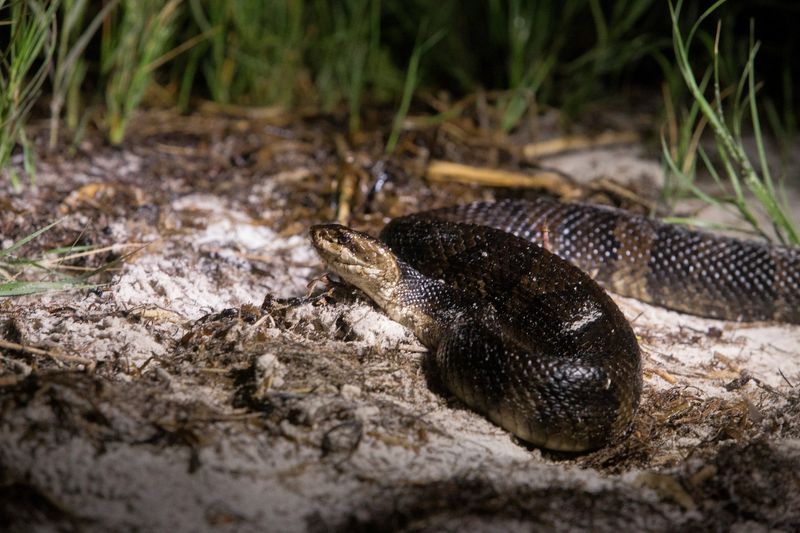
One of the most commonly found snakes in Southwest Florida, the cottonmouth is a snake of lore. Also called the water moccasin, cottonmouths have a reputation among some people as being overly aggressive snakes, animals that will attack humans.
But scientists with the Florida Fish and Wildlife Conservation Commission say the heavy-bodied serpent is not necessarily aggressive but that people should avoid encounters when possible.
“Juvenile cottonmouths are a brown or tan color with darker, reddish brown crossbands containing many speckles down the back,” an FWC website reads. “Juveniles also have bright yellow tail tips. As cottonmouths age, the color becomes darker, so that adults show only a trace of the original pattern or are uniformly dark.”
They’ve also got big heads.
“Cottonmouths have a broad head and a dark stripe that runs through the eye, and there is a deep facial pit between the eye and the nostril,” FWC says.
Eastern diamondback
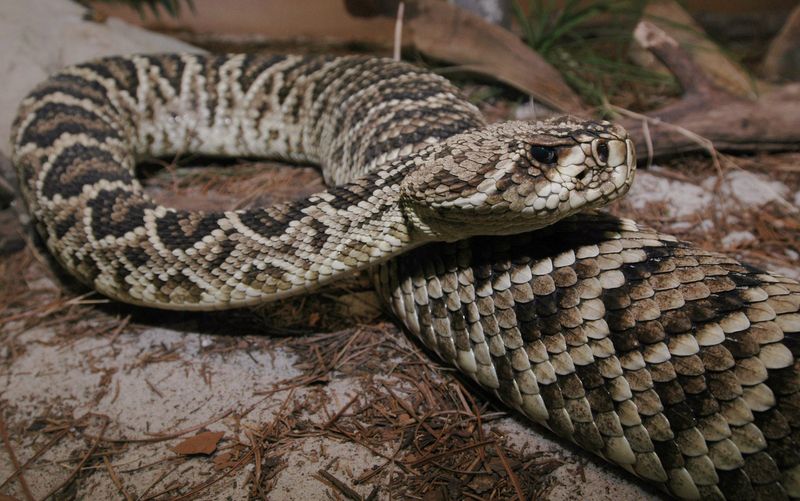
The snakes can weigh 10 pounds or more, making them the heaviest of the venomous snakes found across the United States.
The largest of Florida’s venomous snakes, Eastern diamondbacks can grow to more than 7 feet long, according to the FWC.
“They are ambush predators, meaning they sit and wait in a coiled position for prey to cross their path,” an FWC website reads. “They use their thermal pits to help them locate warm-blooded prey. Once their prey is within range, the coiled snake can strike up to two-thirds its body length to inject its prey with venom. After striking, the snake lets the prey go and later follows the scent trail to track it down and eat it.”
Eastern diamondback snakes eat mostly mammals like mice, rabbits and rats but will also eat ground-dwelling birds.
Timber rattlesnake
These snakes have a series of large, black, chevron-like crossbands down the pinkish gray or tan body, according to the FWC.
Another large, heavy-bodied snake, timber rattlesnakes are found in only 12 counties in north Florida.
“Timber rattlesnakes are not aggressive and avoid direct contact with people and pets,” a Florida Museum of Natural History website reads. “Most bites occur when the snakes are intentionally molested or accidentally stepped on. This is a snake that should be simply left alone and not bothered.”
FWC says the Eastern diamondback in the only snake that is typically confused for a timber rattlesnake.
Dusky pygmy rattlesnake
The little guy of the rattlesnake family found here, dusky pygmy rattlesnakes grow to 12 to 24 inches long
“The body color varies from light to dark gray, and a lengthwise row of black or charcoal blotches discs,” a Florida Museum of Natural History website reads.
These snakes are still heavy-bodied, and their bite, while still venomous, is typically not life-threatening for full-grown adults.
FWC says anyone bitten by a dusky pygmy rattlesnake should seek immediate medical attention.
Chad Gillis is an environment reporter and can be reached by email at cgillis@news-press.com.
Please support local community journalism and stay informed about Southwest Florida news by subscribing to The News-Press and Naples Daily News; download the free News-Press or Naples Daily News app, and sign up for daily briefing email newsletter, food & dining and growth & development newsletters here and here.
This article originally appeared on Fort Myers News-Press: Florida’s venomous snakes more active as weather warms, state warns
Reporting by Chad Gillis, Fort Myers News-Press & Naples Daily News / Fort Myers News-Press
USA TODAY Network via Reuters Connect