

Florida’s steamiest days of the year when the mercury simmers to its climatological peak are on the wane for much of the state based on the calendar.
But with multiple consecutive statewide heat advisories into the second week of August and a rare extreme heat warning on Friday, Aug. 14 for parts of the Panhandle, it doesn’t feel like summer is sunsetting.

National Weather Service meteorologists in Tallahassee warned of dangerously hot conditions with “feels like” temperatures up to 115 degrees on Friday and a “prolonged” heat wave that will continue through the weekend.
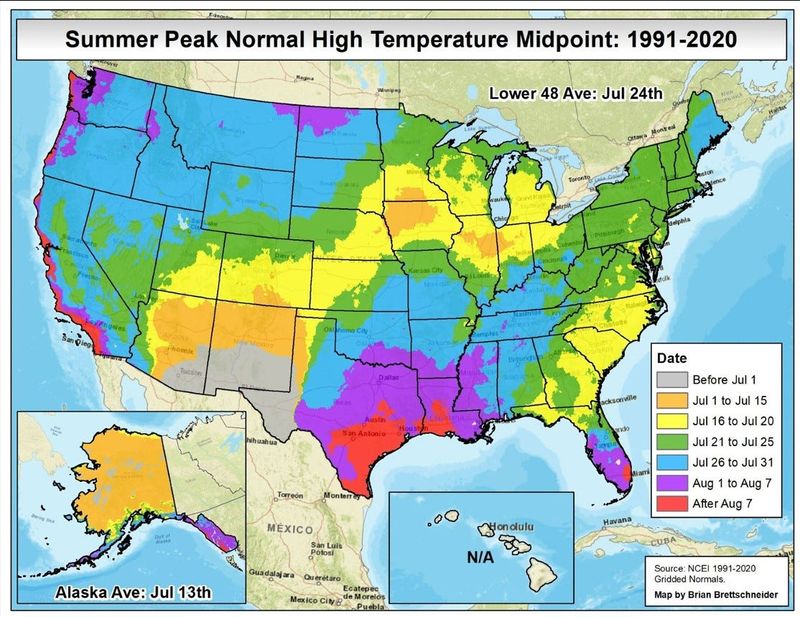
Based on 15 years of climate data, the hottest days should be declining by Aug. 6 in Tallahassee. Based on 30 years of averages, most of the Panhandle and Big Bend should be basking in cooler weather — if only by tenths of degrees — by late July.
A tenacious area of high pressure hovering over the Gulf is partly to blame for the recent stretch of sweaty misery. And a more westerly sitting Bermuda High has been pumping tropical moisture into the state, upping the heat index or “feels like” temps.
But from Key West’s southernmost point to Perdido Key in the western Panhandle, summer’s peak heating should be starting on a very subtle downslope into fall.
“I moved here from New York, so this is my first summer down here and we’ve been kind of cooking up in the (lifeguard) tower,” said Cade Delgado, a lifeguard with the Town of Palm Beach. “The last two weeks have been the hottest for me.”
Why Florida heats and cools differently
Florida Assistant State Climatologist Emily Powell said typical peak summer temperatures only vary by two or three weeks across the state and can depend on whether the area is urban, rural, coastal or inland.
Inland areas may be more influenced by land temperatures that heat up faster than water temps.
A temperature gauge deep in a landlocked part of Everglades National Park registered 105 degrees on July 16, as measured by the Southeast Regional Climate Center (SERCC). Tallahassee reached 101 on July 29.
At the coast, ocean water stays cooler longer but heats up later in the summer, which can mean warmer temperatures that loiter.
In West Palm Beach, the warmest days are Aug. 8 to Aug. 11 when the normal daytime high tops out at 91.1 degrees, according to an analysis by the National Centers for Environmental Information (NCEI) of the years 2006-2020.
In Jacksonville Beach, the daytime high lingers stubbornly at 89.5 through Aug. 14, while Naples suffers with a high of 92.1 through Aug. 22. Tallahassee’s top average temp of 92.3 stretches painfully from late July to Aug. 6 before it begins to tick down.
“For August so far, we’re not seeing a lot of record high temperatures, but we are seeing a lot of heat advisories and heat watches because the humidity is going up,” Powell said. “Right now, this time of year, we expect to see temperatures in the low 90s but the heat index is over 100 degrees and up to 110 in some places.”
Parts of Florida experienced one of their warmest summers on record
Although summer’s astronomical beginning is June 21 when solar radiation reaching Earth is at its highest, temperatures continue to rise for weeks after because the daytime sunshine and heat is greater than overnight cooldowns.
Meteorologically, summer begins June 1 and for many areas of the Peninsula, it’s already been a summer ranking in the top 10 warmest based on the average daily temperature through Aug. 12.
According to the SERCC, Key West, Miami, Fort Lauderdale, West Palm Beach, Naples, Fort Myers, Tampa Bay, Orlando and Ocala were even warmer than that, placing in the top five for warmest average temps between June 1 and Aug. 11.
The National Weather Service in Miami issued 28 heat advisories, which are based on humidity and temperature, between June 1 and Aug. 12 compared to 9 during the same period in 2025.
Miami-based NWS meteorologist Ana Torres-Vazquez said part of the increase can be attributed to big events this summer such as the FIFA World Cup where forecasters tried to account for people not accustomed to South Florida heat.
“We consider how well, or how badly, vulnerable populations will respond to a prolonged period of heat,” Torres-Vazquez said. “The things that a South Floridian might be able to deal with when they are going to the beach may not be the same as a tourist from Europe.”
Fort Lauderdale has had its hottest summer based on average temperatures through Aug. 12. It’s the second warmest summer for Miami and the fifth warmest for Naples.
Chris Fisher, also a meteorologist with the NWS in Miami, said part of the heat in South Florida is attributable to less rainfall and fewer clouds.
Areas from Orlando through the Keys are below normal for rainfall since the start of the rainy season on May 15. Parts of western Palm Beach County are down more than 6 inches.
“During the wet season we depend on those daily thunderstorms to help cool us down but we had long stretches with very little rainfall,” Fisher said. “We had one stretch where there was no measurable rainfall for seven days in Palm Beach, Broward and Miami-Dade counties.”
A lack of cooling rainfall also triggered a heat advisory for the Tampa Bay area Thursday, which is likely to be extended through Friday when temperatures are expected to reach into the upper 90s in some areas.
Is climate change making Florida summers hotter?
Underlying the summer temperatures is increasing heat because of an overall warming world, said Climate Central meteorologist Shel Winkley.
She said Florida has always been hot and humid during the summer months, but the intensity of the heat and how often it shows up can be traced to climate change. Since 1970, Florida has warmed by 2.5 degrees June through August.
“That may not sound like much, but think about what happens to your body when your temperature climbs just 2 degrees. You feel unwell,” Winkley said. “Florida summers have that same fever, largely due to human-created heat trapping pollution.”
“Miami, for example, now averages close to 120 days a year of dangerous humid heat up from 50 such days back in the 1970s,” Winkley said.
Sarasota was highlighted in a Climate Central report as one of the top three cities with the largest increases in warmer-than-normal summer nights since 1970 with a jump of 73. Reno, Nevada had the highest at 79, followed by 73 more in Albany, Georgia.
“You may not be getting record heat everyday but you’re not getting any relief overnight because those temperatures aren’t cooling down,” Torres-Vazquez.
By 1 p.m. on Thursday the temperature in Miami was a scorching 94 degrees with a heat index of 106.
In Palm Beach, lifeguards said they’ve noticed an increase this month of people becoming dehydrated and hopping painfully on hot sand to get to the water, which isn’t much cooler than the air.
High temperatures were forecast for 87 degrees on Thursday. The water was 84 degrees.
“People come up and say, ‘Hey, I’m a little dizzy,’” said Palm Beach lifeguard Lexington Bohn. “We advise drinking lots of water and bringing water with you.”
Hottest days of the year based on 2006-2020 maximum average daytime peak temperature:
Source: NOAA National Centers for Environmental Information U.S. Climate Normals
Kimberly Miller is a journalist for the USA TODAY NETWORK FLORIDA. She covers weather, the environment and critters as the Embracing Florida reporter. If you have news tips, please send them to kmiller@pbpost.com. You can get all of Florida’s best content directly in your inbox each weekday by signing up for the free newsletter, Florida TODAY, at palmbeachpost.com/newsletters.
This article originally appeared on Palm Beach Post: Florida’s hottest days should be fading, but it feels worse than ever
Reporting by Kimberly Miller, USA TODAY NETWORK – Florida / Palm Beach Post
USA TODAY Network via Reuters Connect

By Kimberly Miller, USA TODAY NETWORK – Florida | USA TODAY Network
