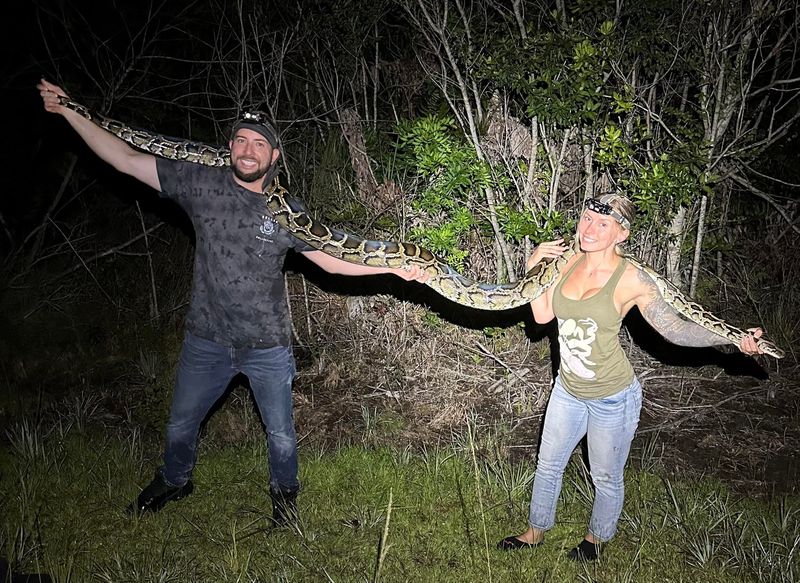
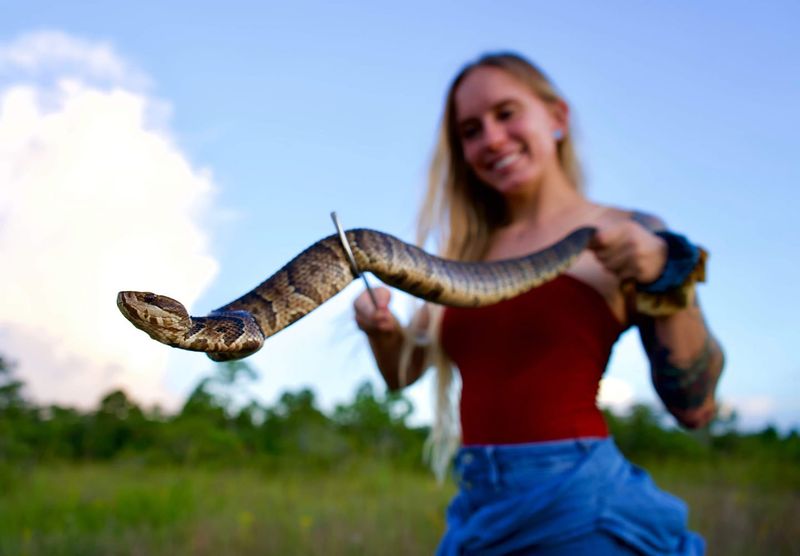
Florida’s python hunts are going commercial as the state partners with a luxury leather manufacturer that pays better and uses more high-tech weapons in the pursuit of the invasive snake.
Gov. Ron DeSantis announced on Oct. 21 during an event in Stuart that the Florida Fish and Wildlife Conservation Commission was teaming up with Miami-based Inversa to increase the number of pythons caught that can be turned into high-end wallets, belts and boots.

The python skin that Inversa processes is available in a matte or glossy finish and in colors that include pink, yellow, green and white.
DeSantis said the decision to partner with Inversa was made in 2024 in an effort to increase python removals by providing more of a financial boost through private enterprise. The idea was first presented by FWC Commissioner Rodney Barreto, DeSantis said.
“It made perfect sense to me because if we can harness the economic incentives to remove the pythons, I knew it would help, I didn’t know it would be this dramatic,” DeSantis said. “The new program accomplished more removals in July 2025 alone than in the entire year before.”
In three months this past summer, 1,022 pythons were removed. That’s compared to 343 during the same period in 2024, according to the governor’s office.
In July, 748 pythons were removed, which is more than the entire previous year’s total.
“We have been able to convert invasives into fashions for consumers from Paris to New York,” said Aarav Chavda, co-founder and CEO of Inversa. “We help government agencies manage invasive species by connecting their biomass to the private sector.”
The South Florida Water Management District has its own python hunting program that is separate from the FWC and Inversa partnership.
Chavda said Inversa pays hunters about 60% more than FWC, but details were not provided.
The approximately 50 hunters that previously contracted with FWC now work for Inversa and the state has a single contract with the company. That has reduced the administrative burden on FWC by 89% while increasing python removal, DeSantis said.
According to Inversa’s website, it also processes invasive lionfish skin for use in wallets, jewelry and flip flogs, as well as the skin from the invasive silver carp, an Asian fish that has spread throughout the Mississippi River basin.
Chavda said his company recently had success using artificial intelligence in the aerial detection of pythons and is working on more AI-enabled python hunting tools.
“The only way Florida will win this war is by consistently removing more pythons every year and that can be accomplished,” he said.
The Burmese python invasion started with releases — intentional or not — that allowed them to gain a foothold in Everglades National Park by the mid-1980s, according to the 2021 Florida Python Control plan. By 2000, multiple generations of pythons were living in the park, which is noted in a more than 100-page 2023 report that summarized decades of python research.
Pythons have migrated north from the park, with some evidence suggesting they may be able to survive as far north as Georgia if temperatures continue to warm and more pythons learn to burrow during cold snaps.
In Palm Beach County, 69 pythons have been captured since 2006, according to the Early Detection and Distribution Mapping System, or EDDMapS. In addition, four have been found dead, and 24 sightings have been reported.
DeSantis also announced Oct. 21 that more federal land in Big Cypress National Preserve in southwest Florida is available for hunting after approval was given by the U.S. Department of Interior.
“We’ve seen a lot of progress and a lot of pythons removed but the simple point of the matter was at that pace it was not enough to get where you needed to go,” DeSantis said about why the state chose to partner with Inversa. “So last year we made the bold decision to engage with a private sector partner to strengthen the program.”
About $2 million is dedicated in the state budget to python removal. It’s wasn’t immediately known how that money will be used in the partnership.
Kimberly Miller is a journalist for The Palm Beach Post, part of the USA Today Network of Florida. She covers real estate, weather, and the environment. Subscribe to The Dirt for a weekly real estate roundup. If you have news tips, please send them to kmiller@pbpost.com. Help support our local journalism, subscribe today.
This article originally appeared on Palm Beach Post: Florida taps luxury leather company Inversa to help with the removal of Burmese pythons
Reporting by Kimberly Miller, Palm Beach Post / Palm Beach Post
USA TODAY Network via Reuters Connect