My week began with a simple notion: Get my first beer at Orchid Island Brewery since it closed its beachside location in 2020. I parked at newly opened Hogan Yards, a beautifully renovated 1950s-era packinghouse along the railroad tracks in Vero Beach, but needed to walk first.
Over the next two hours, I thought a lot about the future of Treasure Coast communities and how they grow.

Success won’t be easy. Failure will be living like people do in many parts of paved-over Florida, where elected representatives didn’t have the guts or patience to lead.
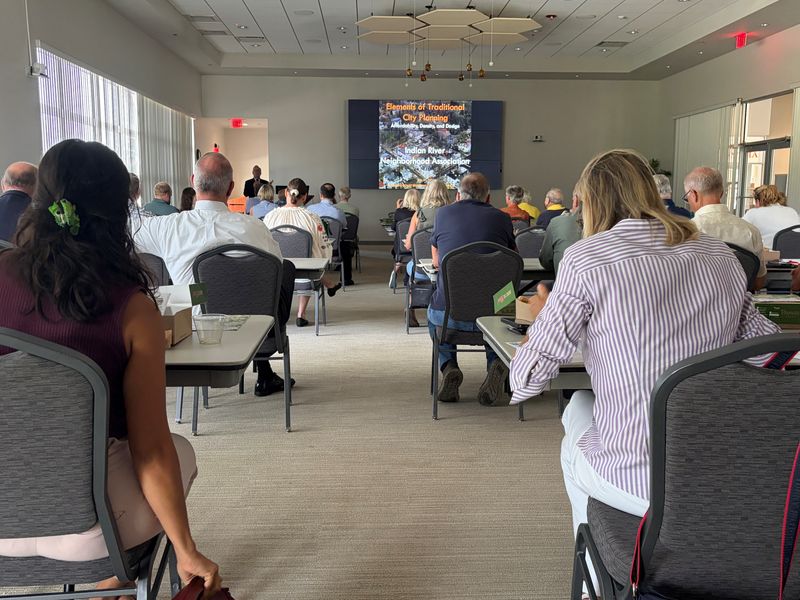
Some of my thoughts were cemented later in the week at a talk I attended.
My walk took me 5 or 6 miles on a brewery crawl through downtown Vero Beach to American Icon (inside a renovated brick, 1920s-era power plant) then toward Walking Tree (inside a renovated 1940s-era Navy warehouse).
Along the way, I appreciated the ease of walking the city’s grid system of streets and sidewalks, past the newly renovated Rotary Corner planter on 14th Avenue, an ever-more-interesting Vero Beach Arts Village, then into an attractive Osceola Park Historic District.
Vero Beach downtown area appreciated
I walked west of 27th Avenue on the north side of State Road 60, where my wife, who rode her bike to the movies downtown, grew up. I strolled along a canal bank to the former nine-hole golf course built by the Dodgers, a park since Indian River County commissioners saved it from developers.
I passed kids’ teams playing in a tournament next door, now the Jackie Robinson Training Complex. Back at Hogan Yards, out-of-town baseball families had lunch outside around an artificial turf area watching their children play football.
Vero Beach ― much like Stuart and Fort Pierce ― is much more vibrant than when I moved here in 1985. Along the coast, buildings reminding us of our heritage — citrus, fishing, Navy and baseball — remain.
There’s room for improvement, though some people in Stuart say too many apartments and condominiums have been built.
Somewhere, there’s a happy medium. That was my takeaway from the presentation in Indian River County I saw from Dana Little, urban design director of the Treasure Coast Regional Planning Council.
Speaking at the behest of the Indian River Neighborhood Association, the session was well attended. It included Sebastian councilmen Ed Dodd and Bob McPartlan, Fellsmere councilwoman Shayla Macias and county commissioners Deryl Loar and Laura Moss, who face massive pressure from developers. Vero Beach council members John Cotugno and John Carroll also were there.
Perhaps they, along with citizen advocacy, can execute strategies critical to our future, including:
Intergovernmental collaboration is essential
“Local governments, if they’re not already, (must) get on the same page,” Little said, echoing a pitch I’ve made for years. “Share the same vision. What is it we want to do? … That makes a difference.”
Sadly, it’s clear elected officials in different communities are not on the same page. Even worse, some don’t even trust each other. Investing time to meet together, publicly, would help.
Such collaboration was recommended in 2005 by the Committee for a Sustainable Treasure Coast and in 2024 by an Indian River County urban services boundary study consultant.
A lack of effective intergovernmental collaboration and communication is partly to blame for the annexations and planned urbanization of thousands of acres into Fellsmere and, to a much lesser degree, Sebastian since the early 2000s.
A lack of collaboration and urbanization has occurred in overgrown South Florida and elsewhere. In sprawling Port St. Lucie, only 17% of the population thinks traffic is good or excellent. Turf battles persist between the city and St. Lucie County, which continues to urbanize ― even adjacent to Indian River County.
Handle growing traffic through grid system
The Treasure Coast has traffic issues, such as Confusion Corner in Stuart, the circuitous routes in old General Development communities in Port St. Lucie and Sebastian, and the awkwardly curving U.S. 1 through Vero Beach.
Our traditional city streets, however, were designed with unblocked north-south and east-west roads, oftentimes with alleys.
Such a grid allows motorists to take many routes. In his presentation, Little showed Beaufort, South Carolina’s grid system, which gives residents thousands of ways to get from Points A to B.
On the Treasure Coast, however, our grid system has been blocked by one gated community after another. The result forces motorists onto main roads that get clogged and potentially widened to six or more lanes at huge cost.
Little also showed the ugliness: Children in Palm Beach County walking on main-road sidewalks separated from neighborhoods by large cement sound barriers.
“The less connected you are, the bigger the streets must be. That’s a given. The more connected you are, the smaller the streets can be,” he said. “And I think that’s a very important message, because … density is important, but you can’t look at an isolation. Building types are important. You can’t look at them in isolation.”
Devil in details of density, design
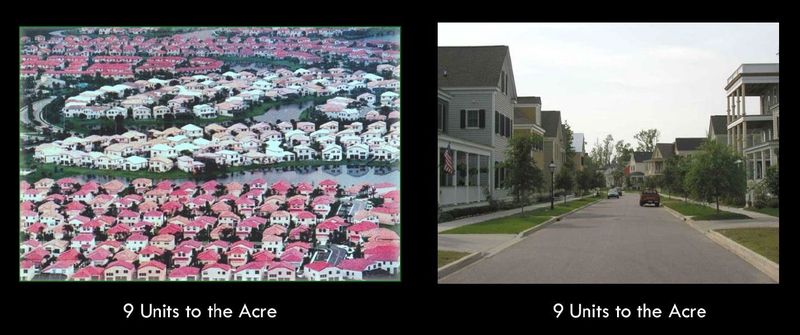
If Florida keeps growing ― and it will — we can choose: the same mass-built subdivisions, with their standard quarter- or third-acre lots, from Interstate 95 west, or find carefully selected areas to the east to increase the number of units per acre.
Fort Pierce and Stuart, the Treasure Coast’s two coastal downtowns, have embraced this, to a degree higher than anyone in Vero Beach has been willing to.
Businesses in many other traditional downtowns — more dense with hotels, rooming houses, row homes and bungalows built in the early 20th century — thrive because people live, work and play there.
Downtown Vero Beach, for example, might be the perfect place to add more people. Redevelopment at the Indian River and Treasure Coast malls might make sense.
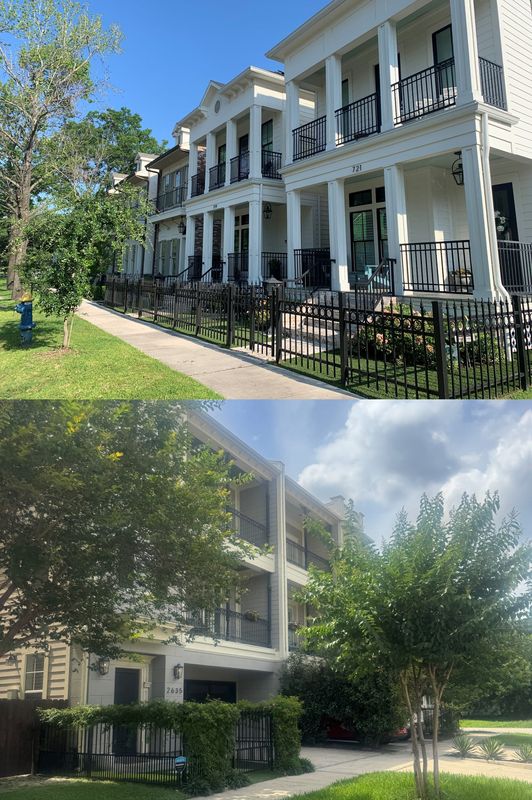
Planners, though, must be careful. Some buildings look good; others do not. People cannot be packed into ugly four-story, modern apartment buildings.
Few people would object to more historic-looking small apartments and homes such as Vero Beach’s historic Pocahontas building, which has 70 units per acre, and garden apartments Little showed at 15 to 20 units per acre.
In Houston, where my son lives, two- and three-story walkup homes ― eight to an acre and within walking distance of shopping — are more affordable.
But collaboration is essential. If our downtowns and former mall sites take more people, can, as Little suggested, more rural areas be protected by transferring density agricultural owners have and can sell to urban developers? That would require counties working closely with cities to find solutions.
Zeroing in on town centers
As we eye development of large tracts ― say 400 acres or more ― the focus must be on traditional neighborhood design, not templated design.
Little cited as an example Abacoa, a 2,055-acre mixed-use community in Jupiter slated for 6,073 residences and 3 million square feet of commercial space.
“The master plan, which resembles a patchwork quilt, melds homes, neighborhoods, schools, shops, offices, recreation sites, nature preserves into a cohesive richly textured whole,” Abacoa’s website says.
Abacoa’s about the size of the Graves Brothers property Sebastian annexed into the city in 2023. Since then, Sebastian has added two adjacent parcels.
Little also cited Newfield in Martin County, a vision of longtime businessman, philanthropist and property owner Knight Kiplinger. He is working with Mattamy Homes to build 4,200 homes, but leave open 2,000 out of 3,400 acres in the community.
Newfield’s town center, slated to be full of homes, retail and civic spaces, would be within a 15-minute walk or bike ride from various neighborhoods, “each with a mix of housing types, sizes and prices — detached homes, townhouses, small buildings of condos and rental apartments — to appeal to everyone from empty nesters to young families and singles,” Kiplinger said.
Creating a town center is more than just bringing chain stores to a strip shopping center on a main road. It’s creating the cultural core of a community, a gathering space for living, working and recreating.
It’s the kind of place you might never have to leave.
But doing it right takes connected roads, higher densities, collaboration and other things Little mentioned.
It’s not easy. Drive around Florida and you can see the failures.
Little, who lives in West Palm Beach, is hopeful.
“I look at this beautiful place as I came up here today, and if I’m cold-bloodedly up here as a developer, I see a lot of development opportunity,” he said, noting that many areas down south are trying to fix problems they, like us, made years ago. “So, you all still have a very good chance.”
I hope so. All it takes is a vision and leadership.
This column reflects the opinion of Laurence Reisman. Contact him via email at larry.reisman@tcpalm.com, phone at 772-978-2223, Facebook.com/larryreisman or Twitter @LaurenceReisman.
If you are a subscriber, thank you. If not, become a subscriber to get the latest local news on the latest local news on the Treasure Coast.
This article originally appeared on Treasure Coast Newspapers: Florida planner shows how growth doesn’t have to destroy us | Opinion
Reporting by Laurence Reisman, Treasure Coast Newspapers / Treasure Coast Newspapers
USA TODAY Network via Reuters Connect