

In January 1974, Florida joined most of the nation in going to year-round daylight saving time. Three students were killed walking to school in the dark in the first 12 days.
Five more would die in pre-dawn accidents walking to school or waiting for the bus before the month’s end.

School officials clamored to have the entire state moved to the Central time zone, some counties pushed school start times as far back as 9:40 a.m. and Florida Gov. Reubin Askew called an emergency special session to debate an issue that one Merritt Island State House Representative said had generated “the most interest I’ve ever seen on any issue.”
The change to year-round daylight saving time was supposed to last through October 1975.
It didn’t last a year and was repealed in the fall of 1974.
On July 14, 2026, the nation again made a move in the man-contrived endeavor to control daylight with the U.S. House’s passage of the Sunshine Protection Act, which would make daylight saving time permanent.
Scott Yates, who begrudgingly earned the nickname the “Time Wizard” for his relentless grassroots work to end the twice-yearly clock changes, was surprised and elated.
“As for which time zone we lock into, I’ve always been agnostic on that. As long as we lock the clock, I’m happy,” Yates said after the bill passed with an overwhelming 308-to-117 vote.
Could neighboring states be on different times, but the same time zones?
Under the legislation, which has yet to be broached in the Senate, and may not be, states can choose between permanent standard time and permanent daylight saving time ahead of enactment.
If states take no stance, they will automatically set their clocks to permanent daylight saving time.
That means neighboring states could be on different times, which the office of the House bill sponsor said shouldn’t be a problem.
“As for concerns about neighboring states being on different times, we don’t expect any, Arizona already operates on a different clock than its neighbors for part of the year without issue,” the office said in a statement.
Arizona and Hawaii have previously opted out of the bi-annual change, remaining on standard time year-round. Puerto Rico and the U.S. Virgin Islands also lock their clocks on standard time.
Also, several states, including Florida, are already split into two different time zones. In Florida, most areas west of the Apalachicola River are in Central Time.
Yates said it only makes sense to allow states to decide their own fate. States whose sunrises would be delayed until 9 a.m. or later, may choose to stay on standard time.
“I think Michigan and Indiana would be well served by standard time. Perhaps a handful of others,” said Yates, who has proposed a two-year phase in period. “I think anybody who says there is exactly one solution that is exactly right for every single state, ignoring geography, has some other agenda they aren’t telling you about.”
For Florida, permanent daylight saving time would mean winter sunrises after 8 a.m. but more light in the evenings.
Florida led the way in changes to permanent daylight saving time
Florida played a big role in making the July vote happen. In March 2018, Sunshine State lawmakers were the first in the nation to pass a bill signaling their intent to stay on daylight saving time year-round if allowed.
U.S. Sen. Rick Scott, (R-FL), who was governor at the time, signed the bill into law two weeks after it passed overwhelmingly in both legislative chambers.
“I probably get asked about this as much as I get asked about the Save America Act,” Scott said in a July News Nation interview. “I passed legislation as governor that said as soon as the federal government allows this we are going to go to daylight saving time and not go back and forth. Some state may want a different time. Have at it.”
At the national level, Florida Congressman Vern Buchanan, R-Manatee County, sponsored the Sunshine Protection Act, and Florida Rep. Anna Paulina Luna, R-Pinellas County, cosponsored it.
“Permanent daylight saving time will improve public safety, promote healthier and more active lifestyles and give families more daylight to enjoy after work and school,” Buchanan said.
Not everyone agrees with that. In an April 2025 U.S. Senate Committee on Commerce, Science, and Transportation, opponents to permanent daylight saving time said it would disrupt a person’s circadian rhythm — the body’s internal cycle of sleep and wake patterns that are influenced by light and dark.
Karin Johnson, a sleep expert, professor of neurology at the University of Massachusetts, and the co-chair of the Coalition for Permanent Standard Time, listed a myriad of health concerns in her U.S. Senate testimony tied to keeping daylight saving time through the winter months.
Those included sleep disruption and car accidents to more obscure links such as stock market volatility and in-vitro fertilization rate failure.
“We are changing the clock time, not changing the sun,” Johnson said during the hearing. “Light helps us get up, and most people will wake up naturally after light.”
Megan Markus, a 16-year-old at Gulliver Preparatory School in Miami, is against permanent daylight saving time because of the late sunrises. She doesn’t want to drive to school in darkness.
But she also doesn’t like changing the clocks twice a year, which makes her a supporter of year-round standard time.
“Both are equally disruptive because it’s more about the shift in sleep schedule than anything else,” she said. “We want something permanent but daylight saving time is not the correct way to go.”
Some of her family members disagree, saying that they favor more light in the evening hours after they get home from work.
“They opined that the only reason I feel the way I do is because I’m still in school and when I graduate, I’ll change my mind,” she said.
National and Florida teachers organizations haven’t taken a stance on the issue, nor has the Florida Association for Pupil Transportation (FAPT).
FAPT President Jamie Warrington said it hasn’t been brought up for discussion in his organization and that no one has reached out to ask about the group’s thoughts on potential impacts.
“We just went through our whole summer conference and daylight saving time didn’t come up a single time,” Warrington said. “I’m just not sure an emphasis has been put on it.”
And although it is often touted as an energy-saving measure, Florida Power & Light had no comment on the current daylight saving time machinations.
In January 1974, nearly a month after permanent daylight saving time started, FPL said there was no measurable energy saving, according to an Associated Press article. Customers, FPL found, were using less electricity in the evenings but more in the mornings.
How we got mixed up in daylight saving time debate
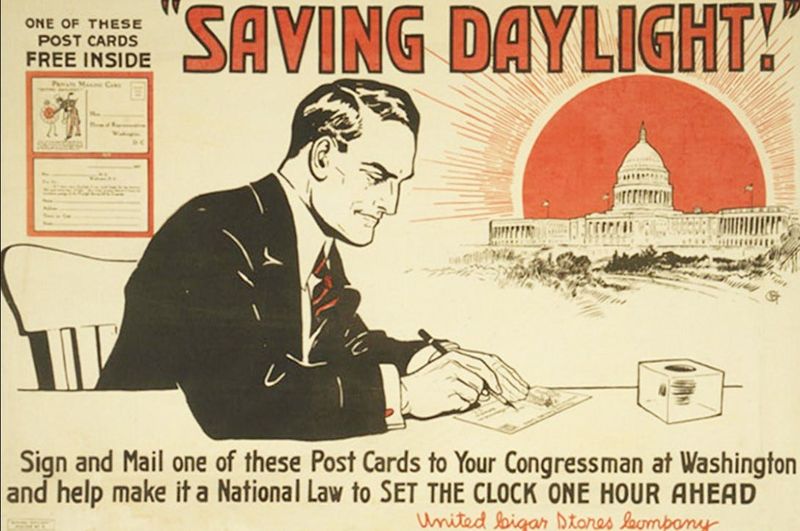
The debate over daylight saving time has raged for more than a century and created unusual allies as some argued it as an energy saver and others wanted it for their own corporate benefits.
Over the years, candy makers teamed with sporting goods manufacturers to lobby for daylight saving time — more light in the evening meant more time to trick-or-treat and hit a home run. Agriculture interests joined the railroad industry to fight the change. Doctors and golfers and parents of school bus riders have all argued for or against.
While the golf industry has generally supported year-round daylight saving time for more afternoon play, that’s not always the case in hotter climates, including South Florida.
Eric Rein, golf operations supervisor for Palm Beach County, said South Florida’s steamy afternoon heat and notorious summer thunderstorms make year-round standard time more appealing.
“It would benefit Palm Beach County more to have that hour in the morning,” Rein said in a 2025 interview. “That’s when our tee times generate the greatest amount of fees for us and those are the higher demand golf times.”
Agreement to lock the clock, but at what time?
Despite the general movement for year-round daylight saving time, a separate bill filed in July in the House would make standard time permanent.
Currently, daylight saving time — when clocks spring an hour ahead — is observed from the second Sunday in March to the first Sunday in November. This year clocks fall back an hour on Nov. 1.
Yates doesn’t have high expectations that the Senate will take up the House’s bill. Pushback from some Senators may derail it and Senate Majority Leader John Thune, R-S.D., told NBC News after the July House vote that he didn’t think a mandate was a good idea.
Republican U.S. Senator Tom Cotton of Arkansas has vehemently opposed a change to year-round daylight-saving time.
“If permanent daylight saving time becomes the law of the land, it will again make winter a dark and dismal time for millions of Americans,” Cotton said in an October 2025 statement.
He noted that the sun wouldn’t rise until nearly 9 a.m. in Seattle during winter and as late as 9:15 a.m. in Grand Rapids, Michigan. In areas of North Dakota, the sun wouldn’t rise until 9:45 a.m.
“So, nobody expects it to get a vote, but nobody expected it to get a vote in the House either, so I remain optimistic,” Yates said.
Kimberly Miller is a journalist for the USA TODAY NETWORK FLORIDA. She covers weather, the environment and critters as the Embracing Florida reporter. If you have news tips, please send them to kmiller@pbpost.com. You can get all of Florida’s best content directly in your inbox each weekday by signing up for the free newsletter, Florida TODAY, at palmbeachpost.com/newsletters.
This article originally appeared on Palm Beach Post: Florida hated permanent daylight saving time once, but now embraces it
Reporting by Kimberly Miller, USA TODAY NETWORK – Florida / Palm Beach Post
USA TODAY Network via Reuters Connect
By Kimberly Miller, USA TODAY NETWORK – Florida | USA TODAY Network
