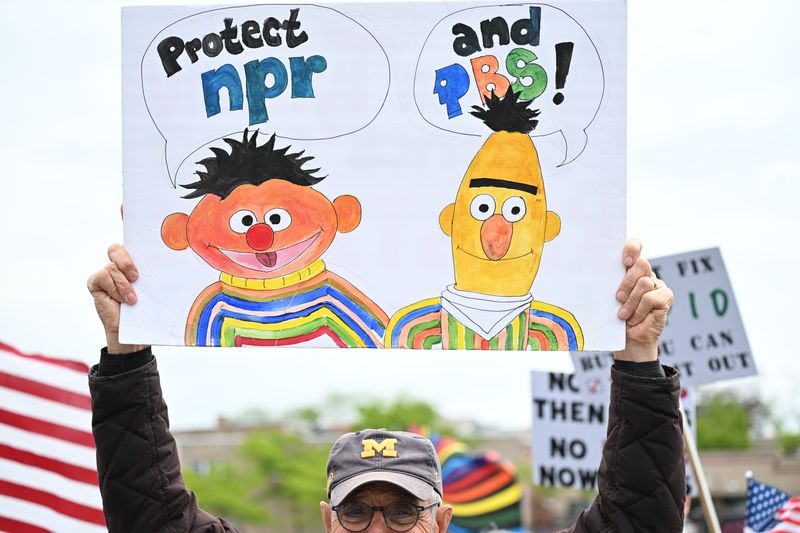
President Donald Trump on July 25 signed off on something that’s long been on the Republican wish list: slashing funding for PBS and NPR.
Last week the House passed a bill at Trump’s request containing $9 billion in spending cuts for public broadcasting stations and the United States’ foreign aid efforts in a 216-213 party-line vote. Around $1 billion in previously appropriated funding for public broadcasting stations and their local affiliates for the next two years will be clawed back.

The bill came in response to an executive order Trump signed in May calling for all agencies to stop, “to the maximum extent consistent with applicable law,” any funding of NPR and PBS whether directly or indirectly. In the order, Trump claimed without evidence that neither entity, known for “Sesame Street,” “Antiques Roadshow,” interview shows, documentaries, independent news coverage and local, regional and national emergency alerts, “presents a fair, accurate, or unbiased portrayal of current events to taxpaying citizens.”
Both PBS and NPR have regularly polled high for decades in user satisfaction and trust.
According to the Corporation for Public Broadcasting (CPB), the nonprofit corporation created by the U.S. in 1967 to fund public programming, a Peak Insights poll from June-July 2025 showed that 68% of American voters believe public media serves as a lifeline for rural and underserved communities, 53% trust public media networks and local stations (as opposed to only 35% trusting media in general), 66% believe that public media provides quality educational programming for children, and 62% believe it should remain free.
Although most member TV and radio stations get much of their funding from donations, the federal budget cuts may severely hamper local stations’ ability to continue all of their operations or even keep the lights on, especially in rural areas.
Central Florida Public Media (WMFE Orlando) said in a notice to supporters it means a loss of $300,000 in federal funding. WEDU in Tampa, a PBS station, said it will lose $2.4 million. Nearby WMNF will lose $230,000. At WUCF at the University of Central Florida, it’s about $2 million.
Help from the state is not likely.
On June 30, Gov. Ron DeSantis vetoed $1.3 million for public radio stations and about $4.4 million for public television stations when he signed the Florida’s 2025-26 budget. Funding for The Florida Channel, which streams the governor’s press conferences, committees and legislative floor sessions and public board meetings, and the state’s public radio emergency network were left unscathed.
DeSantis’ cuts include a loss of $370,400 to each public television station and $100,000 to each radio station.
Which TV stations in Florida are PBS affiliates?
According to PBS, the Florida affiliates are:
Which NPR stations are in Florida?
According to the NPR station list, the NPR-affiliate radio stations in Florida are:
What do PBS and NPR stations offer Florida?
When President Lyndon B. Johnson signed the Public Broadcasting Act of 1967, it created the Corporation for Public Broadcasting (CPB), a publicly funded non-profit corporation to support free, high-quality, noncommercial content with an emphasis on education, the arts, and local communities.
Funding from the CPB allowed smaller television and radio broadcasters to create and distribute content without influence from advertisers.
PBS (Public Broadcasting Service) initially launched in 1969 as a nonprofit organization dedicated to educational programming. Its shows are carried through local member stations and millions, if not billions of American children were raised on “Sesame Street,” “Mister Rogers’ Neighborhood,” “Barney & Friends,” and science shows such as “Nova” and “Nature.”
Most Americans’ first experiences of British television came from PBS. “Monty Python’s Flying Circus, “Mr. Bean,” “Downton Abbey,” “Doctor Who” and many more brought British comedy and drama to our shores. Drama shows such as “Masterpiece,” home improvement shows like “This Old House,” music shows such as “Austin City Limits,” public affairs shows like “Frontline” and many interview shows and documentaries have delighted and informed viewers, for free, for years.
NPR (National Public Radio) came along in 1970, replacing the National Educational Radio Network. It syndicates programming to more than 1,000 public radio stations in the U.S., many of them operated by colleges and universities or local nonprofits.
NPR produces 5-minute hourly news broadcasts every hour, news and public affairs shows like “All Things Considered,” “Morning Edition” and “Fresh Air,” a large number of cultural programs including “Wait Wait… Don’t Tell Me!” and “Planet Money,” music shows like “Tiny Desk Concerts” and many more.
The public media system currently reaches nearly 99% of the population, according to the CPB, providing free programming and services. Member stations regularly create their own, hyperlocal shows to serve their communities.
Public media also provides a national infrastructure for emergency broadcasts, geo-targeted wireless emergency alerts to cell phones and monitoring tools used by public safety officials. Many member stations are emergency broadcasters for the Florida Public Radio Emergency Network, which provides information during severe weather, tropical storms and hurricanes and other emergency events.
(This story was updated to add new information.)
This article originally appeared on Tallahassee Democrat: Federal and state funding end for PBS, NPR in Florida. Here’s how many stations there are
Reporting by C. A. Bridges, USA TODAY NETWORK – Florida / Tallahassee Democrat
USA TODAY Network via Reuters Connect