Calling his job “a dream come true,” Brian Hughes is settling into his role as director of NASA’s Kennedy Space Center with praise for the workforce as preparations continue for Artemis III, critical infrastructure upgrades and ever-escalating commercial launches.
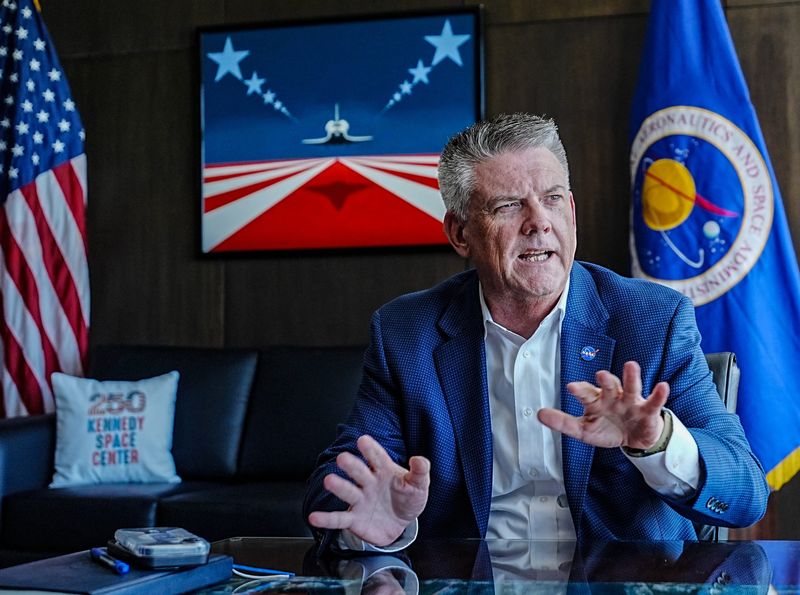
“Just the breadth and depth of knowledge of people that I have here around me: It’s just an incredible comfort as a leader to have so many very, very, very smart people behind you,” Hughes said in his office during a FLORIDA TODAY interview.

“And I’m talking at every level. I’ve already had the opportunity to go out to social hours that people have at the end of a workweek, and see some folks where they’re working in the middle of the day. So from the senior leadership down, there’s just a great energy and enthusiasm backed up by intelligence and work ethic,” Hughes said.
“So it shouldn’t have been a surprise. But it’s just a refreshing reality of where we are,” he said.
Hughes’ appointment was announced May 8 as NASA’s senior director of launch operations, which includes KSC and the Wallops Flight Facility in Virginia. He takes over at a critical time for America’s space program. Next year, the four Artemis III astronauts are expected to launch from KSC into orbit aboard an Orion spacecraft to test newly designed lunar landers from Blue Origin and SpaceX.
NASA’s goal: Set the stage to send the Artemis IV astronauts to land on the moon’s harsh, dusty surface in 2028. But on the other hand, NASA’s Office of Inspector General reported last month that KSC’s dated launch infrastructure — think electrical power, gas supply and distribution, and roads and bridges — is projected to reach near-capacity levels by 2028 or 2029. The OIG audit estimated complete KSC launch infrastructure upgrades would cost at least $1 billion.
“The first thing is, it has to be tackled. There’s no option but to find a path. And the good news is, there’s already been a lot of strategic planning. So it’s not like I walked into a surprise. The folks that have been here for years, if not decades, have been working these processes,” Hughes said.
Hughes said a key challenge is the increasing acceleration of the Cape’s commercial space industry: “We will keep up, but the demands are coming more rapid.”
As Blue Origin’s New Glenn and SpaceX’s mighty Starship rockets increase heavy-lift missions in the near future on Florida’s Space Coast, Hughes said Wallops could potentially serve as “pressure relief” as new players emerge such as Stoke Space, Rocket Lab, Firefly Aerospace and Relativity Space.
The latter company just announced plans to expand Cape Canaveral operations and add thousands of high-paying new jobs by the end of 2034.
“And I think there’s other providers that we might not see yet. I don’t think this sector has seen the end of its innovation by a long shot. I think we’re really just at the beginning of something,” Hughes said.
Management style: Give tools and resources, then ‘get out of the way’
Janet Petro, who retired as KSC’s 11th director in May, previously held management positions with Science Applications International Corp. and McDonnell Douglas Aerospace Corp. before starting her NASA career in 2007. She ascended to the KSC director’s post in 2021.
Conversely, Hughes’ resume is heavy on political and public-affairs positions. Last year, Hughes served as White House deputy national security adviser for strategic communications before becoming NASA’s chief of staff in Washington, D.C., from May to December 2025.
After his appointment, U.S. Rep. Zoe Lofgren of California — the top-ranking Democrat on the House Committee on Science, Space, and Technology — said in a press release she was “appalled” because he has “deep ties to the White House but no background or expertise in space launch systems.”
During the FLORIDA TODAY interview, Hughes said his previous work as CEO of Jacksonville’s Downtown Investment Authority and as the city’s chief administrative officer is comparable to his role at KSC.
Example: Though he is not an engineer, he said he facilitated the Jacksonville engineers in having what they need to build bridges, design downtowns and build parks.
“I’m not a scientist by training. But I obviously work with a lot of them,” Hughes said of NASA.
“And the easy thing is that when you work with extremely smart people — some of the smartest people in the world, which you do at NASA and you do at Kennedy Space Center — all you have to do is give them tools and resources and kind of get out of the way,” Hughes said.
“So that’s my approach to the job. I have a whole diverse group of people that work under me in a lot of important areas. And I’m their conduit to the things they need, and to help manage their time and ability to do very important work for the nation and for the agency,” he said.
Hughes, a U.S. Air Force veteran who served as a boom operator aboard KC-135 Stratotankers, leaves a signature tagline on his NASA internal directives: “Let excellence power every launch.” He said he embraces a management style where he takes 90 days to evaluate his team.
“For me, that’s fast-approaching. And the good news is, the team that was already here in place is well-honed. So it’s a pretty easy transition as a leader when you come in and there are good people at senior levels,” Hughes said.
‘Artemis is the next step in that amazing American journey’
On July 21, Hughes participated in a “Return to the Moon” policy discussion at Florida House on Capitol Hill in Washington, D.C. Asked about the legacy of Apollo 11, he cited President John F. Kennedy’s vision statement amid the backdrop of the Cold War.
“I tell people every day at work, when I have an opportunity, that I’m not aware of any other federal agency that was created and founded on the notion that there’s a thing: We don’t have any idea how we’ll do it, but we expect you to figure it out and go do it. And we did,” Hughes said, drawing laughter.
“So I think it was a moment for our nation and it, of course, set in motion just an incredible multigeneration adventure for our nation. So I would say that it has actually changed the quality of life for all of us here today,” he said.
Later during the discussion, Hughes recalled joining 40-some KSC interns to taste-test microgreens that had been grown in a facility designed to simulate a space station. He said young people growing up in “the Artemis generation” will see that KSC demonstrated why Florida will be forever attached with space history.
“The Artemis program is another demonstration of what makes America special. And what makes America special over the course of our history makes the world better. I believe that to my core,” Hughes said.
“It’s why I’m back in government. It’s why I enjoy every day that I work at NASA. I believe in our country. I believe in what it stands for. And NASA is an embodiment of all of the promise that America has. So, Artemis is the next step in that amazing American journey.”
For the latest news from Cape Canaveral Space Force Station and NASA’s Kennedy Space Center, visit floridatoday.com/space. Another easy way: Click here to sign up for our weekly 321 Launch space newsletter.
Rick Neale is a Space Reporter at FLORIDA TODAY, where he has covered news since 2004. Contact Neale at Rneale@floridatoday.com. Twitter/X: @RickNeale1
Space is important to us, and that’s why we’re working to bring you top coverage of the industry and Florida launches. Journalism like this takes time and resources. Please support it with a subscription here.
This article originally appeared on Florida Today: Exclusive: NASA’s new KSC chief tackles Artemis deadlines, aging infrastructure
Reporting by Rick Neale, Florida Today / Florida Today
USA TODAY Network via Reuters Connect
By Rick Neale, Florida Today | USA TODAY Network