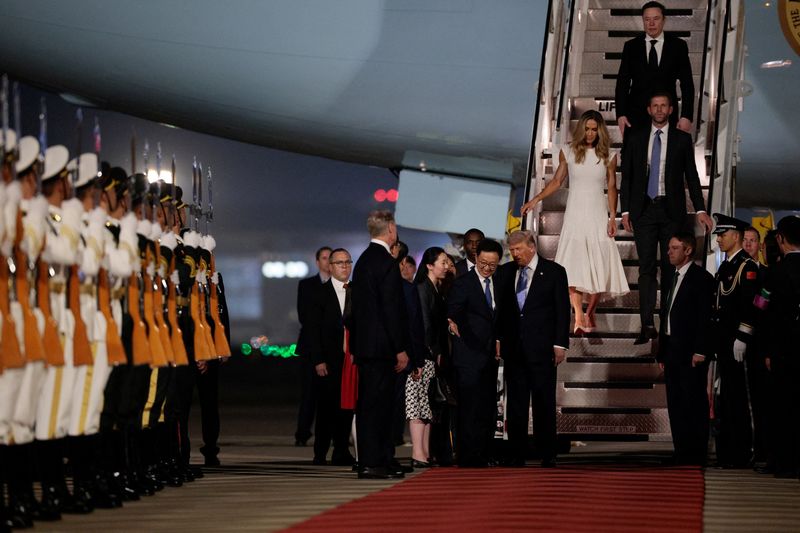
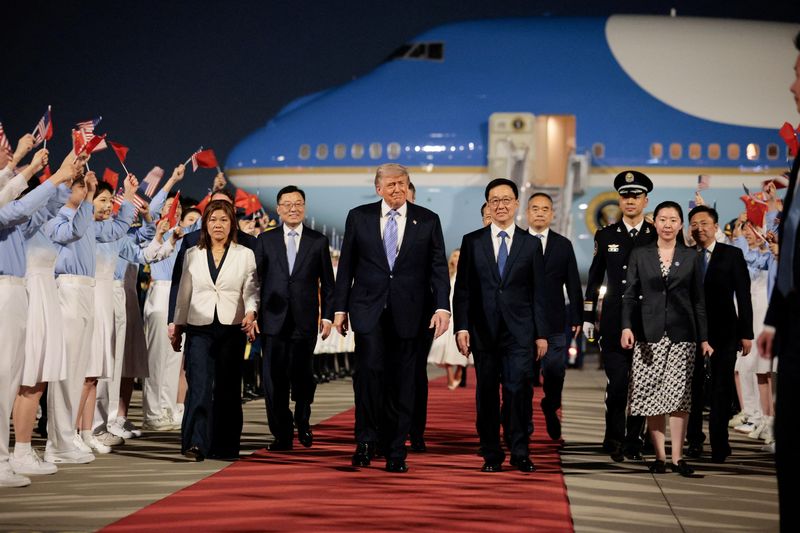
President Donald Trump arrived in Beijing May 13 with an entourage that looked more like a roster of candidates for Mar-a-Lago membership than the Foggy Bottom diplomatic corps.
Traveling with the president was a veritable Who’s Who of American corporate elite and wealth, including the world’s richest man, Elon Musk, and the outgoing CEO of one of the planet’s most significant brands, Tim Cook of Apple.

During an Air Force One refueling stop in Alaska, the chief executive of Nvidia, which smashed market capitalization records at more than $5 trillion this May, joined the travel party. Also represented in Beijing is the president’s own family enterprise, the Trump Organization.
Ahead of his arrival, Trump posted on social media that the Wall Street elite, including the chieftains of blue chip titans Goldman Sachs, GE Aerospace, Qualcomm, were onboard for a specific purpose.
“I will be asking President Xi, a a Leader of extraordinary distinction, to ‘open up’ China so that these brilliant people can work their magic, and help bring the People’s Republic to an even higher level,” the president wrote.
After landing in Beijing, Trump deplaned followed by his second-eldest son Eric and his wife Lara, Musk, and two Cabinet members, Secretary of State Marco Rubio and Secretary of War Pete Hegseth.
The inclusion of Eric Trump, who runs the Trump Organization, also underscored a certain reality, analysts said, that the trip also is a business venture for the family. A March report by the Brennan Center for Justice broke down how Trump, who complained in his first term that the presidency cost him ample commercial opportunities, and his family have profited handsomely this go around.
“Since taking office in January 2025, President Trump has pocketed an estimated $3 billion from his various business enterprises. His family is estimated to have raked in billions more,” wrote Owen Bacskai and Daniel Weiner of the Brennan Center. “Much of the money appears to be coming from foreign governments and others seeking to curry favor with the Trump White House.”
Former ambassador said China trip planning telegraphed US summit goals
The seemingly overwhelming presence of the one percenters in Beijing may seem surprising, but the White House indicated that commercial and economic objectives would be the summit’s principal objective almost from the start.
Nicholas Burns, who served as U.S. ambassador to the People’s Republic during the Biden administration, noted that Treasury chief Scott Bessent, and not Rubio, led the planning for the summit’s agenda from the U.S. side. Burns said he read that as a signal that economic and commercial issues will dominate the talks.
“I think economic and commercial issues will be the focus,” Burns predicted during an April 30 talk at the LeMieux Center for Public Policy at Palm Beach Atlantic University.
Mike Froman of the Council on Foreign Relations wrote on May 8 that he expected commercial agreements for sales of more agriculture, specifically soybeans, and aircraft may well come out of the two-day talks. In fact, the Brian Sikes of Cargill and Kelly Ortberg of Boeing were also aboard Air Force One, according to Trump’s post.
Froman also said the summit could produce the framework for the proposed Board of Trade, a standing body to manage imports and exports with China. The idea was offered by U.S. Trade Representative Jamieson Greer, who was on Air Force One as well, in Paris two months ago.
Froman’s concern is the the summit might leave thorny but consequential non-commercial issues unaddressed. Those, he said, include reasserting U.S. support for Taiwan’s independence, the mushrooming nuclear arms build-up as China seeks to reach 1,500 warheads by 2035, the geostrategic ramififications of artifical intelliegnce applications, the threats from Nortk Korea and Beijing’s propping up Russian military’s Ukraine invasion.
“In the meantime, leaving most of these issues unaddressed runs the risk that one or more of them will create a future conflict that cannot be swept under the rug,” Froman wrote.
U.S.-China relations and the Mar-a-Lago pivot
Trump’s trip to China comes amid an economic and technological rivalry with the Asian giant — a competition that is playing out in Florida and Palm Beach County with debates in Tallahassee over what rights people have as artificial intelligence uses spread as well as opposition to a data center outside of West Palm Beach.
Not to mention, former CIA intelligence officer Michele Rigby Assad warned last year, Beijing’s espionage efforts from Cape Canaveral’s space industry to the Sunshine State’s military defense contractors to even the president’s home and private club in Palm Beach.
“The U.S.-China competition is going to be the defining competition of the 21st century,” said John Mearsheimer, an international relations scholar at the University of Chicago, during a talk at Florida International University on May 6.
As a result, the United States continues to pivot away from the European-centric foreign policy that dated back to its independence and beginnings as a constitutional democracy in the late 1700s. Instead, he and other analysts speaking at the Hemispheric Security Conference hosted by Florida International University this month said Washington has its sights set on China and East Asia as the regions of top concern.
Mearsheimer credited Trump with pursuing the change when he first took office in January 2017, and then hosted Xi at the Winter White House three months later. He added that despite the Obama administration signaling a radical shift in focus, it was the first Trump administration that actually followed through.
“It was Trump who did it,” he said.
In an interview this month, Mearsheimer, one of the leading specialists on international affairs in the United States, said it is no coincidence that the new president’s first guests at Mar-a-Lago were the late Japanese leader Shinzo Abe and Xi.
During the Xi meeting at the Winter White House, Trump famously informed his Chinese counterpart of a U.S. missile strike in Syria as a chocolate cake dessert was served.
Now, Mearsheimer said the Washington-Beijing “competition” is playing out on a variety of issues, including the digital stage.
“Today the United States is involved in mortal combat with China on things like AI,” he said.
That is what is behind the Trump administration’s push for broad application of AI technologies, which led Gov. Ron DeSantis to call for a quasi-AI bill of rights for Floridians the governor said would not conflict with Trump’s aims. It is also why the president desires the construction of massive data centers such as the Project Tango development in Palm Beach County.
Brian Fonseca, who directs national security research at FIU, added that China plays an adversarial role in the U.S. backyard across the Western Hemisphere, too. Beijing, along with Moscow and Tehran, work to undermine democratic institutions and engage in “illicit transnational” criminality.
“I think those things continue to be really incredible, powerful threats that continue to plague the region,” Fonseca said.
Reporting by Hannah Phillips of the Palm Beach Post was used in this story.
Antonio Fins is a politics and business editor at The Palm Beach Post, part of the USA TODAY Florida Network. You can reach him at afins@pbpost.com. Help support our journalism. Subscribe today.
This article originally appeared on Palm Beach Post: Elon Musk, Apple’s Tim Cook join Trump’s China summit. Why it matters.
Reporting by Antonio Fins, Palm Beach Post / Palm Beach Post
USA TODAY Network via Reuters Connect