ORMOND BEACH — Reconstruction of the Interstate 95-U.S. 1 interchange is starting now.
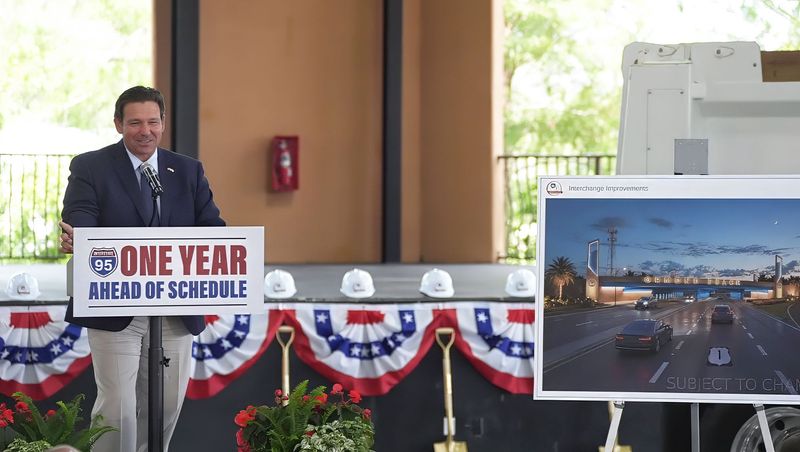
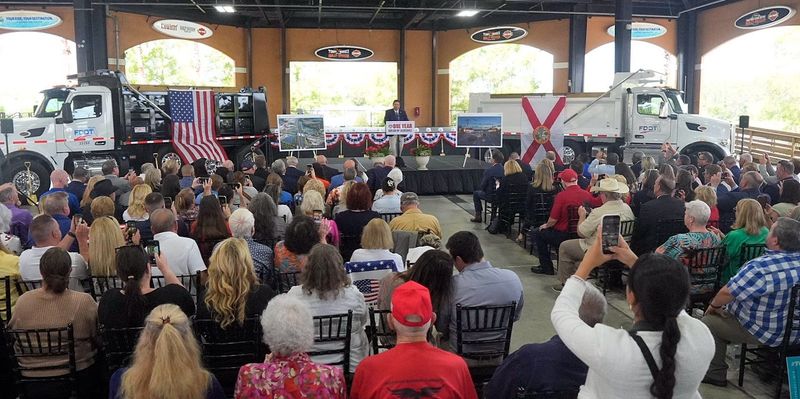
At Destination Daytona on April 30, Florida Gov. Ron DeSantis announced that big changes to the project, including a significantly lower cost and a redesign, will start and finish one year ahead of schedule. The Ormond Beach interchange and other large-scale transportation projects had at one time been expected to start 2030s.

“I’m like, what good does that do anybody, to sit in traffic for this long, and it’s only going to get worse,” DeSantis said. “So we saw an opportunity because we had so much surplus to be able to look at the pressure points around the state, identify the projects that were necessary and urgent, but not scheduled to begin many times until next decade.”
DeSantis added that the redesign to the interchange will save the state more than $70 million.
DeSantis surged the cash to accelerate those projects in the Moving Florida Forward program, an investment of $7 billion into 20 major transportation projects statewide. That bumped up the timeline on some projects by as many as 20 years, according to Florida Department of Transportation officials.
Once the I-95 interchange at U.S. 1 was placed on the Moving Florida Forward list, it was expected to get started in 2027.
Instead, DeSantis stood alongside FDOT Secretary Jared Perdue and Maryam Ghyabi-White, an Ormond Beach transportation engineer who consults with the state and has championed the project, gold shovels in hand, moving earth on April 30, with work to begin in days.
Ghyabi-White pushed the project on DeSantis even before he became the area’s congressman
Ghyabi-White said the 1960s-era exit and entrance ramps have long needed to be replaced.
She said she spoke with DeSantis about the project as far back as 2012, when he was first running for Congress as a relatively unknown, Navy Reservist and former JAG officer.
“He delivered on a promise he made,” Ghyabi-White said.
Moving Florida Forward pushes I-95/US 1 project ahead by 10 plus years
FDOT Secretary Jared Perdue, in an April 29 interview with The News-Journal, said DeSantis’ vision for Moving Florida Forward pushed the department and its partners to innovate.
“He had the brilliant idea of using the state’s record general revenue surplus to reinvest that into communities where Floridians live, work, and play through transportation infrastructure,” Perdue said.
“I-95-U.S. 1 — which really is a staple interchange, one that has a storied history and was part of the original interstate buildup back in the 1960s — is really in need of significant upgrades from a traffic and safety perspective,” he said. “So it’s really remarkable that we’re able to do this project and advance it by more than a decade because of the governor’s Moving Florida Forward initiative.”
At some point, the project was slated to start in 2027.
“We’re actually delivering it to construction a year sooner than was originally planned,” Perdue said.
FDOT touts ‘modified phased design-build’ as innovative approach
The Moving Florida Forward initiative was about more than moving a lot of money into FDOT’s pot, Perdue said.
“His charge to DOT was, ‘We need to cut down on bureaucracy. We need to find efficiency. We need to innovate. We need to go faster and save taxpayer dollars anywhere we can,'” Perdue said.
From the governor’s call, Perdue said FDOT developed what it calls the “modified phased design-build” approach to transportation projects.
Breaking down that phrase, design-build has been an increasingly popular approach to construction projects. It simply means the design and construction phases are handled by one entity, either a company that provides both of those services or a joint venture between a design firm and a construction company.
The “modified phased” portion of the concept covers “very intense competition and collaboration” among contractors and project engineers.
“Essentially we took the best of all the different procurement tools and project-delivery tools out there and found a way to blend them together to have this new process that really harnesses innovation and efficiency and captures those ideas that bring the best value to taxpayers.”
A conventional project typically involves different phases: Planning, design, bidding and construction.
“With this new method, we take the idea of design-build, but we get three teams under contract that then compete by bringing innovation and cost-saving ideas to the table. And we place the expectation on ourselves as the public agency to be embracing and accepting of new ideas that are outside of the box.”
“It places the industry in an intensely competitive environment to find cheaper, more efficient ways to do it, and also a faster way to do it.”
New process sped up I-4 congestion-relief lanes in Kissimmee area
The approach was first used with an Interstate 4 project in the Kissimmee area, where congestion-relief lanes were constructed on the interstate between U.S. 27 in Polk County to World Drive in Osceola County. Those lanes were built ahead of the bulk of the project and delivered eight months ahead of schedule, saving motorists time, Perdue said.
“It took a trip, from Orlando to Tampa, that could take 2.5 to 3 hours and reduce travel time by 50%,” Perdue said. “It made an immediate difference.”
It was originally projected to take 12 to 15 years to build. The congestion relief lanes are typically not completed on a project like that until more than halfway through the job, Purdue said.
With I-4, flipping the congestion relief lanes to the start of the project was a truly innovative idea, he said.
There are other Moving Florida Forward projects that will use the modified phased design-build model, Perdue said.
“We are pioneering a new delivery method that I believe will be proliferated in the industry at some point because it has generated such tremendous opportunity with cost savings and time savings,” Perdue said.
What can motorists expect at the I-95/U.S. 1 project in Ormond?
In 2023, FDOT had selected a diverging diamond design for what was then considered a $215 million project. There were public meetings and presentations.
The diverging diamond would have criss-crossed the northbound and southbound lanes of U.S. 1 in order to achieve safer entrances and exits to I-95. But Ghyabi-White said some of the feedback, particularly from older residents, was a concern, and a modification was needed.
Perdue said the state has used several diverging-diamond designs elsewhere in Florida successfully, but “it takes a lot of land, but in cases where traffic has grown significantly, it has been a good relief tool,… but every idea and every tool has pros and cons.”
The team came up with innovations and cost-saving ideas while simultaneously bringing congestion relief and improving safety, Perdue said.
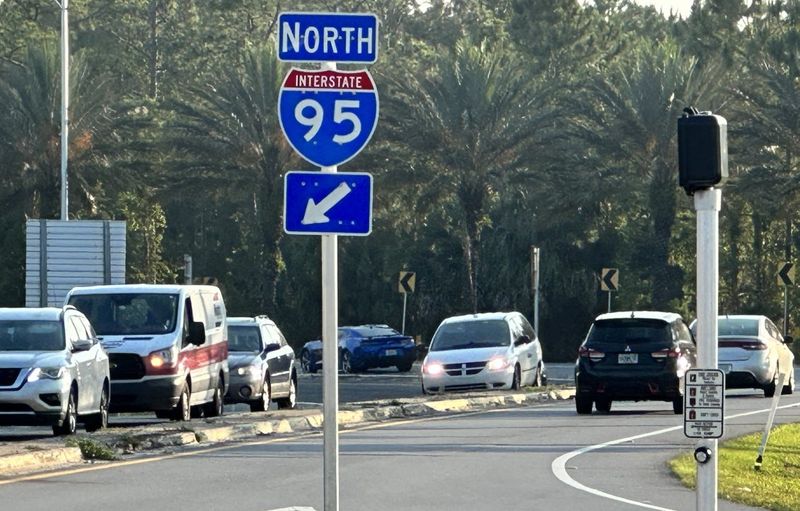
FDOT officials say the new design will involve the addition of three bridges and redesigned loop ramps on I-95 to make it easier and safer for drivers entering and exiting the interstate.
“Reconstructing the interchange and widening the I-95 on- and off-ramps will add capacity and relieve congestion,” the department said in an emailed statement.
Southbound U.S. 1 motorists will no longer have to turn left to access southbound I-95, according to the department.
U.S. 1 will also be improved, with a widening from 4 to 6 lanes planned for 1 mile between Plantation Oaks Boulevard and Destination Daytona Lane.
There will also be a median and a shared-use path for bicyclists and pedestrians along U.S. 1.
How long will work on the I-95/U.S. 1 Ormond interchange take?
The Jr. Davis Construction-Superior Construction joint venture will start work in May. It is expected to be completed in 2029.
FDOT says lane closures will be restricted to night hours and work will not take place during select holidays and special events.
“The new interchange will be a showcase gateway with distinctive architectural features to reflect the community and support local growth and economic development,” according to the FDOT statement.
The north side of the interchange bridge will feature a large “Ormond Beach” welcome sign welcoming southbound residents to the city.
This article originally appeared on The Daytona Beach News-Journal: DeSantis announces start of I-95/U.S. 1 interchange rebuild
Reporting by Mark Harper, Daytona Beach News-Journal / The Daytona Beach News-Journal
USA TODAY Network via Reuters Connect