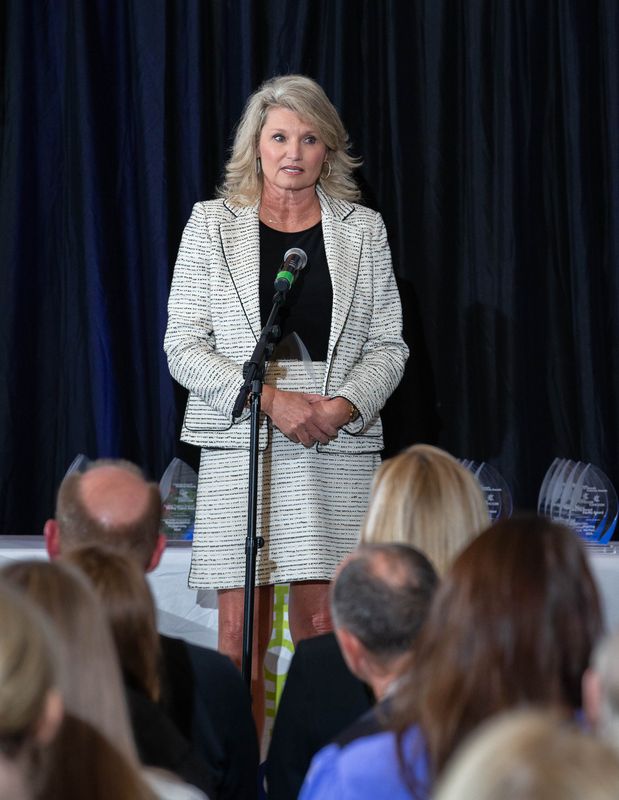
Escambia County Clerk of Court Pam Childers is asking the court to dismiss the core complaints of a lawsuit filed against her for withholding $7,000 in county discretionary funds that Escambia County Commissioners agreed to give two Warrington area nonprofits.
Childers filed the motion to dismiss on May 21.

In it, she argues the nonprofit organizations that filed the lawsuit, The Greater Pensacola Junior Golf Association (First Tee) and Warrington Emergency Aid Center (WEAC), have no legal standing to demand the money from her and hold her personally liable for the payments.
Childers’ reasons include that the nonprofits have no constitutionally protected claim to public money and “an insurmountable problem in that neither is a citizen-taxpayer” with the legal standing to bring a claim for repayment of funds to the county treasury.
State Representative and attorney Alex Andrade filed the lawsuit against Childers on April 24 on behalf of the two nonprofits.
In his lawsuit, Andrade claims Childers unlawfully withheld $4,500 earmarked for youth golf programs run by First Tee Gulf Coast and $2,500 approved to reimburse food pantry expenses for the Warrington Emergency Aid Center (WEAC).
Escambia County District 2 Commissioner Mike Kohler made both requests and has repeatedly spoken from the dais about his frustration with the clerk’s decision.
Childers said using taxpayer money for a “party” for First Tee and buying food for a pantry that only serves a select group of people and excludes most other residents of the county, does not serve a public purpose.
The clerk said it is her job to ensure the funds meet a “county purpose,” and she does not believe they do because neither nonprofit has a contract with the county to provide for a “fundraiser party” or a food drive that “by their own admission, excludes all residents of the county not residing in Pensacola.”
“Therefore, the expenditure constitutes an illegal gift of public money in violation of the Florida Constitution,” Childers said in her answer to their charges. “The Clerk determined that neither expenditure served a legitimate county purpose and so properly denied payment. The payments are not authorized by law or the Florida Constitution and so no relief should be afforded to plaintiffs.”
Andrade argues that it’s not Childers’ job to determine if the money has a county purpose.
The nonprofits’ complaint argues that under state law Childers’ role as the county auditor is strictly ministerial, to “keep their minutes and accounts, and perform such other duties as their clerk as the board may direct.”
They say the county “possesses the home rule and statutory authority to appropriate funds to organizations that are providing recreational, educational, health, safety and welfare programs to Escambia citizens.”
As such, Andrade claims in the suit that the board has the legal right to make the call on the appropriation of the funds and that Childers is out of bounds because she doesn’t have the constitutional authority to decide if payments should be withheld.
Childers argued that the organizations are not legally entitled to the funds simply because commissioners approved the payments.
Her attorneys said that the nonprofits claims they have state protected “property interests” and are entitled to the money is false because the property interest claim is based on a county “program.”
“The county is without authority to fashion a ‘program’ that creates protected property interests in county funds prior to the Clerk’s determination of legality of a proposed expenditure,” the lawsuit said. “Doing so would nullify the Clerk’s pre-audit responsibilities as County Auditor and conflict with the Clerk’s constitutional and statutory duties.”
The sharpest aspect of the legal complaint against Childers is the personal liability claim.
Andrade uses a state law against her that says a clerk of the circuit court is liable when signing county warrants. The statute dictates that if a clerk signs warrants for payments later deemed unlawful, they can be held personally liable.
The lawsuit points out that if Childers is legally correct that funding youth golf and food pantries is unconstitutional, then she would be personally liable for not just the money he claims is owed to his clients, but also the commission’s funding for other private organizations. Those payment add up to more than $1.5 million.
“We are requesting you conduct a review of all payments you have made to similar programs and charities that you now claim should not have been paid and submit a personal refund to Escambia County for all amounts you paid that you now deem unlawful,” Andrade said in his April 14 demand for payment letter to Childers.
Childers argued that “threats to attempt to impose personal liability if she doesn’t comply” do not hold water legally.
“Plaintiffs have an insurmountable problem in that neither is a citizen-taxpayer with any standing to bring a claim for repayment of funds to the County treasury,” Childers’ motion said. “Even under the most basic standing analysis, Plaintiffs’ Count IV fails because their vague allegations that the Clerk’s post-payment audit ‘poses a risk of harm to their reputations or that it ‘raise[s] the potential’ the Commission might take some action, are not concrete injuries unique to them sufficient to confer standing.”
Childers maintains that the Florida Constitution strictly limits the use of public tax dollars.
She argues that commissioners have treated the discretionary line items as individual “slush funds” to curry political favor, and that funding private charitable organizations does not serve a legitimate, legally defined county purpose.
This article originally appeared on Pensacola News Journal: Childers seeks to dismiss lawsuit over withheld discretionary funds
Reporting by Mollye Barrows, Pensacola News Journal / Pensacola News Journal
USA TODAY Network via Reuters Connect