Hurricane Erin remains offshore as it moves northward along the U.S. Southeast coast today, continuing to generate large Atlantic waves that will pose dangerous surf and marine hazards through Friday.
As of Wednesday morning, outer bands from Hurricane Erin are expected to bring worsening conditions to the coast of North Carolina by this evening, according to the latest advisory from the National Hurricane Center.

Meanwhile, ocean swells generated by Erin are slamming into the coastline from Northeast Florida to Southeast Georgia, triggering life-threatening rip currents and prompting a flurry of warnings from the National Weather Service.
Officials are strongly advising everyone to ‘stay out of the ocean and follow patrol guidance. As a result, a High Surf Advisory is in effect through Thursday, with a high rip current risk until Friday stretching across local beach destinations, including St. Simons, Jekyll, and Amelia Islands, as well as Jacksonville, St. Augustine, and Flagler Beach.
In addition to high surf and strong currents, coastal communities are bracing for beach erosion, minor tidal flooding during high tides, and hazardous marine conditions through the end of the week.
So what exactly are rip currents, and why are they so dangerous even when a storm seems far away? Here’s what you need to know.
What is a rip current?
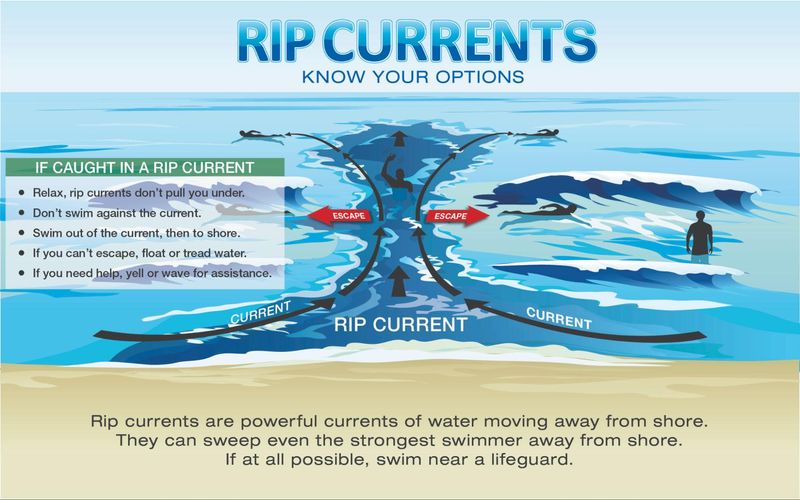
Rip currents are powerful channels of water flowing quickly away from shore, which occur most often at low spots or breaks in the sandbar and in the vicinity of structures such as jetties and piers.
Rip currents form when incoming waves create an underwater sandbar. The waves push more water between the sandbar and the shore until it collapses and the water rushes back to the sea through a narrow gap, where it starts to spread out. But they can be difficult to see when you’re in the water as the ocean over them can still be smooth.
Entering the surf is strongly discouraged. If caught in a rip current, relax and float. Don`t swim against the current. If able, swim in a direction following the shoreline. If unable to escape, face the shore and call or wave for help.
What is the ‘Flip, float and follow’ technique used to escape a rip current?
According to the Great Lakes Surf and Resuce “As long as you are floating, you are alive and buying time for rescue to arrive,” said David Benjamin, executive director.”
The “Flip, Float, and Follow” drowning survival technique was created by the Great Lakes Surf Rescue Project (GLSRP). This technique is designed to help people in dangerous currents, like rip currents, by teaching them to flip onto their back, float to conserve energy, and then follow the current until it weakens, before swimming perpendicular to the current to safety.
Caught in a rip Current? Here’s how to escape a rip current using ‘flip, float and follow,’ technique
Here’s a breakdown of the Great Lakes Surf and Rescue technique:
1. FLIP:Flip over onto your back and float. This allows you to float and breathe more easily.
2. FLOAT:A. Float to keep your head above water.B. Float to calm yourself down from the panic and fear of drowning.C. Float to conserve your energy.
3. FOLLOW:Follow the safest path to safety / out of the water.
Never swim against a current. If you are in a Dangerous Current, assess which way it is pulling you. Then swim perpendicular to the currents flow until you are out of it and then swim toward shore. If you are too tired to swim to shore, continue to float and signal someone on shore for help. Also, the waves may eventually bring you back to shore.
REMEMBER:–As long as you are floating, you are alive.–As long as you are struggling or fighting a current, you are drowning. Conserve your energy and do not do the Signs of Drowning.
What are Erin’s local impact on riptides?
What are the signs of a rip current? Here’s how to spot a rip current:
According to NOAA, Rip currents aren’t always visible. Spotting a rip current can be difficult. For this reason, NOAA recommends that to check for rip currents at the beach, stand back from an elevated position, like a dune line or beach access, and look for places where waves are not breaking.
Here’s a list of clues may indicate that a rip current is present:
How are rip currents formed?
The National Weather Service explains the formation of rip currents: “As waves travel from deep to shallow water, they eventually break near the shoreline. As waves break, they generate currents that flow inboth the offshore (away from the coast) and the longshore directions. Currents flowing away from the coastare called rip currents.”
How dangerous are rip currents?
Rip currents are habitual hazards of Florida beaches. Tens of thousands are rescued from rip currents in the U.S, every year and they make up 81.9% of all surf beach rescues, according to a 2018 report from the Natural Hazards and Earth System Sciences on lifeguard data.
The United States Lifesaving Association has estimated that over 100 people drown every year in the U.S. due to rip currents.
Do rip currents pull people underwater?
According to myths debunked by the National Weather Service, they don’t. A rip current will not pull you under water, but they can pull a swimmer away from the beach beyond breaking waves.
“Sometimes the rip will actually take the foam that’s up by the shore, created from the waves crashing, and suck it into that rip current and you’ll get a foam line that will trail into that rip current,” Deputy Crocker said.
“And you can see that foam line, too. So, it’s really imperative that a person educates themselves when they go to the beach that not only (are) there creatures in the water, but something actually more dangerous – the water itself.”
Contributing Lianna Norman Palm Beach Post and Cheryl McCoud Treasure Coast
This article originally appeared on Florida Times-Union: Caught in a rip current? Learn how to spot one—and survive with ‘Flip, Float and Follow’
Reporting by Doris Alvarez Cea, Jacksonville Florida Times-Union / Florida Times-Union
USA TODAY Network via Reuters Connect