The redrawing of congressional districts every 10 years used to be one of those important but boring procedures that state legislators have to do, with three things uppermost in their minds.
First, any politician with an IQ higher than their age will consider self-preservation: “How do I get a district that will re-elect me?” Second, whichever party runs the House or Senate wants to rig the map to keep itself in power. And third, the law and common courtesy dictate that everybody keeps a straight face while denying any hint of partisan politics in all of this and insist everything was done just for the people.

But the U.S. House is so narrowly divided that several states, including Florida, are pondering a fourth factor. A wave of mid-decade redistricting could determine whether President Donald Trump will be empowered to bring us more and more MAGA in the last two years of his term or if his legislative plans will be stymied by Democrats, who would chair committees investigating stuff Trump wants to keep quiet.
Normally, the national census in years ending with a zero determines which states gain or lose seats in the U.S. House. State legislators divvy up districts, using high-paid political consultants and sophisticated computer software that could tell you how many left-handed liberal women ages 24 to 50 with some college education and fewer than four children live in a specific tract and vote in every election.
OK, that’s a bit of an exaggeration, but not much.
The U.S. House is split 219-212 with four vacancies, giving Trump and Speaker Mike Johnson, R-La., a relatively tiny Republican edge. If just three Republicans switch sides on some hot bill, the roll call will be 216-215 with all members voting. So we can see why the GOP doesn’t want to wait for the 2030 census to restructure the districts.
Mid-term elections are usually cruel to the party in the White House. Republicans lost 40 House seats in 2018, during Trump’s first term, and President Joe Biden bid farewell to nine Democrats in 2022. With the speaker’s gavel, the power to investigate — dare we say “impeach?” — also changes parties when the House majority shifts.
The odds favor a narrow Democratic takeover next year, which is why the Republicans want to re-rig the districts this year.
Texas went first with a special session in which Republicans aimed at five congressional seats. The Lone Star congressional delegation has been 25-12 Republican, so getting rid of five pesky Democrats and adding that many MAGA Republicans would make Johnson a little less nervous when a big vote happens.
Ohio is required to redistrict before the 2026 midterms. California Gov. Gavin Newsom has indicated he’ll call a special session of his deep-blue Assembly to try to snatch some districts from the GOP if Democrats need to offset damage done in other states. New York also has that get-even option, and a Democratic governor, though there are legal technicalities required for a remapping session.
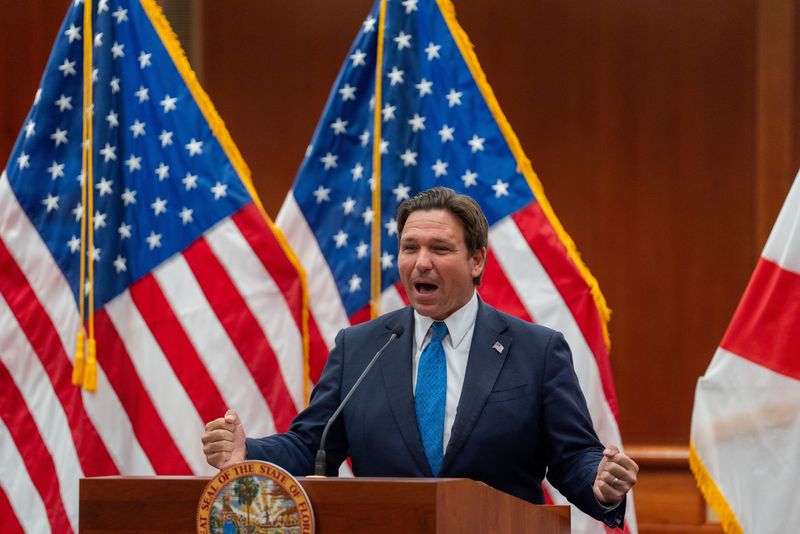
Which brings us to Florida, with our 20 Republicans and eight Democrats in the U.S. House. Gov. Ron DeSantis has said he’s looking at a mid-decade adjustment of district lines, and we can be sure any changes will brighten GOP prospects.
The Florida Supreme Court recently approved the state’s current congressional map, which DeSantis shoved through the Legislature.
“I think there’s ample justification to do it,” DeSantis said of a special legislative session. “My guys are going through the court’s opinion to look at different avenues, but I think that’s something that I certainly would look favorably on.”
Florida voters approved two “Fair Districts” constitutional amendments in 2010 that mandate congressional and legislative boundaries to be drawn without regard to incumbent protection or partisan favoritism. Those are no doubt a source of some merriment behind closed doors when legislative leaders huddle with GOP consultants and the governor’s tacticians.
But lawyers won’t be laughing when Democrats file suit against any mid-decade congressional remapping that emerges from a special session.
“This maneuver is a blatant attempt to rig the system, undermine the will of the voters, and entrench partisan control at the expense of fair representation,” state House Minority Leader Fentrice Driskell, D-Tampa, said of a potential special session. “This isn’t leadership, it’s manipulation.”
Which is to say, it’s just like reapportionment has always been — even back when the Democrats ran things in Tallahassee. The long-term stakes are just higher now.
Bill Cotterell is a retired Capitol reporter for United Press International and the Tallahassee Democrat. He can be reached at wrcott43@aol.com.
JOIN THE CONVERSATION
Send letters to the editor (up to 200 words) or Your Turn columns (about 500 words) to letters@tallahassee.com. Please include your address for verification purposes only, and if you send a Your Turn, also include a photo and 1-2 line bio of yourself. You can also submit anonymous Zing!s at Tallahassee.com/Zing. Submissions are published on a space-available basis. All submissions may be edited for content, clarity and length, and may also be published by any part of the USA TODAY NETWORK.
This article originally appeared on Tallahassee Democrat: Bill Cotterell: Florida’s stakes are high in redistricting redo | Opinion
Reporting by Bill Cotterell / Tallahassee Democrat
USA TODAY Network via Reuters Connect