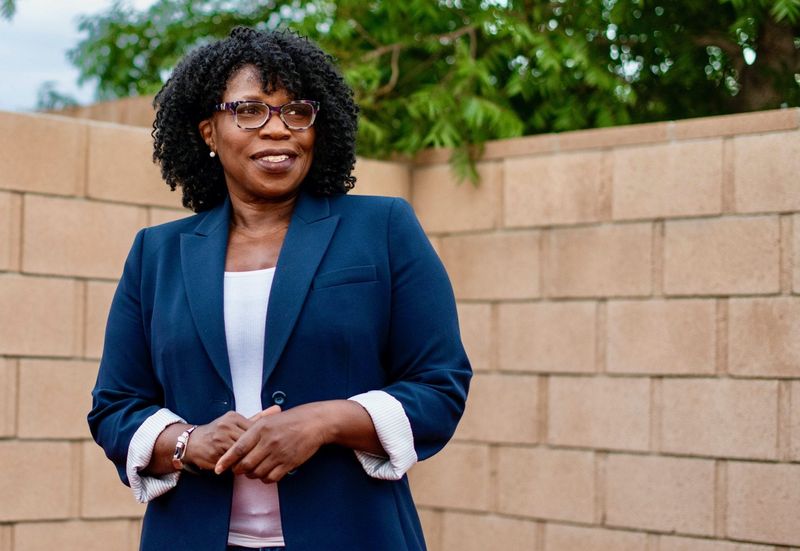
New York Times best selling author Victoria Christopher Murray didn’t find the subject of her latest book, Jessie Redmon Fauset.
Instead, the author insists, Fauset, one of the leading poets and editors of the Harlem Renaissance, found her.

While researching women who played a role in that movement, Murray found this quote from the poet, playwright and author Langston Hughes: “Jessie Fauset at ‘The Crisis,’ Charles Johnson at ‘Opportunity,’ and Alain Locke in Washington were the three people who midwifed the so-called New Negro literature into being.”
That discovery started Murray on a journey that resulted in her latest novel, “Harlem Rhapsody,” historical fiction that tells the story of Fauset’s groundbreaking work alongside her long-running affair with the prominent civil rights activist and NAACP co-founder W. E. B. Du Bois.
Murray will discuss her work at the Literacy Coalition of Palm Beach County’s 34th annual Love of Literacy Luncheon at 11 a.m. April 10 at the Kravis Center for the Performing Arts in West Palm Beach.
“There are so many women who have been hidden in history, Black and white women,” Murray said. “This is what I’ve discovered, and this is why I will always write historical fiction from this point: A history untold is a history that’s erased.”
When she read Fauset’s story, she knew it was one that she had to tell. “She should be the face of the Harlem Renaissance,” Murray said of the period in which her novel was set — the 1920s and ’30s in the New York City neighborhood.
Murray felt a connection to Fauset: Both are writers who have nurtured others in the field.
The connection was so strong that Murray said she had a difficult time leaving Fauset’s world.
“I didn’t want to leave the 1920s. I didn’t want to leave Harlem,” she said.
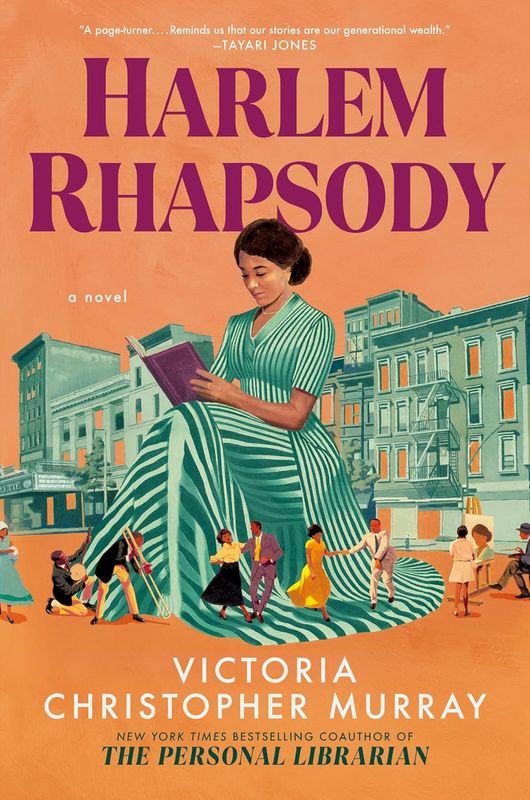
The cover of her novel is another love letter to the period: Murray said she was delighted when her publisher, Berkley, said they wanted to have an artist, David de las Heras, paint a scene from the Harlem Renaissance with Fauset at its center.
“I’m just so proud of that,” she said, adding, “I just thought that it was the most beautiful cover I’ve ever seen, and certainly the most beautiful cover of my career.”
Author dug into the Harlem Renaissance and didn’t want to leave
There was a time element to the story as well: Murray felt that if she didn’t tell Fauset’s story now, it would be lost for good.
“I decided that there’s a lot of women whose stories, if they go untold, they’ll be completely erased, and I’m gonna try to write as many of them as I can before my career ends,” Murray said.
To immerse herself in Fauset’s story, Murray spent five weeks in Harlem, where every day she went to the New York Public Library’s Schomburg Center for Research in Black Culture. She traveled there with another friend who also worked on a book about Harlem. “We went to the library like it was our job,” Murray said.
The library was more than a place of research — Fauset spent time there visiting friends who volunteered and worked at the facility when it was known as the public library’s 135th Street Branch.
At night, Murray and her friend would explore Harlem, eating at “every single restaurant” and soaking in the history of the place.
“It was one of the best experiences I had writing a book, and that’s what I love about historical fiction,” Murray said.
Through her research, Murray found evidence of the affair between Fauset and Du Bois — and between Du Bois and another prominent writer of the time, Georgia Douglas Johnson.
Du Bois’ biographer David Levering Lewis included a list of women with whom the civil rights icon reportedly had affairs in his Pulitzer Prize-winning pair of works. But Fauset had her own section, where Lewis wrote that she and Du Bois were star-crossed lovers, Murray said.
Murray didn’t want the book to be salacious, and even thought about ways to write “Harlem Rhapsody” without mentioning the affair.
“But I discovered her writing, it is so much tied up in her relationship with him,” she said, noting that the title of Fauset’s novel “There is Confusion” was based in her experience with Du Bois.
Delving into stories about powerful women
Murray has long felt compelled to write about powerful women. While some have categorized her earlier work as romance, she said that’s not the case.
“I always wanted to focus on the women, and the strength that they find even in the center of problems,” she said. “So my first few novels were called ‘Christian fiction.’ Again, it wasn’t what I was writing to. I was just writing what was in my heart and characters that I could relate to.”
All of the women in Murray’s novels have successful careers, or are entrepreneurs — something the author can closely relate to. She has a bachelor’s degree in communication disorders from Hampton University and her MBA from New York University’s Stern Business School. She also spent a decade in business and as an entrepreneur before becoming an author.
“It was very easy to bring the world where I live into my writing,” Murray said.
She learned to bring challenges into her books that reflect real issues being faced by women. “At the center of the books were women that I know. I don’t know them personally, but I know them,” Murray said.
‘The Personal Librarian’: An almost-missed opportunity
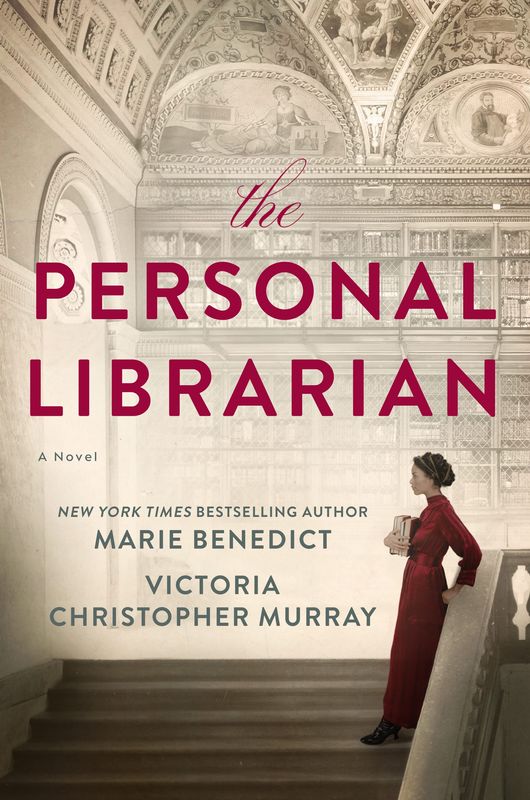
Murray’s first work of historical fiction was “The Personal Librarian,” co-written with Marie Benedict and released in 2019. Benedict had been writing about powerful women who had been forgotten by history, and she reached out to Murray with the opportunity to work with her on a project — an opportunity Murray almost missed.
“My agent sent me this three-page proposal, and I didn’t know what it was. I didn’t understand what my agent wanted me to do,” Murray said. “What could I do with this? Was she interested in writing a book with me, or did she want me to write it? Did she want me to edit?”
The story Benedict had discovered was that of Belle da Costa Greene, the personal librarian for the financier and investment banker J.P. Morgan. It was only discovered after Greene’s death that she was Black, and passed as white for decades.
“Marie, when wanting to write her story, she was trying to do the right thing because she felt like she didn’t know anything about passing,” Murray said. “She didn’t know anything about living as a Black woman in America.”
Benedict read Murray’s 2015 novel “Stand Your Ground” and knew that Murray was the author to help tell Greene’s story. “I hoped that I’d found my partner, as I read this important, award-winning novel about a white police officer shooting a black teenage boy told from two perspectives, the boy’s mother and the wife of the policeman,” Benedict said in a 2021 interview.
But when Murray first read Benedict’s pitch, all she saw was a first page about Morgan. About three months later, Murray’s agent asked her to give the proposal another look.
“The last paragraph said no one knew that she was Black until she passed away, and I couldn’t run to the phone fast enough,” Murray said. “I was almost blown away, because, you know, reading is fundamental,” she added, laughing. “I read it and said, ‘OK. Let’s work on this.'”
Their partnership led to “The Personal Librarian” and “The First Ladies,” their 2023 novel about the strong partnership between First Lady Eleanor Roosevelt and civil rights activist Mary McLeod Bethune. Both received rave reviews, and “The Personal Librarian” was chosen for the “Good Morning America” Book Club.
Since Murray began writing historical fiction, she realized that it is her genre.
“This is my jam,” she said. “This is where I’m staying.”
Victoria Christopher Murray at the Literacy Coalition
If you go
What: Literacy Coalition of Palm Beach County’s 34th annual Love of Literacy Luncheon
When: 11 a.m. April 10
Where: Kravis Center for the Performing Arts, 701 Okeechobee Blvd., West Palm Beach
Cost: Sponsorship levels vary; an individual ticket is $200
Information: literacypbc.org
This article originally appeared on Palm Beach Post: Best-selling author comes to Palm Beach County to talk books, history, powerful women
Reporting by Kristina Webb, Palm Beach Post / Palm Beach Post
USA TODAY Network via Reuters Connect