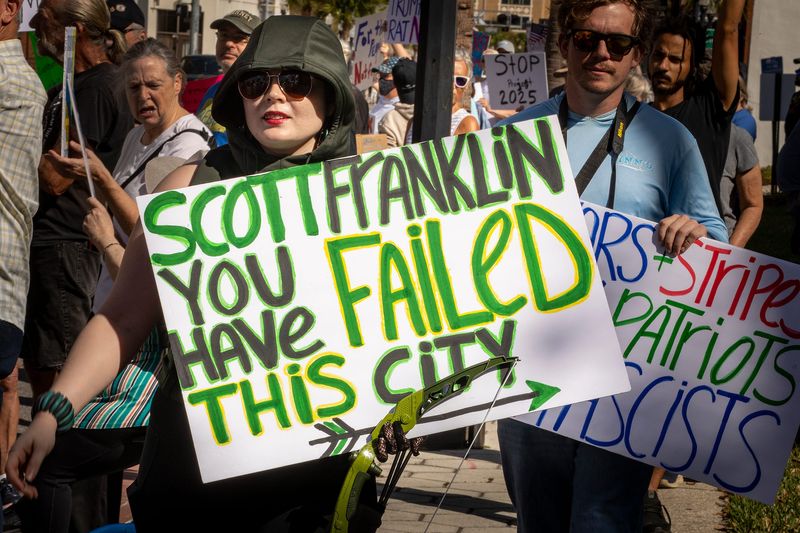
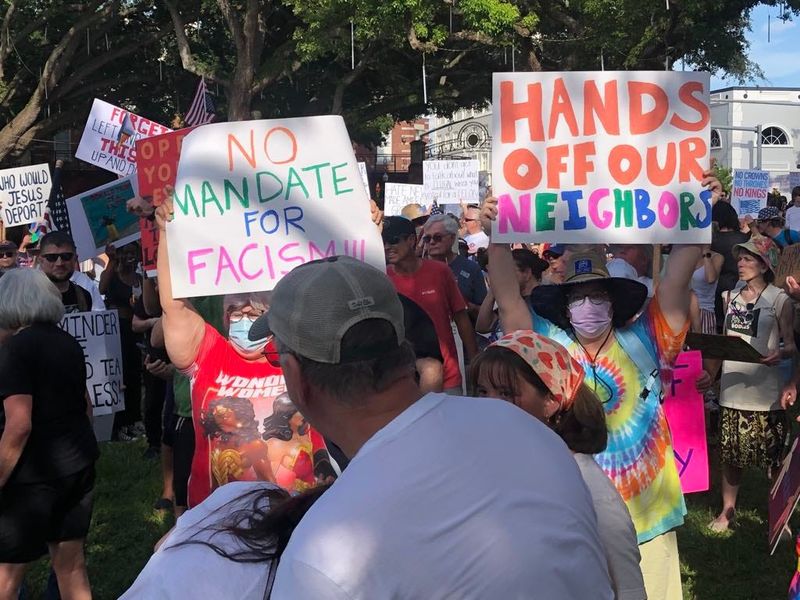
Protests and demonstrations hold an important place in American history.
Starting with the Boston Tea Party during the American Revolution and continuing through the civil rights movement and protests against the Vietnam War, demonstrations have sometimes stirred profound societal changes.

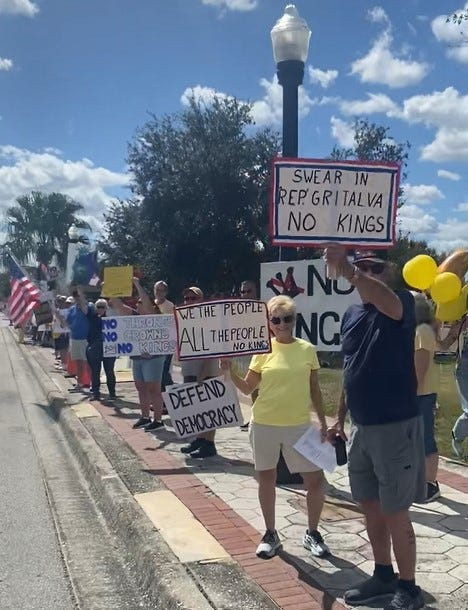
Participants in the “No Kings” rallies may see themselves as part of that tradition, given that the name derives from the language of the colonial revolution against England’s King George III.
The third round of the rallies, expressions of opposition to President Donald Trump’s policies and actions, will take place March 28 throughout the country and even in some other nations. Five rallies are planned in Polk County: two in Lakeland (Freedom Park at 2 p.m. and Lakeside Village at 5 p.m.) and others in Poinciana, Davenport and Lake Wales.
“We want people to be educated and to pay attention to what’s going on,” said Pam Taylor, a leader of Indivisible Polk, the main organizer of the Freedom Park rally. “I also find that having these rallies, where people get together that are like-minded, it really helps build morale, like — ‘We can do this.’ If you just sit in your house and just watch the news, it can get really depressing.”
The first two rounds of rallies produced the largest political gatherings seen in years. The first No Kings demonstrations took place in June 2025. The next round, in October, drew more than 7 million Americans at more than 2,700 events, according to the national No Kings organization.
Taylor said that aerial footage captured by a drone showed an estimated 3,500 people at the Oct. 18 rally in Lakeland. The Ledger estimated attendance at 2,000 in coverage of the event.
Hard to sustain movements
Numbers aside, what political effects are the No Kings rallies having?
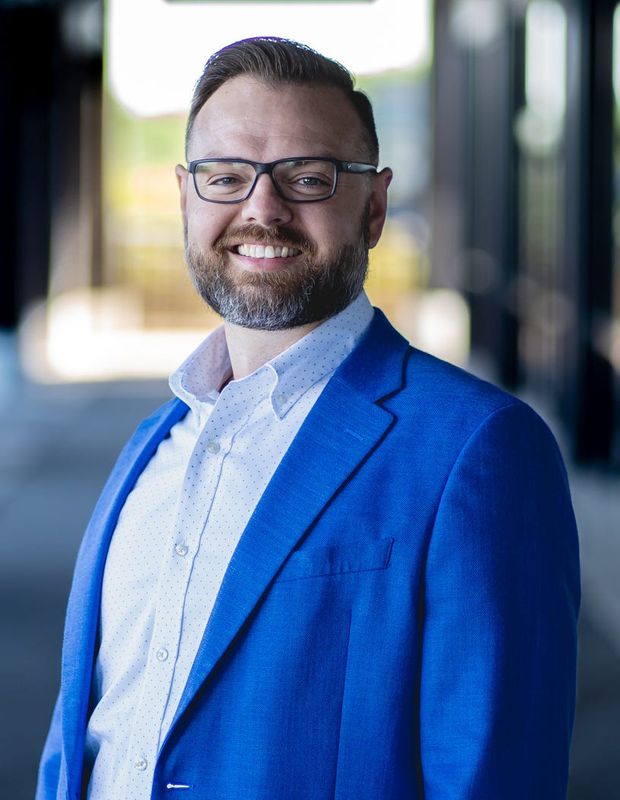
Travis Taylor, a pollster and former consultant for Republican candidates, said that the rallies have not shifted the policies of Trump and his allies, who dismiss the events as examples of “Trump Derangement Syndrome.”
Taylor, who holds a doctorate in political science, noted that Trump faced protests during his first term, from 2017 to 2021.
“The No Kings protests in his second term are really the second verse of the song that never ends,” said Taylor, who is based in Oklahoma. “It’s just a repetition of the same thing, and it’s likely going to have the same outcome.”
Historically, protest movements have succeeded not by immediately influencing political leaders but by moving public opinion, Taylor said, citing the civil rights movement. In that case, the shift made the Kennedy and Johnson administrations more open to supporting civil rights legislation.
Policy change happens through what scholars call “incrementalism,” Taylor said. He cited the anti-abortion movement, which persisted for decades, leading to the Supreme Court’s 2022 decision nullifying abortion rights at the federal level.
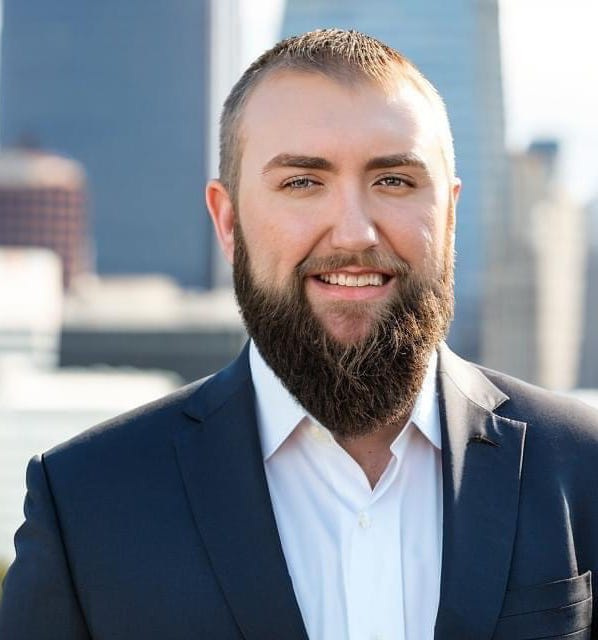
It is too soon to determine what effect the No Kings protests might have, said Darryl Paulson, a professor emeritus of government at the University of South Florida.
“It’s easy to start these protest movements,” Paulson said. “It’s not so easy to sustain them over a period of time.”
The No Kings campaign is “fundamentally different” from the civil rights movement and the Vietnam War protests, Paulson said.
“If you’re taking the civil rights movement, you had multiple leadership groups,” he said. “Everyone automatically thinks of Martin Luther King, who probably was recognized as the main leader of the civil rights movement, but you had a half a dozen major civil rights organizations, many of whom civil rights scholars would argue had as much influence, and in some (cases), greater influence, than Martin Luther King did.”
The anti-Trump movement has not produced identifiable leaders with such influence, Paulson said. The Vietnam War protests mobilized young people, many of them college students, who were motivated by the risk they faced of being sent to a distant war, he said.
GOP leader: ‘Political theater’
Though the Tea Party contingent arose in opposition to President Barack Obama’s election in 2008, that conservative movement did not produce sustained, large-scale demonstrations.
“Republicans and those on the right tend to vote more, they tend to engage in these more traditional forms of public life, whereas those on the left do tend to engage in the more non-traditional forms of civic engagement – protesting and rallies and that sort of thing,” said Taylor, the pollster. “So, I don’t think what we’re seeing is really outside of any historical norm.”
In a recent story for The New Yorker magazine, reporter Charles Duhigg analyzed the different approaches of Democrats and Republicans. Democrats are adept at mobilizing, Duhigg wrote — producing marches and raising money for national candidates — while Republicans are much more effective at organizing. He gave examples of GOP strategies, such as getting more people involved in local party organizations.
No Kings is officially a nonpartisan group, as are many of its partners, such as the ACLU, MoveOn and the Human Rights Campaign. But the organization and the rallies have a decidedly progressive orientation.
Sam Romain, chairman of the Polk County Republican Executive Committee, dismissed the No Kings rallies as “political theater.” He said participants seek attention rather than answers.
“They are not serious civic engagement, nor are they focused on solving actual problems for the people of Polk County,” Romain said by email. “They exist to generate noise, create imagery and feed a media narrative.”
He added: “What is especially dishonest is how these events are marketed as spontaneous grassroots activism when they so often bear the hallmarks of national activist infrastructure, institutional backing and big-money support. That is not authentic local organizing. It is manufactured outrage packaged as public virtue.”
The national No Kings organization is a nonprofit, as are most of its partner groups. The Polk County rallies are organized by local residents, who are not paid.
Pushing for a critical mass
Juanita Zwaryczuk is a leader with Indivisible on the Ridge, which has planned a No Kings rally for March 28 from 10 a.m. to noon in front of the Eagle Ridge Mall in Lake Wales.
“We wanted to do it in Lake Wales because we have never had a No Kings rally right in Lake Wales,” Zwaryczuk said. “Our Indivisible on the Ridge has hosted some protests for different things, but this particular protest, because it gets such a lot of media attention, we really feel like the people in Lake Wales might feel like there’s nobody here that feels the way that they do.”
Zwaryczuk, 76, recalled protesting against the planned Shoreham Nuclear Power Plant on Long Island, New York, in 1979, carrying her young son on her back. Amid local fierce opposition, the plant was eventually closed.
Zwaryczuk cited a political science theory stating that when 3.5% of a country’s population joins nonviolent protests against an authoritarian government, the leadership is likely to lose power. She and many other No Kings participants believe that Trump has moved the United States toward autocracy.
That proportion of the country’s population would be about 12 million — or about 9.2 million, based on the voting age population.
“We’re getting close to that number, and so one of the things we hope to accomplish is to get the most people possible out there so that it will be very obvious to those in charge,” Zwaryczuk said. “So, we’re hoping that the bigger we are, of course, the more they’ll pay attention, because we need our representatives, our senators, to stand up, to get some courage and say no to this wannabe dictator.”
Zwaryczuk responded to conservatives who dismiss the No Kings rallies as meaningless social gatherings.
“Well, I would say that they might want to listen, because this is not just a feel-good effort,” she said. “This is a patriotic effort, and people on the right, I know, also love our country, and yet it seems like they don’t recognize that people on the left love the country as well, and we’re concerned that the way things are going, we won’t be able to even have a discussion about it anymore.”
Hoping to spur more activism
Magdalene DuPree of Lakeland formed a small organization, Defund Oligarchy, Blessed by Liberty, in February 2025. The group later registered as a chapter of Indivisible.
DuPree has been a prominent figure at local protests, including the previous No Kings rallies. Her organization began holding weekly demonstrations at Lakeside Village in Lakeland against Avelo Airlines over its deportation flights for U.S. Immigration and Customs Enforcement.
After Avelo halted those flights, DuPree’s group changed the focus of the weekly demonstrations to the 287(g) program, under which local law-enforcement agencies assist ICE in enforcement efforts.
“So, the biggest thing is visibility, especially in this area,” DuPree said. “There are so many people that I have met that felt like they were the only ones that were questioning what’s going on, or they felt like they didn’t have anybody to talk to. And so having that visibility out there, seeing other people carrying messages, that provokes a lot of conversation among Polk County residents.”
DuPree said that she hopes protests, whether No Kings rallies or smaller events, are just the beginning of activism for many who show up.
“It does make more people feel more comfortable bringing up and talking about their concerns, and it also helps, I hope, get them fired up to contact their representatives and go through with making a phone call, sending an email, going to a commission meeting, because just going to a demonstration for one day doesn’t solve anything,” she said. “But if you can get to that demonstration and you feel informed, or you feel like you’re able to connect with your community and connect with other people and get information that could help you research or put you in the right direction — that’s what I hope.”
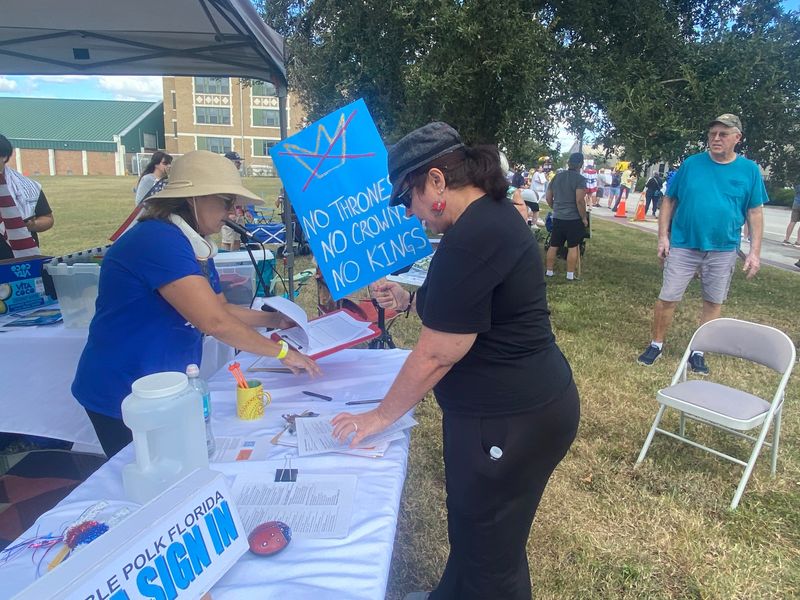
DuPree’s group, Defund Oligarchy, Blessed by Liberty, gives out pamphlets and information to anyone who stops by one of their demonstrations. She likened the protest to an orientation, saying that newcomers are given homework geared toward continuing activism.
Along with joining the No Kings protests, DuPree said her organization has its own platform, emphasizing local issues and environmental justice. The group also has a homeless outreach program, she said.
Could rallies sway midterms?
Even participants in No Kings rallies probably do not expect the protests to influence Trump’s policies, as he has dismissed the events as a “joke” and “very ineffective.” The continuing protests might seem more geared toward swaying the November midterm elections.
Republicans hold slim majorities in both the U.S. House and Senate. A switch to Democratic majorities would limit Trump’s ability to push legislation through Congress.
“Policy change comes about through electoral replacement,” said Travis Taylor, the pollster. “So, Donald Trump, as I said, faced substantial and ongoing protests during his first term in office, and none of those protests changed his approach to policy. It took the election of Joe Biden for policy to shift.”
The president’s party historically loses U.S. House seats in midterm elections, Taylor noted.
“And if we see these protests lead to that electoral replacement in the House of Representatives, then you might see a slowdown and maybe even a screeching halt of the Trump agenda,” he said.
DuPree said the protest movement that began in 2025 sought to showcase opposition to Trump’s policies.
“I think when they originally started, it was not geared toward the midterm elections, because I don’t think people expected this to go on this long,” DuPree said. “I think now, definitely this No Kings — and if there’s another, a fourth No Kings — then yes, I do foresee it being galvanized by the upcoming midterms because that normally is a low-turnout (election) compared to presidential years.”
DuPree said she thinks national protests have yielded some changes. She pointed to Trump’s removal of Kristi Noem as head of the Department of Homeland Security. Trump moved Noem to a new position, special envoy for the Shield of the Americas, after federal officers killed two American citizens in disputed circumstances during a mass deployment to Minnesota.
Avelo’s decision to stop operating deportation flights also followed sustained protests, DuPree noted.
Pam Taylor of Indivisible Polk acknowledged that she has not seen any change in voting or stances from Polk County’s Republican members of Congress — Rep. Scott Franklin of Lakeland, Rep. Laurel Lee of Tampa and Rep. Daniel Webster of Clermont.
Are the rallies having any political impact?
“That is really hard to say,” Taylor said. “I don’t think it’s had a lot of effect, but I think maybe some of the representatives are starting to pay more attention that what’s going on is not what the people want. So, I think some of them are paying a little more attention because all these people going out and protesting doesn’t mean that everyone’s super happy.”
Zwaryczuk said she sees evidence that the anti-Trump movement is taking hold.
“More and more people are coming forward who’ve had enough, and some of them are leaving MAGA,” she said. “We don’t all agree on everything, but we do agree that we value our democracy and we don’t want it to be destroyed. Now, we can talk about the little things later on, but right now, this is the important thing, to save our democracy, because it’s under severe attack.”
Gary White can be reached at gary.white@theledger.com or 863-802-7518. Follow on X @garywhite13.
This article originally appeared on The Ledger: As ‘No Kings 3’ nears, what political impact are the protests having?
Reporting by Gary White, Lakeland Ledger / The Ledger
USA TODAY Network via Reuters Connect