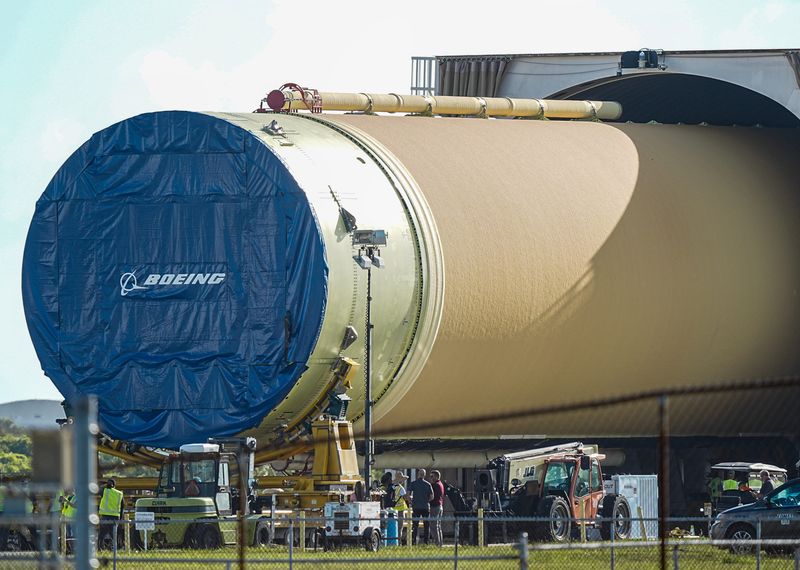
Following NASA Administrator Jared Isaacman’s promise to increase the launch cadence of NASA’s SLS moon rocket, less than a month has passed between the launch of Artemis II and the arrival at Kennedy Space Center of the core stage for the Artemis III mission.
As poor weather moved through the area, NASA’s Pegasus barge arrived at KSC Monday afternoon, carrying the massive orange core stage, which had been transported from NASA’s Michoud Assembly Facility in New Orleans, Louisiana.

Work began early Tuesday to slowly offload the core stage from Pegasus and roll it into NASA’s iconic Vehicle Assembly Building. Parts of the SLS’s solid rocket boosters are already at KSC.
But all this work is happening before the lunar landers, a key part of the Artemis III mission, are ready.
What’s next for Artemis III
The Artemis III SLS (Space Launch System) rocket will now be stacked inside the VAB ahead of a planned launch in 2027. The mission will see the Orion spacecraft dock with either the SpaceX Starship HLS or Blue Origin Mark II lunar lander in low Earth orbit before a moon landing in 2028.
Isaacman recently presented a major overhaul of the Artemis mission lineup, delaying the moon landing to Artemis IV and changing the upcoming Artemis III to a less risky test docking in low Earth orbit.
This switch is also an effort to get the SLS rocket flying more frequently. Isaacman had said the gap between the uncrewed Artemis I launch in 2022 and the crewed Artemis II launch on April 1 was too long.
“That is a very complicated rocket, five private contractors — I don’t know how many subcontractors in it — on decades old design hardware that people aren’t as familiar with,” Isaacman said during an April 2026 full committee hearing on NASA’s budget proposal. “You need muscle memory to do that.”
The program also scrapped the over-budget Boeing-built Exploration Upper Stage (EUS) as well as the moon-orbiting Lunar Gateway in favor of a future moon base.
But he kept the plan to tap private companies to provide lunar landers, with Blue Origin and SpaceX winning the contracts.
“I think that people often ask what’s different from the 1960s moon race versus the present? And there’s certainly a lot of differences, but one of which is that the taxpayers don’t have to foot the entire bill,” Isaacman said.
“You have some of the wealthiest individuals and companies in the world contributing their resources to a capability essential for American leadership in space, and, frankly, for all of humankind. And if they want to come and invest in launch infrastructure that can help enable a capability critical for national security, I welcome it.”
Ahead of Artemis III, Blue Origin and SpaceX lunar landers to be tested
While Blue Origin continues work on their uncrewed Mark I lander, it has not made its debut flight yet. Mark I will be the payload-carrying predecessor to the crewed Mark II variant tapped for Artemis.
Blue Origin’s lander will be launched on its New Glenn rocket, which just saw its third flight from Cape Canaveral, as well as its second first-stage booster landing and recovery.
That third flight did suffer an issue, as the rocket’s upper stage experienced a mishap where the AST SpaceMobile satellite it was carrying deployed in an off-nominal orbit, leading to the loss of the satellite.
Blue Origin and the FAA launched an investigation into the accident, causing fears among the space community of the upcoming Mark I lander being delayed.
Greg Autry, associate provost for space commercialization and strategy at the University of Central Florida told FLORIDA TODAY he does not consider the upper stage malfunction to be a large setback to Blue Origin.
“I think they’ll identify this issue to solve it, and you’ve got a super solid, capable rocket available for next year,” said Autry. “They’ll be able to launch their lander — if their lander is ready.”
Blue Origin’s CEO Dave Limp has been consistently posting about the testing progress being made with the first uncrewed Mark I lander, named Endurance.
SpaceX readying Starship for next launch
As for the Starship HLS (Human Landing System) lander, Autry says that timing depends on how the next Starship test flight out of Texas goes. He noted that SpaceX’s lander model is vastly different plus it is launching on the company’s massive Starship Super Heavy, which undergoes continual design changes.
“It’s a bit harder to put dates on that sort of program, because they may do a complete redesign again,” said Autry.
Since the multiple mishaps last year, Starship has made significant progress on subsequent test flights from Texas. This included functioning payload deployment from the ship and an almost intact landing of the ship as it fired its engines and hovered down over the Indian Ocean after coasting in space.
SpaceX’s design is ambitious. The aim is for full reusability of the Super Heavy booster as well as the Starship itself, catching both at launch towers. The ship itself would also need to refuel in orbit to make the flight to the moon. That refueling requires the launch of multiple Starships to carry propellant to the lander.
However, SpaceX has been taking it slow as it approaches the first flight of the redesigned Version 3 (V3).
Starship’s third major design, the Version 3 (V3), is set to see an upcoming test flight out of Starbase, Texas as soon as next month. This is also the version of Starship which will launch from Kennedy Space Center Pad 39A possibly as soon as year’s end. Launch Complex 37 in Cape Canaveral Space Force Station is also being developed for future Starship launches.
If Starship is ready in time for Artemis III, it is currently unknown if that launch would occur from Texas or Florida.
With Artemis III planned for sometime in 2027, it remains to be seen which lander, if not both, will be presented to NASA.
Brooke Edwards is a Space Reporter for Florida Today. Contact her at bedwards@floridatoday.com or on X: @brookeofstars.
This article originally appeared on Florida Today: Artemis III rocket core stage arrives at NASA’s Kennedy Space Center
Reporting by Brooke Edwards, Florida Today / Florida Today
USA TODAY Network via Reuters Connect