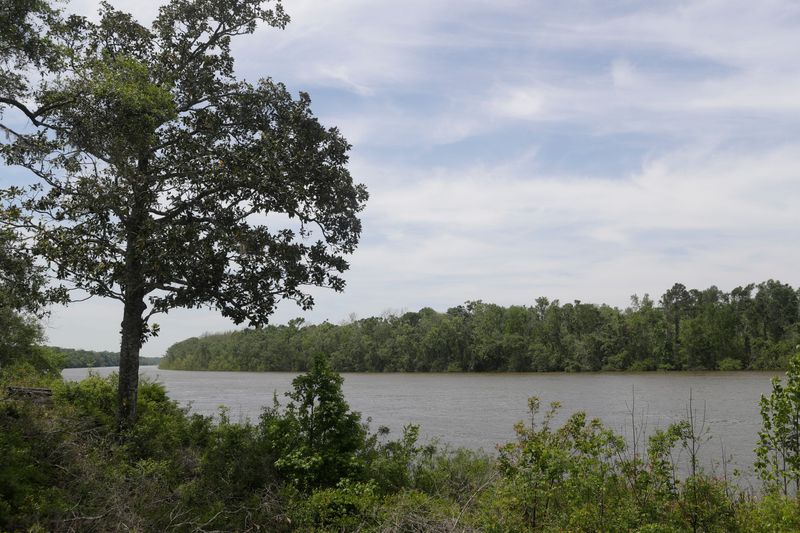
There’s been no dredging of the Apalachicola River for 20 years. The river moved its sand and sediment on its own.
During that time sloughs reopened, floodplain forests rebounded and the debate over whether the Apalachicola should be a navigable working river or a living ecosystem quietly receded among the people who lived along its banks.

But now, dredging is back on the table. For the first time, all six Florida counties through which the Apalachicola flows have formally joined forces to influence what happens next.
The U.S. Army Corps of Engineers held a public hearing March 31 in Bristol to inform residents about the potential resumption of dredging of the the river.
The Corps said it is studying how to maintain the tri-state Apalachicola-Chattahoochee-Flint River Basin, or ACF, as a working navigable waterway, something Congress authorized decades ago.
But after all the revelations of technical studies, expert opinions and public meetings, the river’s fate ultimately will be decided by the state of Florida. Without a Water Quality Certification from the Department of Environmental Protection, dredging cannot resume.
Why dredging ended
It was the Department’s denial of a permit request in 2005 that stopped the dredges and let the river begin healing. And DEP remains a switch that can turn this project on or off.
Despite $100 million in federal funding for a navigable river basin project, and engineering analyses and congressional directives, the future of navigation on the Apalachicola hinges on a permit DEP can or cannot grant.
The Corps has not yet applied for a permit.
“If an application is submitted, DEP will review the proposal to ensure it meets all applicable water quality standards as part of the state’s water quality certification process,” Alexandra Kuchta, DEP communications director said.
Meanwhile, six Florida counties along the Apalachicola River – Jackson, Calhoun, Gulf, Liberty, Gadsden, and Franklin – have all adopted resolutions calling for stricter oversight and the creation of an independent technical advisory group to assist the Corps in deciding whether to dredge.
What the counties want
Five of the county commissions adopted identical statements, calling on the Corps to work with them “to develop a balanced and forward-looking plan that supports navigation while preserving ecological integrity.”
Franklin approved a complementary resolution that includes the ecological integrity statement while also acknowledging dredging will increase the flow of fresh water into Apalachicola Bay and that will help reestablish the county’s oyster industry and create jobs.
The resolutions mark an unprecedented show of unity among the counties and signal that local governments want to be involved in the Corps’ development of an Environmental Impact Statement (EIS) that’s also needed before dredging can resume.
Florida ended dredging along the Apalachicola in 2005 when it denied the Corps a Water Quality Certification that verified a dredged Apalachicola River met state water-quality standards. DEP’s decision was rooted in the Clean Water Act, which gives states a veto-like authority over federally permitted projects that may discharge pollutants into state waters.
Calhoun County Commission Chair Darryl O’Bryan said traditional dredging is not a sustainable long-term solution for the region because it does not “fix” navigation problems but creates a permanent obligation to keep a 9-foot channel.
The Apalachicola does not have a rocky or clay bottom, but one covered by an enormous amount of sand that drains from a 19,000 square-mile river basin. That sandy bottom is inherently mobile. Sandbars shift after floods and rain events, and dredged areas routinely refill within months.
The county commissions and local residents said they seek to preserve the environmental gains made over the past 21 years and support commerce.
Balancing navigation with natural Florida
The resolutions were originally developed by the Riparian County Stakeholders Coalition, a non-governmental environmental support organization formed in 2012 and now known as the Apalachicola River Counties Alliance, or ARCA.
“Navigational dredging can either help us return the Apalachicola system to a more natural state or turn it into an industrial ditch,” Jim McClellan, the ARCA chair said.
McClellan said the coalition can bring to the table local experts who understand river hydrology, navigation requirements, ecological restoration and the needs of the communities to help the Corps develop a responsible dredging plan.
Florida is the key
Congress had authorized the ACF, which is 290 miles total of navigable waterway that connects to the Gulf Intercoastal Waterway, as a federal navigable waterway in 1945. The Corps constructed a series of dams and locks to create a 9-foot deep, 100-foot-wide navigation channel from the Gulf upstream through Florida to inland ports.
For 60 years the Apalachicola was used to transport timber, grain, and fuel to and from South Georgia and western Alabama through Florida. The Bristol meeting was part of an evaluation of whether to maintain that 9-foot-deep navigable channel.
“Public meetings provide an opportunity for all to hear directly from the individuals involved in the dredging resumption evaluation,” said James Hathorn, chief of water management for the Mobile District.
“We want to hear from individuals and communities that feel they will be impacted both positively and negatively by the action.”
Where the project stands
Corps representatives emphasized that no decisions have been made and that the process remains in its early analytical stage.
Ashley Kleinschrodt, the project’s manager, said the Corps currently was “identifying potential locations for dredging and for the disposal of the dredged material.”
The Corps expects to issue a Notice of Intent in August, which formally begins the development of an environmental impact statement. A draft EIS is scheduled for release in Spring 2027.
Supporters of dredging argue that restoring navigation could benefit military readiness, regional commerce and recreation. Critics worry that resuming dredging without fundamental changes would undo two decades of natural recovery.
Whether dredging is in the Apalachicola River’s future largely will depend on whether Florida says yes or no when the Corps seeks a Water Quality Certification – and whose vision of the river shapes that decision.
Apalachicola River dredging timeline
James Call is a member of the USA TODAY Network’s Florida Capital Bureau. He can be reached at jcall@tallahassee.com and is on X as @CallTallahassee.
This article originally appeared on Tallahassee Democrat: Apalachicola River dredging debate returns after 20 years
Reporting by James Call, USA TODAY NETWORK – Florida / Tallahassee Democrat
USA TODAY Network via Reuters Connect