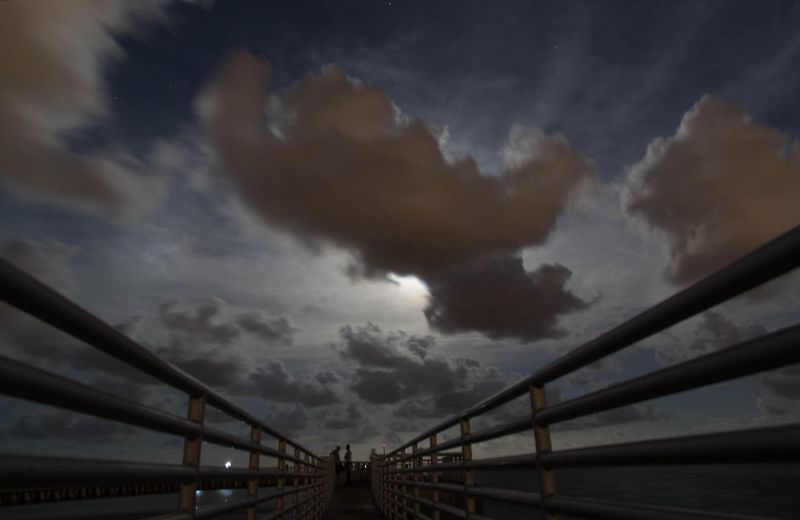
A bluish-green fireball falling to Earth at more than 71,000 mph was reported by scores of Florida residents on Monday, Feb. 2, hours after the nearly full snow moon rose above the horizon and outside of any known meteor shower.
About 75 people noted their experience seeing the fiery chunk of asteroid on the American Meteor Society’s website with sightings from Pensacola to Hollywood.

“It was an amazing experience to have, while completely unexpected,” one person wrote on the AMS fireball log, describing a “small yellow/orange poof at the end of the arc.”
Molly Wasser, media lead for NASA’s Planetary Science Division, said the fireball was seen at 9:37 p.m. and detected by two NASA meteor cameras. It was also captured by a camera on a Tesla truck.
It was first spotted at an altitude of 56 miles above a point in the Gulf due west of Bonita Springs.
“The fireball, caused by a small fragment of an asteroid moving at 71,600 miles per hour, traveled northwest for 60 miles before disintegrating 28 miles above the ocean,” Wasser wrote in an email. “At its brightest, the meteor rivaled the full moon in intensity and exhibited a bluish-green color to both observers and cameras.”
Bob Lunsford, who writes for the American Meteor Society, said in a Jan. 30 column that February is the beginning of the fireball season for the Northern Hemisphere. A fireball is defined as a meteor brighter than the planet Venus, according to the AMS.
He said in an email that the object seen Monday was not space debris because meteors usually only last a few seconds, while space debris is usually visible for a minute or two.
The spring fireball season happens during a drought in meteor showers and near the vernal equinox, which is March 20. The next major meteor shower is in April when the Lyrid shower is active between April 14-30.
But why spring is fireball season remains a mystery, said Bill Cooke, lead of NASA’s Environments Office, in a NASA blog.
“We’ve known about this phenomenon for more than 30 years,” said Cooke. “It’s not only fireballs that are affected. Meteorite falls — space rocks that actually hit the ground — are more common in spring as well.”
About 10 people in Florida also reported seeing a bright object fall to the ground near 7 p.m. Those sightings ranged from Delray Beach to Deltona.
“Out of nowhere and looked like shooting fire but fast and disappeared while going downward but no sound,” someone from Delray Beach wrote on the AMS site about the 7 p.m. sighting. “Was huge and was close.”
Wasser said there was not enough information to draw any conclusions about the 7 p.m. sighting.
Why are fireballs blue?
The color of fireballs is believed to be partly dependent on what they are made of. Certain elements display signature colors when vaporized, according to AMS. Sodium produces a bright yellow color, nickel shows as green, and magnesium as blue-white.
How fast the meteor is traveling may also play a role. Slow-moving meteors are often reported as appearing red or orange. Swift-moving meteors are frequently reported as blue.
Kimberly Miller is a journalist for the USA TODAY NETWORK FLORIDA. She covers weather, the environment and critters as the Embracing Florida reporter. If you have news tips, please send them to kmiller@pbpost.com. You can get all of Florida’s best content directly in your inbox each weekday by signing up for the free newsletter, Florida TODAY, at https://palmbeachpost.com/newsletters.
This article originally appeared on Palm Beach Post: ‘An amazing experience’: What was the bright blue-green object in Florida sky?
Reporting by Kimberly Miller, USA TODAY NETWORK – Florida / Palm Beach Post
USA TODAY Network via Reuters Connect