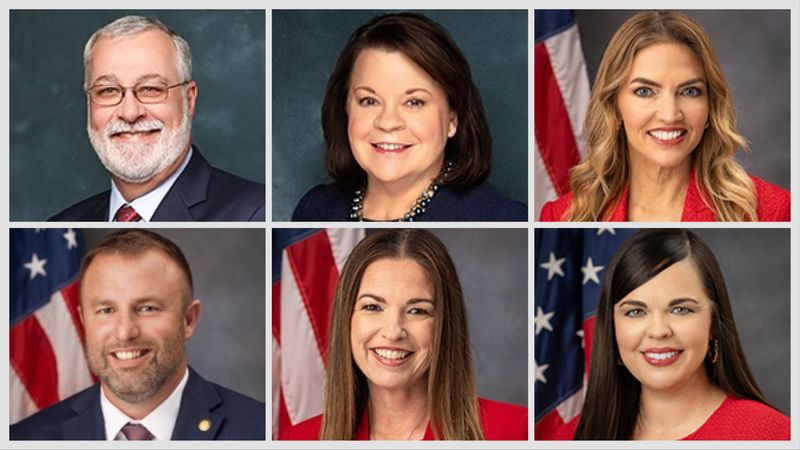
Polk County’s six members of the Florida Legislature expressed unanimous support for the revision of congressional maps outside of the traditional 10-year cycle.
In the Florida House, Rep. Jon Albert, R-Frostproof; Rep. Jennifer Canady, R-Lakeland; Rep. Hilary Holley, R-Polk City; and Rep. Jennifer Kincart Jonsson, R-Lakeland, all voted to approve the congressional district map provided by Gov. Ron DeSantis’ staff. The House adopted the map by a nearly party-line vote of 83-28.

Sen. Colleen Burton, R-Lakeland, and Senate President Ben Albritton, R-Wauchula, helped the measure pass by a vote of 21-17 in the state Senate.
DeSantis, a Republican facing terms limits, pushed the Legislature to engage in redistricting, a process that normally occurs once a decade in response to new population information from the U.S. Census. Legislatures had approved revised boundaries for U.S. House districts in 2022, but Florida joined other states in remaking maps ahead of this fall’s midterm elections.
DeSantis called a special legislative session for the purpose, and his office provided the map that is likely to increase Republican dominance among the Florida delegation. Republicans now hold 20 of Florida’s 28 U.S. House seats, and the new map is projected to boost their margin to 24-to-4.
Republicans make up 41.3% of registered voters in Florida, with Democrats composing 30.2% and others at 28.6%, according to the Florida Division of Elections.
The Ledger left voicemails or sent text messages seeking comment after the vote on April 29 to all six Polk legislators. None had responded by the afternoon of April 30. The Ledger could no find no public statements that any had made about the vote.
Florida has revised congressional maps before outside of the 10-year cycle, but that was in response to court rulings that found previously approved maps invalid.
During discussion before the House vote, the bill’s sponsor, Rep. Jenna Persons-Mulicka, R-Fort Myers, was the only Republican to speak. Several Democrats spoke in opposition to the redistricting plan. About 25 Democrats recorded official written explanations of their vote, while no Republicans did.
Are Fair Districts rules still valid?
Florida’s action follows moves toward redistricting in other states. President Donald Trump has urged Republican-controlled states to redraw their maps in hopes of increasing the number of Republicans in the U.S. House, where Republicans hold a 218-212 advantage.
Republican-led Texas adopted a new map intended to boost the party’s advantage, and Democratic-controlled California and Virginia responded by taking steps to revise their congressional districts.
Democrats in the Florida Legislature accused DeSantis of engaging in partisan gerrymandering, the drawing of boundaries for partisan gain. A map leaked to Fox News before the administration had officially transmitted it to the Legislature depicted the state’s outline color-coded by the presumed party of each future U.S. House member. The map was entirely red (for Republican), except for four blue areas.
Florida voters in 2010 passed two constitutional amendments, known as the Fair Districts Acts, that forbid the Legislature from drawing congressional maps to favor or disfavor a political party or incumbent. The amendments also prohibit devising districts that limit the ability of minorities to elect representatives of their choice.
A second tier of standards declares that districts must be contiguous, compact and, where possible, use existing political and geographical boundaries. Those standards can be superseded by the first-tier standards or federal law.
A lawyer for DeSantis said that federal law supersedes language in the 2010 Fair District amendments, making the congressional map constitutional. DeSantis cited a Supreme Court ruling, just announced the day of the legislative vote, that largely invalidates provisions of the Voting Rights Act barring racial discrimination in creating districts.
DeSantis has argued that Florida needs to revise its congressional districts because he believes the state was undercounted in the 2020 Census and has experienced rapid population growth, making the existing district boundaries obsolete. Florida, though, has endured population surges in the past and has not responded with mid-decade redistricting.
The revised map, which is likely to face legal challenges, creates electoral vulnerability for one of Polk County’s U.S. House members. It drastically revises the boundaries of District 9, the seat held by Rep. Darren Soto, D-Kissimmee.
Before redistricting, District 9 covered Osceola County, part of Orange County and a small section of eastern Polk County. Osceola County has a large Latino population, and Soto – believed to be the first Florida representative of Puerto Rican heritage – won the 2024 election with 55.1% of the vote.
The new District 9 spreads to take in all or part of Indian River, Highlands, Okeechobee and Glades counties, all heavily Republican.
Party leaders react to votes
In the absence of comments from Polk County’s legislators, The Ledger sought statements from the leaders of the county’s Democratic and Republican parties.
“Today, Trump’s loyal subjects in the Florida legislature once again failed to respect the will of the Florida voters,” John Hill, chair of the Polk County Democratic Party, said by email. “In 2010, 63% of Floridians voted to amend the state’s constitution to prevent politically and/or racially motivated redistricting. It’s hard to be the ‘Free State of Florida’ when all we are is ground zero for the MAGA Fascist agenda.”
Hill described the redistricting as an illegal act directed by President Trump.
“Thousands of citizens are shuffled into gerrymandered districts simply to ensure Republicans remain the party in power and destroy our democracy brick by brick,” he wrote.
Hill added: “Worse, the DeSantis administration justifies its desecration of self-rule by citing today’s openly racist US Supreme Court ruling. To the individuals who gave their lives, their livelihoods, and their blood, sweat and tears for a more just and perfect union ― we hang our heads in shame at the blatant lynching of our hard-fought American values.”
The six legislators from Polk branded themselves as “enemies to fairness, diversity, equality and justice,” Hill wrote.
Sam Romain, chair of the Polk County Republican Executive Committee, offered a contrasting assessment.
“People are moving to Florida because they believe in the direction of this state,” Romain said by text message. “Polk County is one of the clearest examples of that growth, with families, workers, and businesses choosing our community because they see opportunity here.”
He added: “Our congressional districts should reflect the Florida that actually exists today. I support maps that give Polk voters a stronger voice and make sure our growth, infrastructure, agriculture, energy, and working-family priorities are represented in Washington.”
Gary White can be reached at gary.white@theledger.com or 863-802-7518. Follow on X @garywhite13.
This article originally appeared on The Ledger: All 6 Polk legislators join Republican approval of congressional maps
Reporting by Gary White, Lakeland Ledger / The Ledger
USA TODAY Network via Reuters Connect