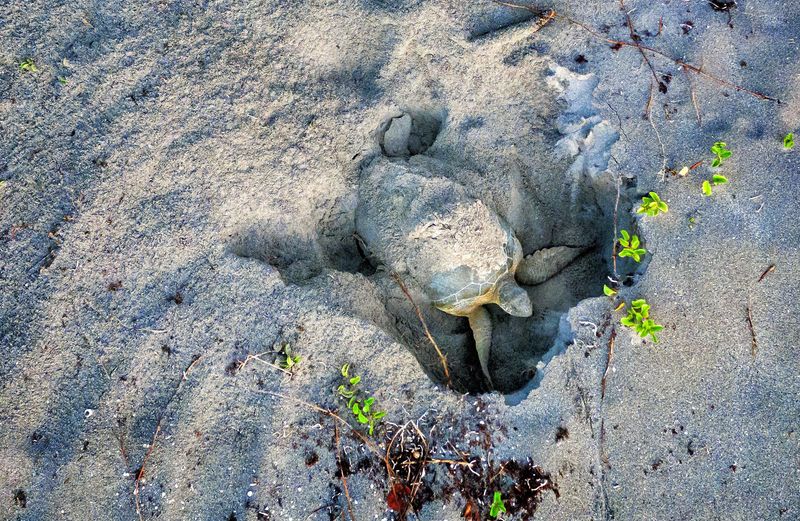
Watch your step on the beaches near Jupiter: Loggerhead Marinelife Center is predicting that 2025 will be a top-three year for sea turtle nestings.
So far this season, the nonprofit conservation center in Juno Beach has counted 9,081 nests from loggerhead sea turtles, 2,445 from green turtles and 258 from leatherbacks.

What’s more, each species is nesting earlier than they historically do in the sands from the Juno Beach Pier to the northern tip of Tequesta.
The center is seeing a trend toward earlier nesting over the years, said Justin Perrault, Loggerhead’s vice president of research. It has scientists projecting a total of 19,000 to 20,000 nests in 2025, he said.
“We’re not expecting record years for any single turtle, single turtle species. But all when you combine all three pretty decent years together, it looks like it’s going to be a pretty good year,” Perrault said.
Loggerhead counted 25,025 nests in 2023, the most since it opened in 1983. Scientists counted 14,951 in 2024.
When is turtle nesting season?
Sea turtle nesting season normally runs from March-October with the first nests usually spotted around late March.
Each year, Loggerhead staff count turtle nests on the 9.5-mile stretch of beach in Juno Beach, Jupiter and Tequesta. They usually spot thousands of loggerhead, leatherback and green sea turtles nests on the beach, with the most from loggerheads. All three species are either threatened or endangered.
What does the nesting process look like?
The nesting female comes up on the beach and digs a end chamber that is typically 2 to 3 feet deep and will lay her eggs in the sand and disguise the nest. Once under the ground, it can take about 45 to 60 days on average for those eggs to hatch in unison underneath the sand. The turtles all wiggle together in unison causing the sand to drop.
“The whole process of hatching to emergence from the sand can actually take three days or more for the turtles to actually emerge,” said Perrault.
Once the hatchlings reach the surface, it’s a mad dash to the water, avoiding holes and predators while making sure they’re crawling in the right direction.
How can you protect the sea turtles during a hatching?
People should not approach a nesting sea turtle or any hatchlings. While bystanders might want to help the sea turtles make it into the ocean, the best thing to do is to leave them be.
If they think the sea turtle needs assistance or see someone disturbing them, they can call the Florida Fish and Wildlife Conservation Commission at 1-888-404-FWCC (3922).
How can you protect the sea turtles once they are in the ocean?
“It’s important [for boaters] to go slow and be on the lookout for wildlife that might be in the water and to wear polarized sunglasses so that you can see these animals a little bit better,” said Perrault.
So if you’re going to go enjoy the beach, which we highly encourage and recommend, it’s one of the best parts of Florida, “leave no trace”. So if you’re going to the beach, make sure that you leave it as you found it. Fill in your holes, pick up your trash off the beach, knock down your sandcastles. Treat the environment with the “same respect as you would your home”. These are some of the best things that you can kind of do for sea turtles and and other marine life in general.
Francesca Abarca is a journalist at The Palm Beach Post, part of the USA TODAY Florida Network. You can reach her at fabarca@gannett.com. Help support our journalism. Subscribe today.
This article originally appeared on Palm Beach Post: A record year for sea turtles? Early nesting has Loggerhead Marinelife Center thinking big
Reporting by Francesca Abarca, Palm Beach Post / Palm Beach Post
USA TODAY Network via Reuters Connect