

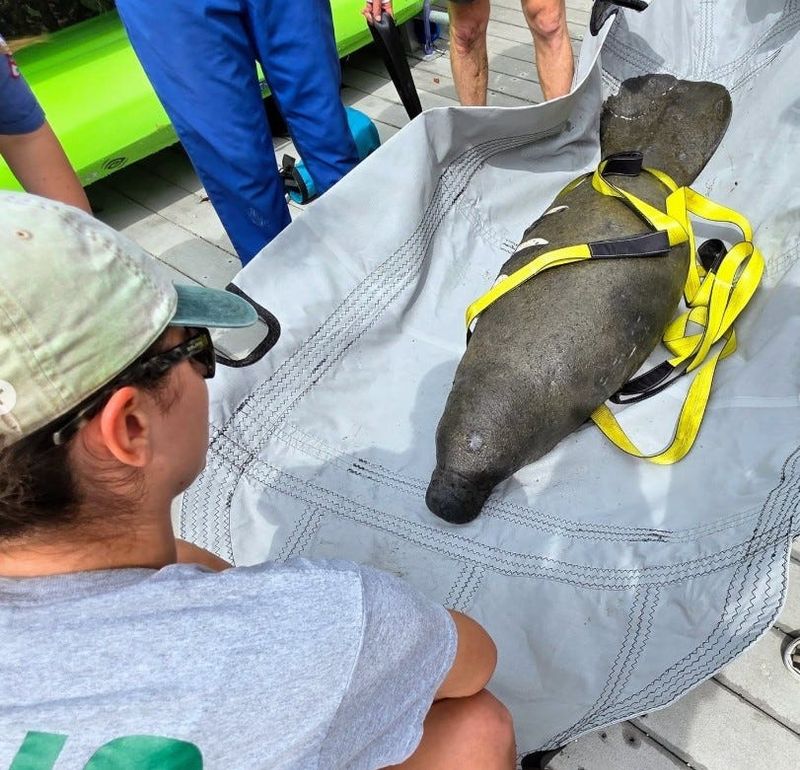
A manatee calf rescued from a St. Petersburg waterway in June had been slashed by a boat propeller and was sick with a chest infection but also suffered from a more curious injury — shark bites.
The calf, which was pulled from a brackish canal near Eckerd College, had teeth marks in a crescent shape that clearly matched that of a shark’s mouth on its tail and peduncle, where its tail attaches to its body.

And while it’s not unusual for Florida’s beloved behemoth to come in contact with one of the state’s most fearsome aquatic predators, it’s rare for a violent interaction to occur, experts said.
“I cannot think of a case where sharks initiated an attack on a healthy manatee,” said Save the Manatee Club Executive Director Patrick Rose. “I have been at this over 50 years and have seen manatees in the presence of sharks hundreds, if not thousands, of times.”
Why manatees and sharks rarely encounter each other in Florida
Lumbering and large, manatees have no natural predator. But they can encounter sharks where freshwater canals mix with ocean water on an incoming tide or even off the coast in full saltwater where manatees can also wander.
If it’s brackish water, the shark could be a more temperamental bull shark, which can tolerate some freshwater, Rose said.
Also, sharks may follow manatees for a meal, but the manatee itself is not on the menu.
Instead, sharks trail the federally threatened marine mammal to snag fish that move out of the manatee’s path or that are flushed out when it’s snacking on seagrass and freshwater plants.
“Generally, almost always, there is some underlying issue whether the manatee was struck by a boat, or had a wound and the shark took a bite,” Rose said. “In some cases the manatee is dead before they were bitten but even that is not very common.”
When was the first recorded shark attack on a manatee?
In 2001, researchers at the Interamerican University of Puerto Rico, wrote a paper about what they said was the first shark attack on a live West Indian manatee. The Florida manatee is a subspecies of the West Indian manatee.
The researchers in Puerto Rico believe the culprit was a tiger shark and noted that before their paper, there was no recorded evidence of shark attacks on live manatees in Florida or the Caribbean even though their habitats overlap.
“Tiger sharks ambush their prey, and given the location of the wound, the shark probably snuck up on the manatee, tried to take a large, massive bite, but was unsuccessful,” the paper said. “Sharks and crocodiles also share habitat with the Wesst African manatee, but no records exist about natural predation.”
American alligators also live peacefully with manatees. The Save the Manatee Club calls them “Florida’s odd couple” for coexisting without acting as prey or predator. Videos by the club show gators and manatees snout to snout in freshwater springs and hanging out casually in estuaries.
The calf rescued in St. Petersburg in June was taken by Zoo Tampa for rehabilitation but ultimately was euthanized about two weeks later.
Zoo Tampa Director of Communications Sandra Morrison said the 195-pound calf’s most serious injuries weren’t immediately obvious.
“Although the watercraft wounds and shark bites were significant, veterinarians grew increasingly concerned after observing its behavior during rehabilitation,” Morrison said. “He would take a quick sip of air and then sink to the bottom, even in shallow water.”
X-rays and other exams found a severe infection inside the manatee’s chest, which can spread through traumatic wounds and fill the chest with infected fluid. That makes it increasingly difficult for the manatee’s lungs to expand.
“Our manatee and veterinary teams explored every reasonable option before concluding the calf could not recover,” Morrison said. “Eventually, the infection progressed to the point that the veterinary team determined that euthanasia was the most humane course.”
Manatees downgraded from endangered to threatened in 2017
Florida Fish and Wildlife Conservation Commission officials estimate about 8,350 Florida manatees live in state waterways, according to its website. They were downlisted in 2017 from endangered to threatened under the Endangered Species Act.
While boat strikes are a regular menace to manatee health, in recent years they have also suffered from starvation when seagrasses in the Indian River Lagoon were wiped out by algae blooms, and from cold stress during winter’s chilliest days.
Through July, 419 manatees have been recorded dead in Florida, including 75 killed by boats and 39 by cold stress.
Rose fears a change this year to the Endangered Species Act that excludes the consideration of habitat when determining whether something, such as development, will harm a species will severely hurt manatees and other Florida natives.
“That has far reaching consequences and will put many species literally on the brink of extinction before you could take serious action,” Rose said. “We are hoping we can overturn that.”
If you see an injured, distressed, or an abandoned calf call the FWC Wildlife Alert Hotline at 888-404-3922.
Kimberly Miller is a journalist for the USA TODAY NETWORK FLORIDA. She covers weather, the environment and critters as the Embracing Florida reporter. If you have news tips, please send them to kmiller@pbpost.com. You can get all of Florida’s best content directly in your inbox each weekday by signing up for the free newsletter, Florida TODAY, at palmbeachpost.com/newsletters.
This article originally appeared on Palm Beach Post: A dying Florida manatee carried clues to a rare and violent encounter
Reporting by Kimberly Miller, USA TODAY NETWORK – Florida / Palm Beach Post
USA TODAY Network via Reuters Connect
By Kimberly Miller, USA TODAY NETWORK – Florida | USA TODAY Network
