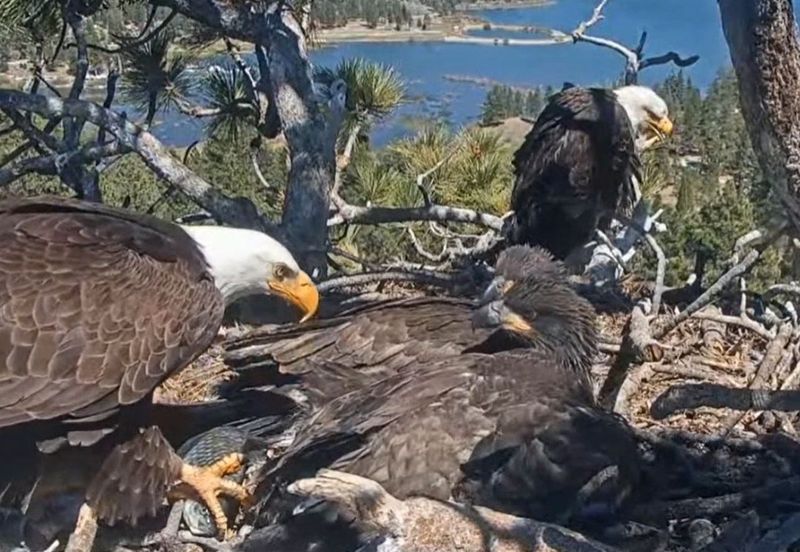
Eagle-eyed fans across the the world have watched Big Bear’s famed bald eaglets grow since they hatched in early March.
But as the chicks have grown to nearly the size of their parents, curious viewers of the Friends of Big Bear Valley Eagle Nest Cam, which documents the nest 24-hours a day via a solar-powered webcam, a common question has emerged: When will the chicks develop their iconic white heads?

Unlike their mother, Jackie, and father, Shadow, chicks Sunny and Gizmo have primarily black heads, matching the color of the rest of their bodies.
At what age to bald eagles’ heads turn white?
It can take up to five years for bald eagle chicks to develop the iconic white coloring on their heads.
“At around 5, they take on their mature coloration — black body, full white head and tail,” according to FOBBV.
“Adults are dark brown with a pure white head and tail,” according to the California Department of Fish & Wildlife. “Younger birds are mostly brown, mottled with varying amounts of white. They acquire their adult plumage at 4 or 5 years of age.”
How long do bald eagles live?
Many of those who have watched the eaglets grow have been astonished by how quickly they’ve progressed.
After Sunny and Gizmo hatched on March 5 and March 8, respectively, they have ballooned to well over 10 pounds, thanks to a steady supply of fish and other food supplied by their parents.
But they still have a long way to to go.
In general, bald eagles tend to live between 15 to 20 years in the wild, according to the U.S. Fish & Wildlife Service. In captivity, the can live even longer.
When will the chicks leave the nest?
The eaglets have been seen stretching and flapping their wings in recent weeks in anticipation of their first flights.
They generally take their first flights at 11 or 12 weeks of age, according to CDFW. Sunny and Gizmo’s first airborne adventures away from their nest, perched 145 feet up in a Jeffrey Pine near Big Bear Lake, could be only weeks away.
Eaglets tend to stay close to the next for several weeks, or even months, as they refine the art of flying and learn hunting skills from their parents, experts said.
After that, the young apex predators will be off to establish their own territories, potentially hundreds of miles away from their birth nests.
“In these post-nesting dispersal areas, the young birds join other bald eagles to feed on salmon and other plentiful food,” according to a CDFW statement. “Telemetry studies show that some of these young birds reach northern and western Canada before returning to California a few months later.”
Young bald eagle most often set up their new homes near reservoirs and lakes.
More information on the Big Bear bald eagles is available on Friends of Big Bear Valley website at friendsofbigbearvalley.org. The Eagle Nest Live Came can be viewed online via YouTube.
This article originally appeared on Victorville Daily Press: When will the Big Bear bald eaglets get their iconic white heads, leave the nest?
Reporting by Brian Day, Victorville Daily Press / Victorville Daily Press
USA TODAY Network via Reuters Connect