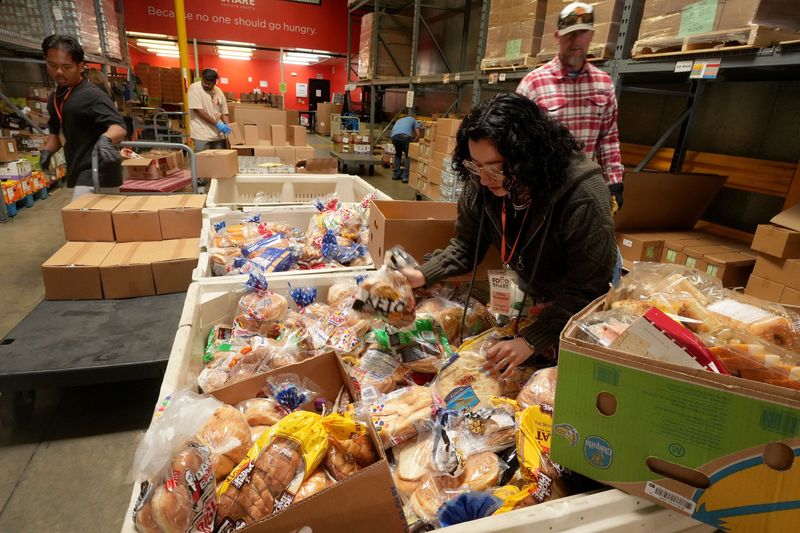
Ventura County’s regional food bank expects demand to spike based on severe cuts to federally funded food assistance and other programs.
The recently approved federal budget includes sweeping changes to the Supplemental Nutrition Assistance Program, or SNAP, which helps people afford groceries, officials said. The California Association of Food Banks described the cuts as the most severe in the program’s history, ones that would make it harder for millions to access food.

Locally, Food Share and nearly 200 local pantries have long provided a safety net to fill any gaps, said Monica White, president and CEO of the Oxnard-based nonprofit. Now, those gaps are expected to widen.
“This one hit us hard,” White said.
Whether people counted on SNAP, known as CalFresh in California, or Medicaid, the federal changes mean people will have fewer resources and smaller family budgets, officials said.
“We expect they will come to get support from us,” White said. “But that will put even more pressure on the food bank to find more food to serve more people.”
The increases would be on top of jumps that came during the COVID pandemic. Food Share reported a more than 170% increase in the number of food recipients since 2019.
Last year, around 253,000 people received food at a local pantry or distribution site, according to the organization. Most did so three or fewer times a year, according to White.
That figure may change, with more needing assistance or requiring help more often, she said.
Need skyrockets during COVID pandemic
There are still a lot of unknowns, White said. But filling gaps left by the budget cuts likely would mean purchasing more food.
Food Share relies on various funding streams and programs, from private donations to government funds. Annually, the organization purchases about 20% or $2 million worth of the food that it distributes.
That money pays for regularly needed items from peanut butter to beans as well as special programs for students, farmworkers and others, according to White.
Several years ago, when numbers skyrocketed at the height of the COVID pandemic and shutdowns, the organization and local pantries distributed roughly 26 million pounds of food. That’s 5 million more than it did last year, according to White.
“We needed more food and were able to secure more dollars,” she said.
At the time, the additional funding came from county government, community members, foundations and grants, she said. Whether similar sources would be available now is unclear. White said she is “incredibly concerned” about the situation.
“Here we are again facing yet another unprecedented turn of events,” she said.
Feds cancel food shipments
Nearly 200 pantries countywide receive food for free from Food Share, which also has its own distributions. Kay Wilson-Bolton, chief financial officer of the Spirit of Santa Paula, said there’s no question more food will be needed locally.
“There’s going to be a shortfall,” she said. “It is turning into a crisis.”
Around 25%, or 5 million pounds, of Food Share’s food comes from the U.S. Department of Agriculture. The items come via a variety of programs, some of which had their own cuts earlier this year, according to White.
Among them, the USDA canceled several truckloads of milk, cheese, chicken, pork chops and eggs for Food Share as well as others nationwide. Locally, the food cost more than $500,000 to replace, White said.
For more information about the organization or to find food distribution sites, visit foodshare.com.
Cheri Carlson covers the environment and county government for the Ventura County Star. Reach her at cheri.carlson@vcstar.com or 805-437-0260.
This article originally appeared on Ventura County Star: ‘This one hit us hard’: County’s food bank braces for demand as feds cut SNAP, Medicaid
Reporting by Cheri Carlson, Ventura County Star / Ventura County Star
USA TODAY Network via Reuters Connect