Just as plane trees populate Hausmann’s Paris boulevards; cypress dot the winding borders of Tuscan roads; Berlin’s grandest promenade Unter den Linden, literally under the linden trees, proceeds towards the city center; and London features flanks of chestnut and lime trees along its charming lanes, the defining tree in Palm Springs is the Washingtonia filifera, the fan palm.
It is central to the Coachella Valley’s history. While the word is often over-used, these palms are truly iconic. Washingtonia filifera is the only palm native to California, and its two largest naturally occurring oases stand in Andreas and Palm Canyon, the largest undisturbed palm oasis on Earth.

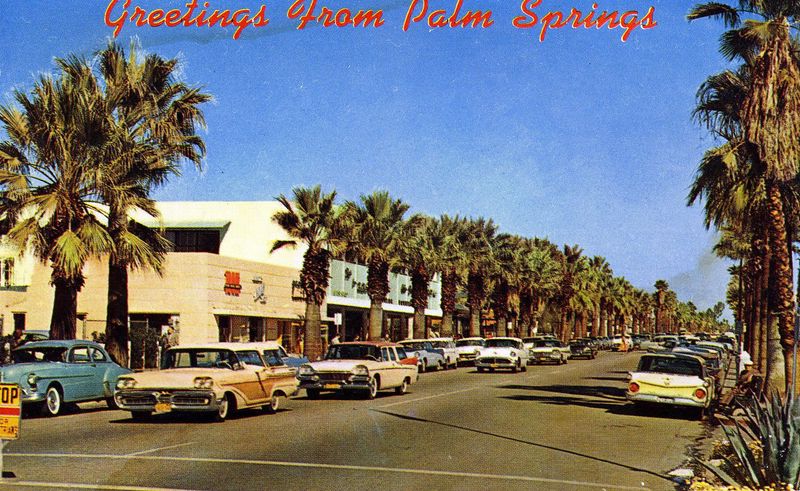
So, it was quite natural to choose to line Palm Canyon Drive, the principal street of the city, with an allée of Washingtonia filifera to define its entrance and to mark Palm Springs as a place like no other.
Historian Steven Keylon illuminates this distinctive civic feature in a nomination prepared for the Palm Springs Preservation Foundation. It may be found on their website, pspreservationfoundation.org and details the history of this character-defining feature of the town and the thoughtful, purposeful intention of planting these particular trees in this specific arrangement. Given the current debate about how to maintain this tremendous gift from the city’s forefathers, the history is instructive.
“An allée is a double row of trees planted at fixed intervals along both sides of a road or walk, close enough and even enough that the two rows stop reading as trees and start reading as one thing: a corridor with a beginning, a length, and an end. The word is French and the form began in the garden — the long green corridors of Renaissance and Baroque estates — before seventeenth-century designers carried it past the garden wall and into the town.”
“Three things separate an allée from a street that happens to have trees on it. The trees are of the same or similar species and scale. They stand on both sides, facing each other across the space. And they are set on a stated interval, so the eye reads rhythm rather than accident. Palm Canyon Drive has all three ….”
Keylon summarizes, “The Palm Canyon Drive Palm Allée is a designed, engineered, authored, dedicated, and illuminated civic landscape, conceived and built beginning in 1949 as the centerpiece of a voter-ratified municipal beautification program, and the design extended in later campaigns through about 1963, with later planting continuing beyond it. It is significant as a historic designed landscape — a planted allée executed to a written specification and species schedule, advertised for bids and, when none came, built by the city’s own day labor under a supervising nurseryman, and wired as it was planted for a lighting scheme installed the following year — and for its association with the postwar civic beautification of Palm Springs and with Councilwoman Ruth Hardy, the first woman on the Palm Springs City Council and the driving figure of the project. The allée gave the resort its signature approach and remains the defining feature of its main street.”
The double-row rhythm created by the procession of stately palms creates the character of the drive into town, and points toward the Palm Canyon itself, the very reason for the eponymous village of Palm Springs.
The planting deliberately alternates between the filifera, with its stout trunk and full, dried-frond skirt, and the taller, slimmer Mexican fan palm, Washingtonia robusta. Keylon details the addition of the robusta and its specific, fascinating history, and that may also be found in the nomination.
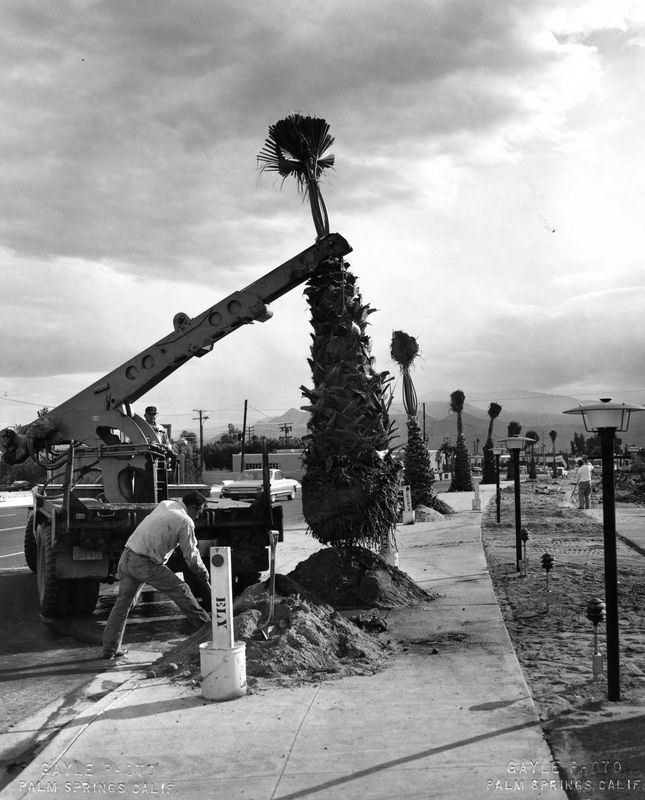
During the first 1949 campaign, the trees were set about 35 feet on center, at heights running from roughly 12 to 35 feet and averaging near 20, and planted in near-equal numbers of 154 filifera and 155 robusta, 309 trees total. It was a major civic undertaking and a milestone in the development of Palm Springs itself.
A commemorative plaque set in a stone base at the foot of three palms at Andreas and Palm Canyon, dedicating the mile of palms to the pioneer nurseryman Clarence C. Neel, who had died that spring leaving his son Earl to finish the project he had championed, anchored the composition at its ceremonial center.
The whole was purpose-built and publicly owned. The city council found 62 large palms, most of them filifera, already standing between Ramon and Alejo, a 1938 view was “just telephone poles and parked jalopies on the only paved street in town.” The 1949 work regularized a line and brought the older trees onto the same water and light system as the new.
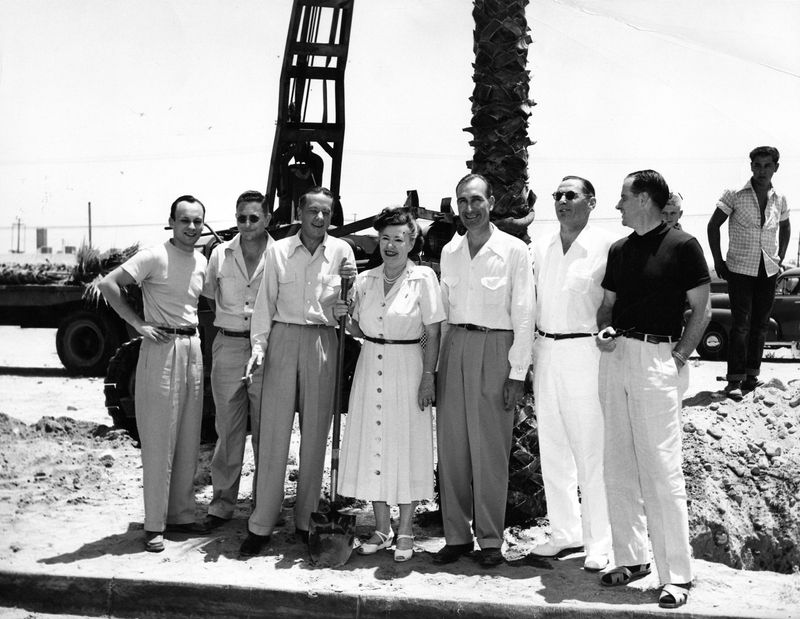
The first palm, a robusta, the “No. 1 Tree,” was planted one Monday morning in late June at the southeast corner of Ramon Road and Palm Canyon Drive, with the park board, the planning commission, and a crowd of civic leaders attending the momentous occasion. The Desert Sun noted, that when finished the project “will change the entire appearance of Palm Springs’ main thoroughfare.”
The planting then ran north from Ramon toward Baristo, with an individual water outlet and a light conduit brought to each tree in the line.
The planting sped along all summer and on Saturday, Oct. 1, 1949, the completed mile was dedicated and timed to the ceremonial opening of the winter season, such that the trees became the town’s public face for the year ahead and every year since.
A “Blessing of the Trees,” was staged in what the paper called an old Spanish custom. Nearly every downtown merchant dressed a window for the occasion; a platform went up at the southeast corner of Andreas and Palm Canyon. The advance notices set out the program: the clergy and the city officials gathering at the stand at five o’clock, Mayor Charles Farrell pulling a ribbon strung from the speakers’ stand to the crowns of the palms, the lights flashing on the fronds, and the lights burning all night. The paper credited Ben Shearer, head of the park board, “with pushing the tree-planting idea to fulfillment,” and Councilwoman Ruth Hardy as in charge “of the official work on the planting program.” Muriel Fulton and Stewart Williams spoke about the importance of civic beautification by trees.
Keylon also recounts the history of the debate about maintaining the distinctive palm-frond skirts on the filiferas. In 1981, a resident deplored the stripping of palms to look “like plucked chickens” as “an aesthetic crime.” Another argued that the untrimmed palms harbored vermin and should be cut yearly.
The consciousness of history that created the allée was considered. The result was the city’s first written policy which recognized the skirts as enhancing the palms’ distinctive appearance. Again in 2009, the city reaffirmed its policy of keeping the skirts in their natural condition, marking Palm Springs and these trees as special. The trees appear on the city seal with their full, characteristic skirts.
In July 2026, the city council took up the issue and decided to reverse the long-held philosophy.
Tracy Conrad is president of the Palm Springs Historical Society. The Thanks for the Memories column appears Sundays in The Desert Sun. Write to her at pshstracy@gmail.com.
This article originally appeared on Palm Springs Desert Sun: The history and planting of Palm Springs’ iconic palm trees
Reporting by Tracy Conrad, Special to The Desert Sun / Palm Springs Desert Sun
USA TODAY Network via Reuters Connect
By Tracy Conrad, Special to The Desert Sun | USA TODAY Network