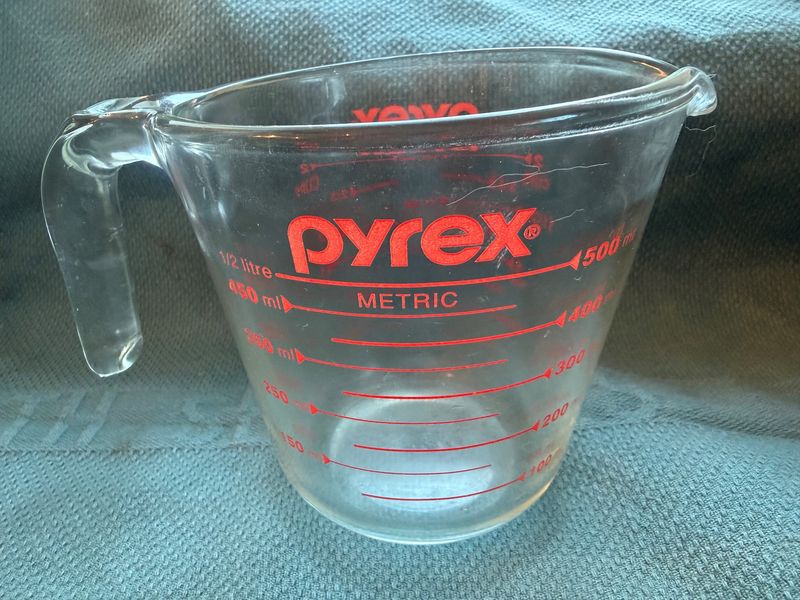
So, here I am at oh-dark-thirty today, blearily making coffee and wondering what I’m going to write about this morning. All this sun has baked my brain into something resembling a bran muffin, so there are very few original thoughts coming my way these days. As I’m pouring the boiling water into my press coffee maker, barely managing to avoid scalding myself, I looked down at the Pyrex container and a dim-light bulb went off. Pyrex! People collect Pyrex, right? They certainly do, and thus a new column was born.
As it turns out — and as I desperately hoped — Pyrex is interesting stuff. It was something of an accidental discovery made in 1915 by the spouse of a Corning scientist. The original breakthrough actually came about seven years earlier with the invention of Nonex, a special borosilicate glass used to make railroad lanterns. Anyway, when said spouse was doing some baking and needed a container resistant to heat, she wound up using an ersatz bowl made of Nonex. The result was a pretty good sponge cake and the beginnings of a new product line for Corning.

After a bit of tweaking, Pyrex was introduced two years later to great fanfare and success. At the time, soda-lime glass was the universal standard and used for nearly everything. It was cheap to make and worked well for products like bottles and windows, but soda-lime glass has a low threshold of thermal shock and shatters into a million pieces when broken. With the addition of boron trioxide, Pyrex glass can withstand a substantially greater range of heat and when distressed will snap into large pieces rather than shatter.
So, with the exhortation “Bake in Glass: Swift, Clean, Economical!”, Pyrex was introduced to the masses, and Corning was in the cookware business. The name came from an errant combination of “pie” (an early anticipated use) and Nonex. Product followed product: first a 12-piece line, then the famous measuring cups and after that many other variations on the theme. The iconic red markings on the measuring cups were added in the 1940s, and a 1980s modification of the handle allowed for stacking. If you know your way around a kitchen, you almost certainly have a stack of Pyrex put away somewhere. More than 80% of American households do.
Today there are collectors aplenty of Pyrex and especially so because of the product’s utility. There aren’t many collectibles that still deliver the prospect of everyday use. Special patterns and prototypes are particularly sought by enthusiasts, and some have reached four-figure price points. Interestingly, the invention of tempered soda-lime glass in the 1950s prompted Corning to reconfigure its Pyrex line, but borosilicate examples were recently reintroduced and remain in demand. And if this column prompts you to do a little baking, save a piece or two for us.
Mike Rivkin is the former proprietor of Antique Galleries of Palm Springs. His new venture will open later this fall. Contact him at scmcorp@sbcglobal.net.
This article originally appeared on Palm Springs Desert Sun: Pyrex is not just for bakers
Reporting by Mike Rivkin, Special to The Desert Sun / Palm Springs Desert Sun
USA TODAY Network via Reuters Connect
By Mike Rivkin, Special to The Desert Sun | USA TODAY Network