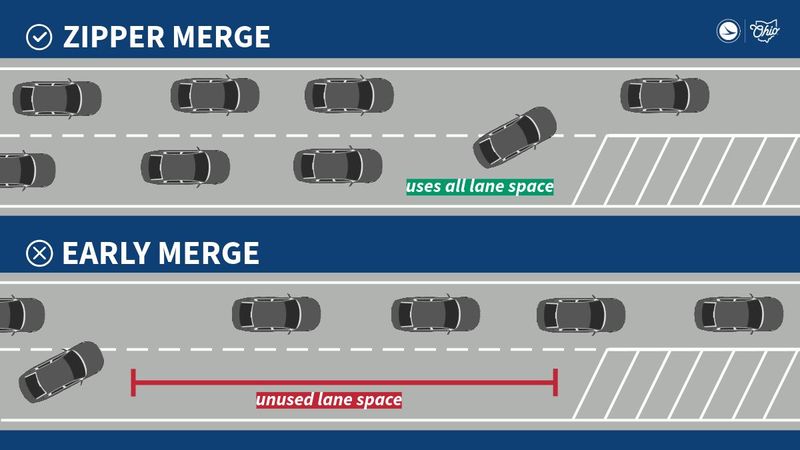
California drivers are well accustomed to rush-hour standstills and stop-and-go congestion. Why, then, isn’t the zipper merge utilized as a traffic tool to speed things up?
Zipper merging means switching lanes late. Some drivers view this last-minute approach as “inconsiderate and possibly rude driving behavior,” according to AAA.

While unfair to some, zipper merging is the most efficient way through many of California’s road construction chokepoints and improves traffic flow more than when vehicles form a single line early, USA Today reports.
Departments of transportation in other states recommend this move as an efficient way to control traffic, like in Wisconsin.
“The zipper merge allows for everyone to move at the same rate, minimizing delays for all,” the DOT website says. The driving technique can also reduce traffic backups by up to 40%, according to the DOT.
California drivers and various news outlets have long debated the benefits of zipper merging to mitigate traffic on California’s most congested freeways. Caltrans and the California Highway Patrol have not yet launched campaigns to promote zipper merging statewide.
When should I use the zipper merge?
The zipper merge is most effectively used in construction zones where a normally open lane is closed, and traffic is backed up.
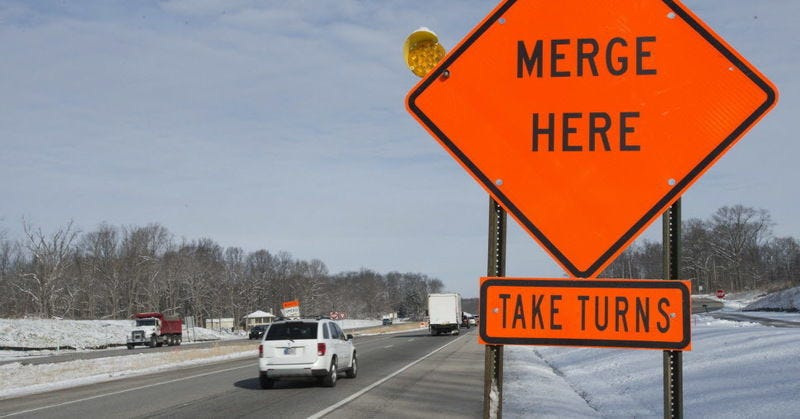
Construction zones typically have lane-closed signs in place well before a lane ends. The key to a zipper merge is to keep going in that closed lane until you are prompted to merge.
The zipper merge is not meant for situations in which traffic is moving at highway speeds. In that situation, it makes more sense to safely merge when you’re able if there are no traffic backups.
Is the zipper merge safe?
Zipper merging is safe if using the proper signals.
When your vehicle reaches the end of a closed lane, signal to merge. The merging drivers should take turns with the other drivers to merge into a single lane. That alternating pattern is what gives zipper merging its name.
Zipper merging is most effective when all motorists know the rules, transportation officials say. If a driver in the open lane doesn’t know to take turns with drivers who zipper merge, the technique becomes less effective.
“The zipper merge can be interpreted as cutting in line. But research has shown that the zipper merge is more efficient because it uses more available road space for as long as possible – helping to keep traffic moving,” according to AAA.
California’s most congested freeways
California’s most congested freeways are dominated by major corridors in Southern California and the Bay Area, according to statewide Caltrans data. Exact rankings vary slightly by year and methodology, but a handful of the same freeways receive consistent high traffic volumes.
These freeways are consistently ranked as congested and may benefit from zipper merging:
McKenna is a reporter for the Daily Press. She can be reached at mmobley@usatodayco.com.
This article originally appeared on Palm Springs Desert Sun: Stuck in California traffic? A zipper merge could speed things up
Reporting by McKenna Mobley and Caden Perry, USA TODAY NETWORK / Palm Springs Desert Sun
USA TODAY Network via Reuters Connect