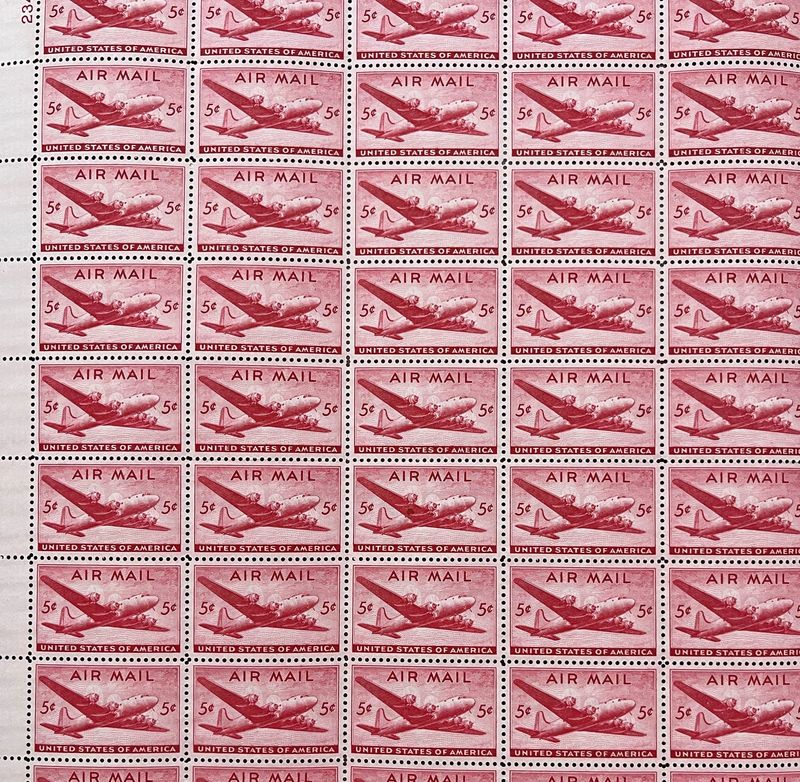
It occurred to me recently that while I’ve expended plenty of ink on coins over these last months, I’ve give short shrift to stamps. In fact, there was a time when stamps nearly rivaled coins in terms of the number of enthusiasts. The list of famous collectors include Warren Buffett, Jacques Cousteau, King George V, Queen Elizabeth II, President Franklin Roosevelt and many more. And not a few countries, especially tiny island nations in the western tropical Pacific with few exportable resources, have generated significant foreign exchange from the sale of their exotic stamps. Let’s expend a few letters on this topic today.
The first postage stamps to appear were in England around the middle of the 19th century. Prior to that, a number of European countries offered postal service, but it was expensive and the burden to pay often fell upon the recipient rather than the sender. In 1837, a British schoolteacher came up with the revolutionary idea of fixed rate postage to be paid in advance. Three years later, the famous “Penny Black” was issued that when affixed to a letter allowed the sender to mail up to 1/2 ounce anywhere in the United Kingdom. Its design featured the youthful visage of Queen Victoria and, from that day to this, no country of origin has ever appeared on British stamps … only its monarchs.

As for American postage, our system followed the British in its evolution to pre-stamped postage in 1847. The first two stamps issued were surprisingly expensive, including a five-cent stamp (almost $2 in today’s money) that featured Benjamin Franklin and a 10 cents stamp with an image of George Washington. Fortunately, the cost of delivery decreased over the years to the point where domestic mail service today is significantly cheaper in relative terms than 180 years ago. Subsequent highlights included the 1893 issuance of the Columbian Exposition series, the first to celebrate an even rather than a national figure, the introduction of self-adhesive stamps in 1974 and the 2007 establishment of Forever stamps that immunized senders from future increases in postal rates.
If not as popular in years past, stamp collecting today remains a popular hobby among more than five million Americans. Stamp values peaked about 25 years ago, but that’s not to say that highly coveted stamps are cheap. Only two known examples of an 1868 one-cent stamp known as the Benjamin Franklin “Z-Grill” are known to exist, one of which was recently sold for an eye-popping four million dollars. A single example of the famous 1924 “Inverted Jenny” — in which the plane was imprinted upside-down — will set you back six figures, and any number of other rarities sell at prices that would otherwise cover the purchase of a nice car.
Although digital communication has come to dwarf written correspondence, there remains something extremely personal about receiving a hand-written note from your letter carrier expressing congratulations or condolences. It’s a sad thing that more people don’t communicate that way anymore. As for an opportunity for young people to learn about biography, history, geography and politics, stamp collecting is unsurpassed. Those of us with many stripes on our sleeves would do well to encourage our grandchildren to take up stamp collecting. And the next time you’re in Washington, D.C., consider visiting the United States Postal Museum. Among all the many museums in our nation’s capital, it is truly among the most interesting.
Mike Rivkin and his wife, Linda, are long-time residents of Rancho Mirage. For many years, he was an award-winning catalogue publisher and has authored seven books, along with countless articles. Now, he’s the owner of Antique Galleries of Palm Springs. His antiques column appears Sundays in The Desert Sun. Want to send Mike a question about antiques? Drop him a line at silverfishpress@gmail.com.
This article originally appeared on Palm Springs Desert Sun: Stamp collecting is still alive and well
Reporting by Mike Rivkin, Special to The Desert Sun / Palm Springs Desert Sun
USA TODAY Network via Reuters Connect