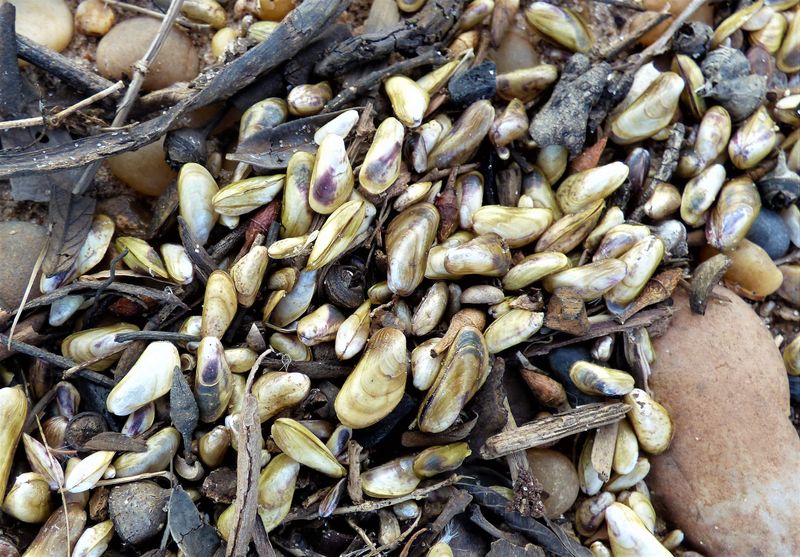
The San Joaquin County Board of Supervisors declared a local emergency Tuesday, April 28, as the invasive golden mussel continues to damage infrastructure and threaten water systems across the Sacramento-San Joaquin Delta.
The board of supervisors approved the proclamation after hearing an update from county staff and members of an ad hoc committee formed to respond to the infestation, which was first detected at the Port of Stockton in October 2024 — the first known appearance of the species in North America.

Hilary Crowley, the county legislative officer, said the mussels likely arrived via ballast water discharged from cargo ships. Native to Asia, the species can tolerate brackish water and low calcium levels, allowing it to spread more widely than other invasive mussels, such as quagga and zebra mussels.
“A single female golden mussel can produce up to one million offspring a year,” Crowley said. “They reproduce quickly and in high numbers.”
Crowley said the mussels have now spread throughout the Delta but have not yet been detected in California waterways that do not receive Delta water.
“They threaten the reliability of the state’s water supply and the environment,” Crowley said. “They reduce the food supply for the endangered Delta smelt and other plankton-feeding fish. Infrastructure and infested water require costly retrofitting or ongoing removal of the organisms to maintain gates, screens, hydroelectric facilities and flood control structures.”
The species attaches to hard surfaces and clogs pipes, pumps and flood control systems, creating costly maintenance challenges. At the Smith Canal Gate Project in Stockton — a $96 million flood control system completed in 2024 — crews recently spent 10 hours and $10,000 removing mussels from the structure.
“If we’re having a flood issue and need to clean the gate before we can close it to save the communities, it’s kind of getting out of control,” District 2 Supervisor Paul Canepa said.
Canepa said officials first thought the invasive golden mussel was a boating issue, but it became “way more than a boating issue.” He referred to the Delta as “ground zero” for the infestation in California, which now affects agriculture, municipal water systems and flood protection infrastructure. Farmers and water districts are facing mounting costs as pipes become clogged and require replacement.
District 1 Supervisor Mario Gardea said Stockton is “ground zero” because the city’s inland port receives shipments from countries around the world. He said he initially thought the issue was recreational until he was invited to McDonald Island, where he saw the problem firsthand.
“It’s not just one or two mussels,” Gardea said. “The mussels are coating the intake pipes, the pipes that exhaust the water from keeping the island from flooding. Our municipalities rely on the Delta for water and to release our water for flood mitigation, so what happens if our pipes are clogged up and we’re unable to remove the water from our streets?”
Gardea said the county must act quickly to secure funding and develop mitigation strategies.
“Eradication, in my belief, is impossible,” Gardea said. “It’s about mitigation. We’re not going to be able to eradicate these mussels out of our system. It’s a matter of making sure that we capture the funding, and do our research on how we’re going to mitigate and protect our community and our farmers from future costs, and the ability to use our water to irrigate our farms.”
The county’s Golden Mussel Ad Hoc Committee, formed in late 2025, has been coordinating with state and federal agencies, water districts, environmental groups and private industry. The group aims to ensure local concerns are addressed as scientists study the species and policymakers develop a response.
At the federal level, U.S. Rep. Josh Harder, D-Tracy, has introduced the Golden Mussel Eradication and Control Act of 2025 (H.R. 3717). The bill would deploy a rapid response program to monitor, contain and begin eradicating the current infestation, invest in new technology and inspection stations to speed local response efforts, and increase coordination among state, local and federal agencies through a comprehensive report outlining best practices and updated guidance on golden mussel prevention.
In California, the state formed the California Golden Mussel Task Force in April 2025 to coordinate a comprehensive response framework.
Additionally, three golden mussel-specific bills are moving through the Legislature, including AB 2032, the Golden Mussel Response Act, advanced by Assemblymember Rhodesia Ransom, D-Tracy, in February. The bill would streamline permitting and allow water agencies to respond more quickly to prevent, control and remove invasive mussels.
Christopher Neudeck of Kjeldsen, Sinnock & Neudeck Inc., a civil engineering firm specializing in flood control, water utilities, water resources, emergency response and environmental restoration, warned the costs could reach tens of millions of dollars if infrastructure replacement becomes widespread. He described ongoing experiments with prevention tools, including ultrasonic devices, though results remain uncertain.
“It’s a pandemic,” Neudeck said. “We’re going to find a solution, but it’s not going to be cheap.”
As part of the proclamation, the board directed county staff through the Office of Emergency Services to continue coordinating with local, regional, state and federal partners to pursue funding, technical assistance, mitigation strategies and infrastructure protection resources. County officials said the board will review the status of the emergency at least every 60 days, as required by law.
Record reporter Hannah Workman covers news in Stockton and San Joaquin County. She can be reached at hworkman@recordnet.com or on Twitter @byhannahworkman. Support local news, subscribe to The Stockton Record at https://www.recordnet.com/subscribenow.
This article originally appeared on The Record: San Joaquin County declares emergency over invasive golden mussel
Reporting by Hannah Workman, The Stockton Record / The Record
USA TODAY Network via Reuters Connect