The word “modern” is perhaps one of the vaguest descriptors. It seems to capture anything that is oriented toward an unrealized future, has an iterative or tenuous view of the past, and deploys some technological or novel technique. The array of things captured under this definition, ranging from the Eiffel Tower to Abstract Expressionism to the iPhone, is somewhat incomprehensible: buildings, people, paintings, books, plays, symphonies, and entire periods.
Such a broad definition of modernism is deceptive to its fragmented nature. In the popular imagination, there are the modernists, and there is everyone else, when, in reality, many of the modernists were at war with each other as much as they were with the past.

Burns, as has been extensively documented by architectural historian Steven Keylon in his publication on the architect, went on to design dozens of Late Moderne structures throughout the Coachella Valley. Among the most interesting is the second project that he designed, a 1947 duplex for the Palm Desert realtor Edith Eddy Ward.
The history of architecture is certainly no exception. While “modern architecture” brings to mind walls of glass, overhangs, machined materials, and the evasion of ornament, the movement’s history is eclectic both in style and concept. Functionalism, Brutalism, New Formalism, Metabolism, the International Style, and Organic Architecture are just a few styles from the cluttered history of architecture, each with completely different formal and conceptual objectives. To further complicate matters, popular versions of architectural modernism, like Streamline Moderne, Art Deco, and Googie, were portrayed by many of the movement’s protagonists as aberrations of their ostensibly intellectual premise.
Amidst the clutter is the history of Late Moderne, a style that flourished from the late 1930s into the early 1950s and had a particularly salient moment in the Coachella Valley under the designer Herbert W. Burns. With a variety of influences, Late Moderne architecture emphasized streamlined form, organic materials and palettes, and horizontality juxtaposed with vertical elements. It was not the high modernism of contemporary movements — like, for example, the work of Albert Frey — but it was a modernist style in its own right and, unlike others, exceedingly popular with the public.
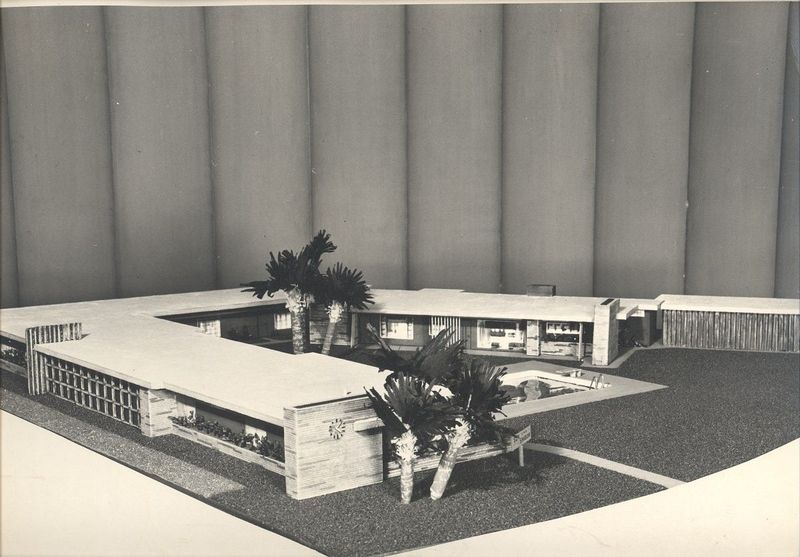
Burns arrived in Palm Springs in 1945 after a varied career, and for his last act, settled into architectural design and development. His first project was the Town & Desert Apartment Hotel, a complex which he owned and operated with his wife Gayle. The design was the precedent for his strain of the Late Moderne, and the projects that followed were variations on a theme: vertical sandstone volumes puncturing a sprawling, horizontal structure adorned with decorative vertical poles and walls of glass, all rendered in a palette of desert pastels.
A character in her own right, Ward arrived in Palm Desert in 1946 and soon became the Palm Desert Corporation’s leading sales agent, peddling empty desert lots to a moneyed clientele. Carl Henderson, who had been brought on by his brother Cliff to handle the community’s sales, complained that she was “unethical in her dealings and unscrupulous in her methods.” Her profligate use of the Shadow Mountain Club to entertain prospective clients aside, in reality she proved to be Palm Desert’s most scrupulous saleswoman, and Carl essentially found himself out of a job. (Later, she happily adopted the nickname “Shady Lady of Shadow Mountain.”)
In 1947, Ward commissioned Burns to design a duplex for her and her mother, Margaret “Bunny” Ward. Sited immediately adjacent to El Paseo (then a desolate street), the duplex was a flat-roofed structure juxtaposed with two of Burns’ signature sandstone columns. Its interior featured sandstone-faced walls and corrugated glass room dividers and looked out onto a panoramic desert expanse. As a Los Angeles Times feature on the duplex noted, it was able to bask in the “glory in the sun and sand, yet ignore their hardships.” Later, in a Palm Springs Life profile, Ward recalled how she offered Gloria Swanson a refreshment at the property after showing her some land in the area. “The first move the svelte and elite movie queen made was to kick off her shoes and make herself comfortable!”
Ward and her mother’s tenure at the Burns duplex was short. In 1949, always inclined to make a good deal, she sold the property to Fred and Mildred Talbot, a couple who had stayed at the Town & Desert and become interested in owning a Burns design of their own. Ward, anticipating Palm Desert’s growth, originally had Burns design the duplex so that it could be easily expanded into a small hotel, and the Talbots did just that.
The Talbots again hired Burns, who designed two wings that seamlessly created a low-slung, V-shaped structure with a pool at center. Completed in 1950, the twelve-unit property opened as the Sun and Shadow Apartment Hotel and was in operation for over three decades.
The building (now occupied by the Lotus Garden Center) can still be found on the corner of San Luis Rey Avenue and Larrea Street, just a block off El Paseo. Although alterations have clouded some of Burns’ original design, his distinct sandstone volumes still rise above its horizontal footprint, testifying to the structure’s history and the sheer diversity of that thing we call modernism.
Thanks for reading! Tracy Conrad will be on hiatus for the next few weeks and she’s asked her colleague Luke Leuschner at the Historical Society of Palm Desert to amuse you in her absence. You can still write to her at pshstracy@gmail.com.
This article originally appeared on Palm Springs Desert Sun: Palm Desert history: Sun and Shadow, Edith Eddy Ward and Herbert Burns
Reporting by Luke Leuschner / Palm Springs Desert Sun
USA TODAY Network via Reuters Connect