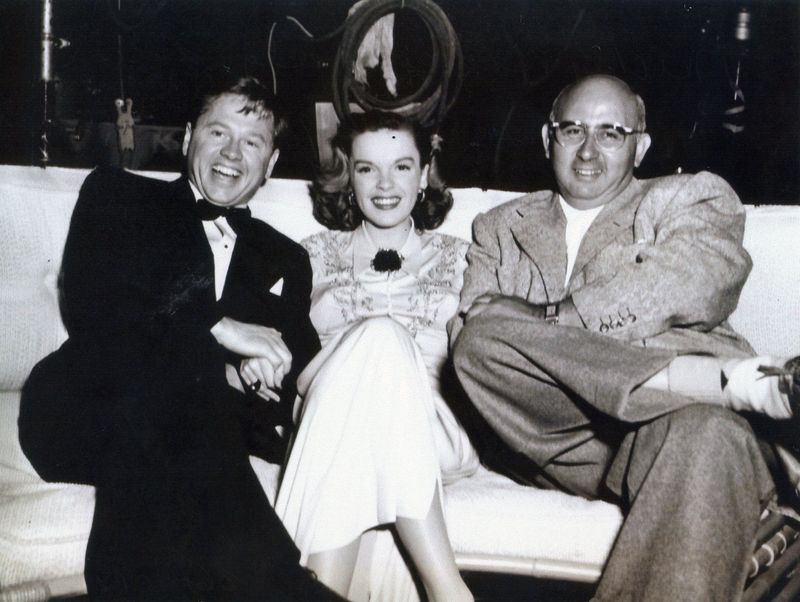
Composer George Gershwin was interviewed on the radio and asked the perennial question which came first when working with his brother Ira, the music or the words? He answered that he wrote the tune and Ira would generally walk around humming it until the lyric came to him.
The loss of his composer brother at such a young age was devastating, and the lyricist was left to find working relationships with other composers. A decade and a half after his brother’s death, Ira was paired with Harold Arlen and they had to find their own way of working, their own rhythm.

Arlen was a consummate professional, used to providing the music for the words of different lyricists. He composed “Blues in the Night,” “That Old Black Magic,” “It’s Only a Paper Moon,” “Stormy Weather,” “Come Rain or Come Shine,” “I Gotta Right to Sing the Blues,” and “Let’s Fall in Love.” His songs are now so familiar it’s impossible to overestimate Arlen’s contribution to the American Songbook.
In 1977, the New York Times profiled the composer explaining the depth and breadth of his writing, “Arlen, unlike many of his talented colleagues, wrote important songs with four major lyricists—Ted Koehler, (Yip) Harburg, Johnny Mercer and Ira Gershwin. Since the melodies he wrote for these collaborators vary so markedly in rhythmic, harmonic and melodic structure, and thereby in over‐all impact, it is hard to believe that one man wrote them all.”
Ira Gershwin and Arlen were assigned to a Warner Brother’s movie that was to star Judy Garland. It would be a reunion for Arlen and Garland. Arlen had penned “Somewhere Over the Rainbow” and “Get Happy,” both of which proved to be huge hits and became synonymous with Garland. Such an iconic song was hoped for again.
The movie, “A Star is Born” was a remake of the successful 1937 film starring Palm Springs resident Janet Gaynor. The assignment was to make the film a musical version for Garland.
Arlen and Gershwin had finished just two songs, one being “The Man That Got Away.” Much was left to be done. But Arlen wanted to go to Palm Springs to recuperate. His father had died recently and he wasn’t feeling well.
Gershwin’s brother George had spent time in Palm Springs during a tryst with actress Paulette Goddard. A tantalizing bit of home movie in the Library of Congress shows them cavorting at the El Mirador Hotel. Ira knew all about Palm Springs and vehemently opposed Arlen’s plan. He was adamant they not play the music for anyone until they had more songs completed, insisting they shouldn’t share.
Don’t go to Palm Springs! Moss Hart was there, and he was writing the screenplay for the film. Garland and her husband Sid Luft were there. Luft was producing the movie, and it had been his idea to pitch it to Warner Bros. as Garland’s comeback vehicle after her release from her MGM contract. Garland and Luft were living at 334 Hermosa Place. (The address has serious Hollywood provenance. Samuel Goldwyn lived here in his retirement in the 1960s. Director Edmund Goulding rented the house in the 1950s. Lucille Ball and Desi Arnaz lived there in 1953.)
Don’t go to Palm Springs! It would be impossible not to bump into Hart, Garland and Luft in the small town. And then Arlen would be tempted to share before everything was ready. But Gershwin’s protest was to no avail, and off Arlen went to the desert.
As Gershwin predicted, Arlen encountered the star and her husband, on the golf course at Tamarisk Country Club. Arlen was accidentally following Garland and Luft as they teed off, and he was mindless, or perhaps purposely, whistling, (instead of humming as was Gershwin’s habit,) the new tune. Garland was instantly intrigued. She asked about the melody, she didn’t recognize it, it was new, what was it exactly?
Arlen demurred. Garland wasn’t deterred.
Mark Steyn writes, “But on the 18th hole he whistles it again, and Sid Luft lobs his ball 320 yards into the sand trap, and, while he’s digging it out, Judy drags Harold back to the clubhouse, sits him down at the piano, and forces him to play that damn tune he’s been whistling all day. And so he does. And she’s delighted.”
“And, when Sid gets out of the sandpit, she calls him in to hear it. And he loves it. And Sid wants Moss Hart to hear it, so they all go round to Frank Sinatra’s place, where Moss Hart and my old chum Kitty Carlisle are staying … And there they run into a slight hiccup, because, somewhat remarkably, there’s no piano at the Sinatra compound. But next door is the old Jolson pad, where Joley’s widow Erle now lives with the screenwriter Norman Krasna, who’d just finished White Christmas. So off they go and Arlen plays it again, and the Lufts love it, and the Harts love it, and the Krasnas love it, and pretty soon half of Palm Springs has heard it, and ‘The Man That Got Away’ has become the song that got away – from Ira Gershwin. And, while Arlen is still wondering how he’s going to explain all this to his writing partner, Moss Hart wanders back to the Sinatra house and calls Ira to rave that the new song is going gangbusters ‘out of town.’”
Gershwin at home in Beverly Hills received the enthusiastic praise. He was mostly relieved that they liked it, forgiving Arlen for having shared prematurely, never saying a word about the broken promise.
In the weeks leading up to the Sept. 29, 1954, premiere of movie containing the song, Jack Warner sent telegrams to seemingly every movie star under the sun. The Warner Bros. studio chief was determined to repay the hefty investment in the film by creating an unrivaled atmosphere of importance. It was the first time a premiere was nationally televised. (Warner, also a Palm Springs resident, had a magnificent estate in Las Palmas.)
The premiere was other worldly. All the stars under heaven attended, along with 20,000 fans. The Hollywood Reporter noted, “Jack Warner eyed the milling mob outside the Pantages preem of ‘A Star is Born’ and said, ‘It’s the greatest night in the history of movies.’” Lauren Bacall, Humprey Bogart, Shelly Winters, Bob Stack, Gower Champion, Dean Martin, Liberace, Virginia Mayo, Mamie Van Doren, Cesar Romero, Doris Day, Desi Arnaz, Lucille Ball, Lena Horne, Marlene Dietrich, Elia Kazan, Rosemary Clooney, Jose Ferrer, Marilyn Monroe, Charlton Heston, James Dean, Ursula Andress, Elizabeth Taylor and Joan Crawford were all in attendance. Janet Gaynor, who had starred in the original film, was there. “’Tonight, a star is reborn,’ proclaimed Dorothy Lamour of Garland’s return. Recalls Kim Novak, then a contract player at Columbia, ‘It was like seeing Hollywood in its grandest style. I was just spellbound.’”
And of course, Palm Springs resident and longtime Garland friend, Frank Sinatra was there.
The afterparty at the Cocoanut Grove in the famed Ambassador Hotel was attended by 800 people. “Warner’s tip for the waiters alone was $1500.” The Hollywood Reporter continued, “Biggest thrill: Judy singing ‘The Man That Got Away’ in ‘Star’ — tears your guts out….”
“The Man That Got Away” had been resurrected from a melody Arlen had written more than a decade before. Back then, he’d given it to Johnny Mercer, who also lived in Palm Springs, to write the lyric. Uncharacteristically, Mercer failed the majesty of the melody with some less serious lyrics. That doomed it to sit in Arlen’s files for years.
The two men’s method of collaboration was to meet in the afternoon at Gershwin’s home, with Arlen seated at the piano, and Gershwin writing lyrics from a nearby armchair. Hart had requested a “dive song” for the film. When Gershwin’s wife Leonore overheard the initial melody Arlen was trying out for the song, she reportedly said it sounded like something Geroge Gershwin could have written. That stopped Arlen cold. He switched to the old melody languishing since the unsatisfying attempt with Mercer.
He played the old tune for Gershwin. After listening for a while, Gershwin suggested the title. Arlen asked if it shouldn’t be “The Man WHO Got Away” but Gershwin liked the allusion to every fisherman’s tall tale and the title stayed.
Tracy Conrad is president of the Palm Springs Historical Society. The Thanks for the Memories column appears Sundays in The Desert Sun. Write to her at pshstracy@gmail.com.
This article originally appeared on Palm Springs Desert Sun: Gershwin, Arlen, Sinatra and Garland get away to Palm Springs
Reporting by Tracy Conrad, Special to The Desert Sun / Palm Springs Desert Sun
USA TODAY Network via Reuters Connect