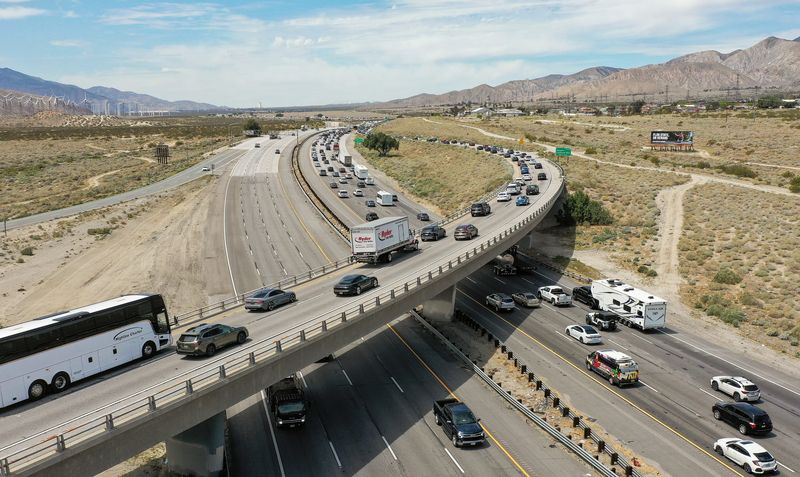
Getting stuck in traffic is a common and frustrating experience in California. But it may feel even more exasperating when you’re in the left lane — you know, the “fast lane” — and the car in front of you is going slower than everyone else on the freeway.
But there is no specific law in the California Vehicle Code that specifies a given speed you should be driving in the No. 1 lane, which is the left lane, said Dan Olivas, a spokesperson for the California Highway Patrol, in an email to the Desert Sun.

California motorists should always drive at a safe speed that accounts for the weather, visibility, traffic and the surface and width of a highway — and never at a speed that endangers a person’s or property’s safety.
However, the California Vehicle Code does state the following, said Olivas:
“No person shall drive upon a highway at such a slow speed as to impede or block the normal and reasonable movement of traffic unless the reduced speed is necessary for safe operation…”
Driving at an “exceptionally slower rate of speed than the traffic” on the freeway could force other motorists to brake quickly, Olivas said. Additionally, drivers may have to avoid traveling slowly or impeding traffic, which could lead to road rage.
“If a driver is driving in such a manner as to be impeding traffic, they could potentially be stopped and receive a citation,” Olivas said.
What is the speed limit on most freeways in California?
California Vehicle Code establishes that the maximum speed limit on a multi-lane highway is 65 miles per hour, said Caltrans. However, the vehicle code explains that the Department of Transportation, with the approval of CHP, can up the maximum speed to 70 miles per hour if it’s determined that a speed greater than 65 miles per hour would help “orderly movement” of traffic. There are some conditions for this, though.
In California, if you’re driving on a freeway at a speed greater than 100 miles per hour, you can face a fine of up to $500, and you may also be suspended from driving for, at most, 30 days, according to the California Vehicle Code. That’s for a first conviction.
Does a speeding ticket go on your record?
Each time you’re convicted of a moving traffic violation, it’ll be placed on your driver’s record, according to the California Department of Motor Vehicles. Any conviction that involves the safe operation of a car on a highway, including speed, is one point, said the California DMV.
“If you are given a one-point traffic violation, the judge may offer you the choice to attend a traffic violator school to have the citation not reported to your insurance company but remain on your driving record,” said the California DMV.
Is it illegal to drive in the left lane on a highway?
Rules regarding driving in the left lane can vary among states. For example, the Missouri State Highway Patrol stated that on a highway with two or more lanes in each direction, a driver is “mandated to drive in the right lane unless passing slower traffic, letting another driver have enough room to enter the highway safely, or preparing to make a legal left turn.”
Once you’ve completed the pass, you must return to the right lane by law.
“It is not legal or safe to continuously drive in the left lane,” according to the Missouri State Highway Patrol.
When asked whether California has any laws that regulate how a left lane on a freeway can be used legally by a motorist, Olivas said there isn’t one, but pointed out that there are rules regarding the carpool lane and for 3-axle vehicles traveling on freeways.
Paris Barraza is a trending reporter covering California news at The Desert Sun. Reach her at pbarraza@gannett.com.
This article originally appeared on Palm Springs Desert Sun: Driving slow in the left lane can frustrate Californians. Is it illegal?
Reporting by Paris Barraza, Palm Springs Desert Sun / Palm Springs Desert Sun
USA TODAY Network via Reuters Connect