

By Jim Bloch

How did the SDS end up north of Port Huron?
With date of the its national convention — June 11, 1962 — fast approaching, the SDS leadership had yet to secure a site.

“We had to find a place to meet,” said Hayden
Sharon Jeffrey, a cofounder of the SDS along with Bob Ross, Al Haber, Hayden and others in 1960, turned to her labor activist mother, Millie, for help.
Millie, who was community relations director for the UAW, arranged for the students to use the labor camp in Lakeport, which the CIO had purchased — with the help of a UAW contribution — before its merger with the AFL in 1955.
Millie even attended the conference. “I went up one day, but I was intimidated by all those brilliant university students,” she laughed.
Millie loved the students.
“I remember Tom sitting in front of our fireplace one night reading Alice in Wonderland aloud,” she said in a 2002 interview, two years before she died at 93. “We had popcorn and a fire going. They were wonderful – fresh thinkers, deep thinkers, left thinkers. And they were ready to change the world.”
On the beach
“We drove in at dark,” said Hayden.
To the young members of the SDS, the labor camp was paradise.
“I think the breeze off the lake – there’s something uplifting, an energy in the Great Lake region that inspires,” said Hayden.
“The setting was quite beautiful,” remembered Ross, a professor of sociology at Clark University when I interviewed him in 2002. “There were old log bunk houses tucked into the woods, which each slept about ten people. The central hall, where the dining room was and where we met, was within a stone’s throw of the water. It was rustic, simple, woods stuff. We had one cold and rainy night with storms rolling in from the lake.”
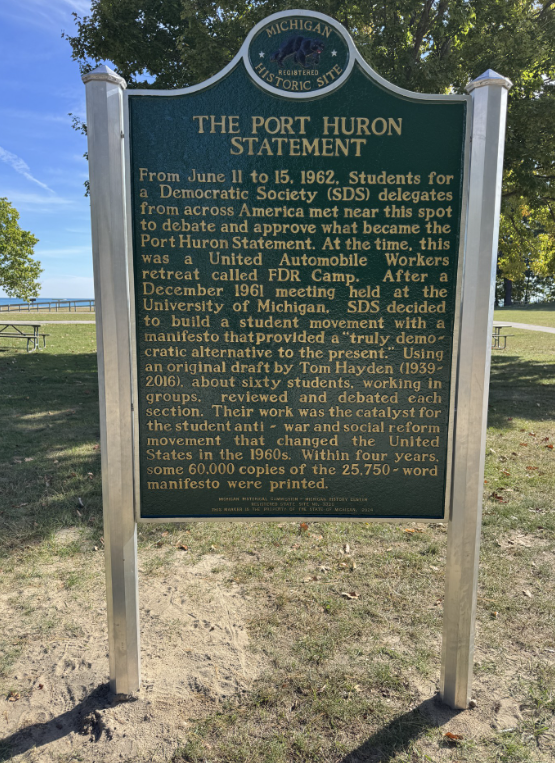
The bunk houses and big hall are long gone, replaced by barbecues on poles and picnic tables: In the late 1960s, the labor camp became part of Lakeport State Park’s day-use area.
Before the conference, the leaders of the SDS asked Hayden to write preliminary statement.
“I was told to write it in draft form and we’d discuss it in Port Huron,” said Hayden. “I buried myself in the library and interviewed people and read 50 or 60 books and wrote 25,000 words in draft form.”
The lengthy manuscript was mimeographed and mailed off to the attendees, who piled into cars, many from other states, and headed for Port Huron
Over the five day period, the students separated Hayden’s document into its thematic parts and broke into groups responsible for hashing through each part.
They worked around the clock.
“We didn’t party,” said Hayden. “We didn’t go to restaurants.”
“Over the four or five day period, there were about 80 people in-and-out of the conference, with no more than 50 at one time,” Ross said. “In the decisive ending session, where we passed the statement, there were about 30-40 people.”
“We were exhausted from this,” said Hayden, who took to sleeping in the doorway of the dining hall so that people would step on him and wake him in the morning.
To insure a uniform style, the SDS assigned the final draft to Hayden.
“Tom was the basic pen,” Haber said. “But the final product was as collective a pen as we could imagine.”
“The ideas were all of our ideas,” Jeffrey said. “It was us.”
The process of parsing, arguing over and reassembling the Port Huron Statement on the Lake Huron beach was exhilarating.
“It felt like a spiritual experience,” said Hayden. “There was an aurora borealis over the lake on the last night of the convention.”
“It was euphoric, deeply profound,” said Jeffrey. “After we approved the final draft, we all went down to the lake, where there was a dock and a sandy beach. Some of the kids went swimming and we watched the end of the night and the coming of dawn. We were elated. We were sure that we had done something visionary and had done it collectively. There was something deeply moving, something almost spiritual about it.”
“It was like God was sending us a message,” said Hayden.
Jim Bloch is a freelance writer based in St. Clair, Michigan. Contact him at bloch.jim@gmail.com.
