

No one, including Republicans, should be terribly surprised that progressive Democratic candidate Abdul El-Sayed could very well win Michigan’s Senate primary race — or that democratic socialist candidates are gaining traction throughout the country, fueled by enthusiasm from young voters.
They should be aware that El-Sayed could have a good shot at winning in November, too.

Socialism is the logical extension of what I’ll call “socialism lite” — the only form of civic and economic governance Americans under roughly the age of 30 have ever witnessed.
El-Sayed’s policies, including Medicaid for All, wealth distribution and taxation, free public education, abolishing ICE and an end to financial support for Israel, are socialist in nature even if he is not a self-identified democratic socialist.
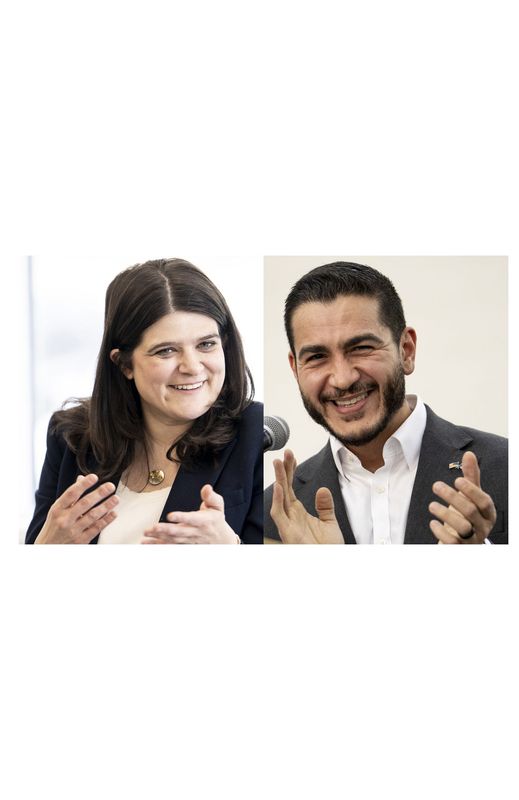
His rise against established U.S. Rep Haley Stevens (and state Sen. Mallory McMorrow, D-Royal Oak, who dropped from the race on Sunday) has caught national attention. Tuesday night he and Stevens faced off in their first, maybe only, debate.
He comes across as a compelling and confident candidate on his own, even if you disagree with him.
But his real edge is that he has met the moment — and, unfortunately, the moment is socialism.
Roughly one in five likely voters in Michigan’s Democratic primary exclusively identify as a Democratic Socialist. Nationally, about 17% of Americans have a favorable view of leaders who identify as such.
That’s causing chagrin among some mainstream Democrats. President Donald Trump and Republicans are now pushing the term “communist” instead.
But splitting hairs over the difference won’t dissuade an incredibly dissatisfied younger electorate — nor does it negate why we are at this point.
Trump’s third presidential campaign created the bed for what appears to be a coming socialist revolution. He ignited the working class and coalesced voters around economic concerns that few elected leaders at that point were willing to verbalize. His policies have not been socialist. But the populism underneath his unique, and not necessarily free-market, economic philosophy has now turned entirely on capitalism — and support for someone who embodies it to Trump’s degree has plummeted.
Trump’s well-publicized involvement in private markets and industries, his attack on Federal Reserve Chairman Jerome Powell, his proclivity to increase government spending and his tactic against companies that may not agree with him haven’t helped shape the idea that capitalism is fair or just.
Consider as evidence the reaction to the murder in plain sight of Blackstone CEO Wesley LePatner in Midtown Manhattan last year, and the quick rise to fame the killer enjoyed.
But long before Trump, the civic expectation was formed and taught in public schools that government should intervene frequently and aggressively to solve economic problems, shape markets, protect favored industries and cushion citizens from risk. That is the story of much of America’s last century — and this one.
The U.S. government bailed out many major banks in 2008 to stop a total collapse of the money system. The bailout of the Detroit Three automakers peaked in 2009. Obamacare passed in 2010. Bernie Sanders beat Hillary Clinton in the Michigan 2016 Democratic primary. The state went for Biden in 2020, and the “uncommitted” movement and its anger over the War in Gaza was a major factor that tipped Michigan away from Kamala Harris in 2024.
The trend line is clear to see, and it covers the formative years of many voters under 30.
The message absorbed by younger voters has been straightforward: If government can intervene to help favored industries, protect domestic manufacturing, pressure corporations and reshape markets in pursuit of national goals, why shouldn’t government intervene to address housing costs, health care expenses or student debt?
If it can spend money on a war overseas that the majority of young voters disagree with, why can’t that money be spent at home?
The premise that government would be heavily involved was given up decades ago, so now the only issue is one of degree rather than principle.
That helps explain why democratic socialism no longer sounds radical to many younger Americans. They are not rebelling against the system. They are extending its logic.
And it’s part of why candidates like El-Sayed have found an audience and why socialism appears to be an inevitability at this point.
Conservatives and Republicans will need to do more than criticize socialism to win. With their backs up against the wall, they will have to explain why government-directed economics should stop at the policies they want and not continue toward the policies El-Sayed and others are proposing.
Or maybe government-directed economics shouldn’t exist at all.
kbuss@detroitnews.com
This article originally appeared on The Detroit News: With socialism on the rise, don’t count out Abdul El-Sayed | Buss
Reporting by Kaitlyn Buss, The Detroit News / The Detroit News
USA TODAY Network via Reuters Connect
By Kaitlyn Buss, The Detroit News | USA TODAY Network
