

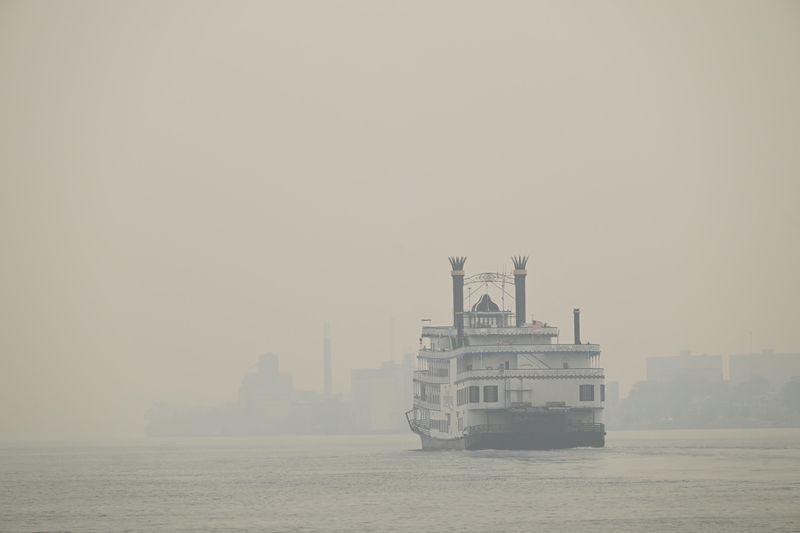
Wildfire smoke cloaked Metro Detroit on Thursday and was forecast to stay until the early weekend, creating a thick haze after traveling hundreds of miles from Ontario and northern Minnesota, where raging wildfires are sending a cloud of ash into the air.
The haze, which was so thick that the downtown Detroit skyline was barely visible from Belle Isle, affected everything from outdoor day camps to concerts in southeast Michigan, with officials canceling programs and moving some indoors. Wayne County’s Circuit Court, one of the busiest courts in Michigan, canceled all proceedings on Thursday and Friday because of the smoke.

Officials extended an air quality alert into Friday, warning the conditions could be “very unhealthy to hazardous.”
Health officials urged residents to be cautious and stay indoors if possible.
“Obviously, this is really bad,” said Dr. Devang Doshi, a Corewell Health pulmonologist. “I don’t recall seeing levels like this even a couple years ago,” when Canadian wildfire smoke migrated south and blanketed the region.
The air quality in southern Michigan reached levels so toxic Thursday that it was considered an “emergency condition” by federal environmental officials who warned everyone could be impacted, especially children and people with asthma or other respiratory conditions.
Detroit was ranked as having the worst pollution in the world among major cities through most of Thursday, with its air quality index reading for particulate matter reaching 724 or “hazardous” at one point in the morning. It topped Toronto and Minneapolis, cities in the regions where wildfires burned, until falling to third worst behind Minneapolis and Chicago at 4:30 p.m. with a reading of 231, which was considered “very unhealthy.”
It was even worse in the central Upper Peninsula, where Marquette County Emergency Management Coordinator Brian Hummel said ash fell like snow on Wednesday and Thursday.
“I had a layer of ash on my vehicle yesterday morning when I was leaving home to come into work,” he said. “This is my first time experiencing something like this.”
How long will wildfire smoke last in Michigan?
The plume of smoke hanging over Metro Detroit came mostly from wildfires in Ontario. It was steered here by south winds and trapped on the surface by the high-pressure system over southeast Michigan, National Weather Service meteorologist Kevin Kacan said.
“That causes the atmosphere to sink,” Kacan said. “It allows the smoke to descend toward the surface and get trapped, which is why we’ve had such poor air quality over the last 24 hours.”
The smoke should clear by Saturday morning, when a warm front from the south and southwest will lift it away from Metro Detroit, he said. Some smoke may return Saturday night, but it won’t be as concentrated as it is Thursday, Kacan said.
Thursday’s temperatures were in the mid-80s, lower than earlier this week when a heat dome pushed thermometers to 100 degrees. The smoke had a minor cooling effect, Kacan said, and was paired with a cold front that came off Lake Huron.
The best way to stay safe is to stay inside with the windows closed, said Kathleen Slonager, a nurse and executive director of the Asthma & Allergy Foundation of America Michigan Chapter.
Running air conditioning units and indoor air purifiers help clean indoor air, she said. If people go outdoors, they should wear a high-quality mask that is at least an N-95.
People who have asthma and other chronic health issues are especially at risk of exposure to the smoke in the air, Slonager said.
“It can really narrow those airways, inflame the airways, put all that gas and particulate matter (in your body) as well,” she said.
Smoke causes cancellations, closures and a free gym offer
In Detroit, a city with one of the highest asthma rates in the nation and a large senior population, city officials planned to send out a citywide message to residents’ mobile phones Thursday afternoon outlining steps to deal with the noxious air. Mayor Mary Sheffield and the city’s Chief Public Health Officer Ali Abazeed also will be recording a social media video Thursday on how to stay safe.
Cities across Metro Detroit closed pools and splash pads, canceled concerts and even sent workers home early in some areas because of the poor air quality.
Detroit officials encouraged people without air conditioning to go to cooling centers at city recreation centers and public libraries.
Chuck Kallil, of Canton Township, knew as soon as he stepped outside Thursday that he wouldn’t be taking his 8-year-old daughter Emersyn outside. Instead, the pair went to an indoor activity center called Stemville in Northville, where Emersyn played with a machine that drew a picture of her chosen animal, “a really cute seal.”
“We 100% decided to come here today to stay inside,” Chuck Kallil said. “I was the first one up this morning. It looked foggy, so I walked on the back deck and could smell the smoke. It just made me sick.”
Day camps either canceled or moved their activities inside because of the smoke Thursday, including Royal Oak Schools, which had students and staff stay indoors to reduce the exposure to outdoor air.
Overnight camps such as Interlochen Arts Groups in northern Michigan said they are closely monitoring the air quality conditions affecting their area and adjusting programming accordingly.
Planet Fitness opened its Michigan locations Thursday to anyone wanting to exercise indoors for free and with no obligation to join through Sunday.
Warmer world fuels wildfires, asthma expert says
Wildfires are clearly worsening as the climate warms, said Slonager with the Asthma & Allergy Foundation of America Michigan Chapter.
“I’ve lived here in Michigan for over 40 years and never, until last summer or the summer before, never have we ever had any issues like this,” she said. “And now, it’s like a regular occurrence that we’re getting these wildfires happening more intensely. Everything is much drier, the wildfire season is lasting longer, and we’ve got to tie it back into climate change.
“It’s a public health issue, plain and simple. This is a public health issue. It’s not political.”
Wildfires are becoming bigger and harder to control as the atmosphere warms, said Jonathan Overpeck, a climate scientist and University of Michigan climate and energy professor.
That’s because warmer air sucks more moisture out of the ground and out of trees and other plants. That dries them out and creates more fuel for fires. In turn, those fires release carbon dioxide, which exacerbates human-caused climate change, Overpeck said.
“The situation, as it gets warmer, will continue to get worse faster,” Overpeck said. “We’ve got to just stop burning fossil fuels, the natural gas, coal and oil.”
The largest increase in extreme fires has taken place in the western U.S. and northern boreal forests of Canada, according to NASA. National Aeronautics & Space Administration scientists who reviewed the agency’s satellite data found extreme wildfires became more frequent, more intense and larger from 2003-23.
Wildfire smoke contributes to asthma, heart attacks, dementia, researchers say
The smoke is more than unpleasant. It’s dangerous. It has tiny particles that are small enough to seep into people’s blood and damage their lungs, hearts and brains. Exposure to the pollutant, called fine particulate matter, can trigger asthma attacks and other breathing issues.
It gets worse. When wildfires tear through communities, they burn trees and shrubs but also gas stations, homes, factories, cars and anything in their way. That creates a “toxic soup” that University of Michigan epidemiology professor Sara Adar said can lead to early death, trigger asthma attacks and contribute to dementia.
Exposure to any kind of fine particle pollution is associated with greater rates of dementia, Adar wrote in a 2023 investigation in the journal JAMA Internal Medicine, but researchers have found that the link is particularly strong when those particles come from wildfire smoke.
“Our brains are incredibly sensitive to how much oxygen we get, the pumping of the blood,” Adar told The News last year. “Anything that’s going to damage the blood vessels, which is part of what causes heart disease …, is going to damage the brain as well.”
ckthompson@detroitnews.com
Staff Writers Anne Snabes and Louis Aguilar contributed.
This article originally appeared on The Detroit News: How long will wildfire smoke cloak Detroit, Michigan? Expert weighs in
Reporting by Carol Thompson and Charles E. Ramirez, The Detroit News / The Detroit News
USA TODAY Network via Reuters Connect

By Carol Thompson and Charles E. Ramirez, The Detroit News | USA TODAY Network
