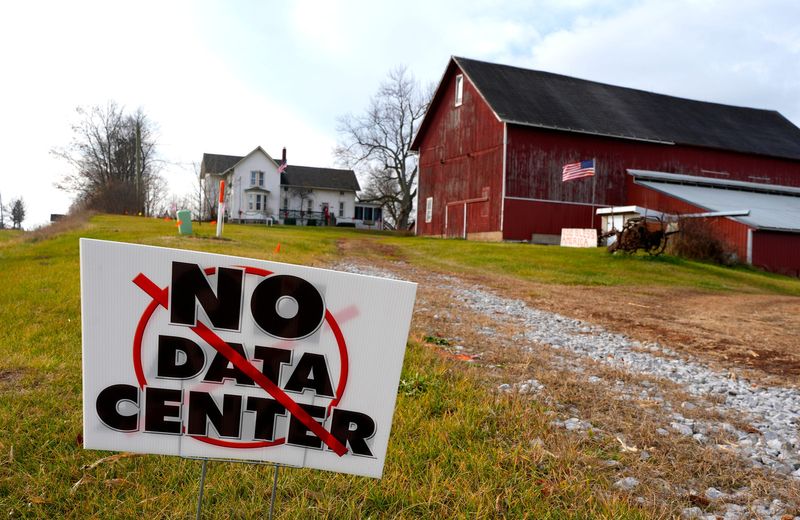
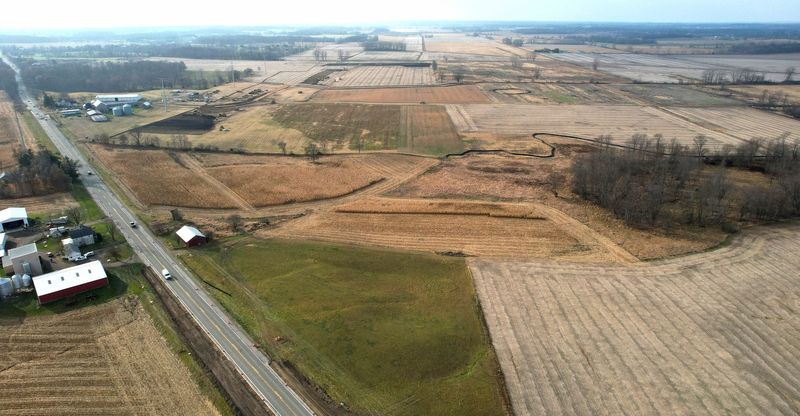
Some of the world’s largest tech companies are looking to set up huge data centers in small Michigan communities, drawing questions from residents and leaving ill-equipped local governments to grapple with massive proposals that, in some cases, they don’t have the power to stop.
Data centers aren’t new to Michigan, but they’ve gotten bigger: New ‘hyperscale’ developments with more computing power — in demand by generative AI and large language learning models — can span hundreds of thousands of square feet.

Given the sheer size of such centers, some of Michigan’s smallest, rural governments are facing big questions about how relatively new developments can change their communities. And without an established playbook, some local officials feel ill-equipped to handle all the uproar around new projects.
And there’s a lot of uproar.
In communities like Saline Township, Gaines Township, Gibraltar, Lowell, Kalkaska, Howell Township and more, halls have been filled with residents asking local officials how hyperscale or smaller-sized data center projects are going to affect their water, electric rates, the ambient sound of their neighborhoods and other aspects of their daily lives.
Data center developers vow to build and operate responsibly — the state has rules for companies receiving tax breaks, aimed at protecting water and energy supplies. Still, some residents are skeptical of their claims and are asking their local governments to stop the projects.
“There’s all of these things that just scream they’re above the law and our township has no right to a say in how our residents, me, how I live,” said Tammie Bruneau, a Saline Township resident who has organized opposition against a hyperscale data center campus in the community.
Due to zoning laws in Michigan, many townships can’t actually prevent a data center project from moving forward, so long as developers can meet site planning standards and other typical requirements. Data center developers have mostly asked for permits under industrial zoning, a land use many communities in Michigan have already established for things like manufacturing and construction facilities.
In Gaines Township, one of three west Michigan communities where Microsoft has purchased property to potentially open data centers, the local planning commission is weighing the company’s application to change the parcel’s zoning from rural and residential use to light industrial use. To get approval, Microsoft would have to comply with a series of requirements for water use, energy use and potential decommissioning.
The planning commission tabled a vote on rezoning at an April 15 meeting that nearly 600 residents attended, according to Dan Wells, township community development director. Most in attendance opposed the data center. Still, he said the Microsoft proposal is moving forward, although it’s difficult to place a timeline on its completion.
“We have to judge this as an industrial project. That’s how we have it set up in our zoning ordinance and we have to follow that process of review and approval,” Wells said.
“If we step outside of that, then we are basically setting ourselves up for a lawsuit, which we don’t want to do.”
Developers court communities
Companies looking to bring data centers to Michigan are trying to win public relations battles locally through town halls and open houses.
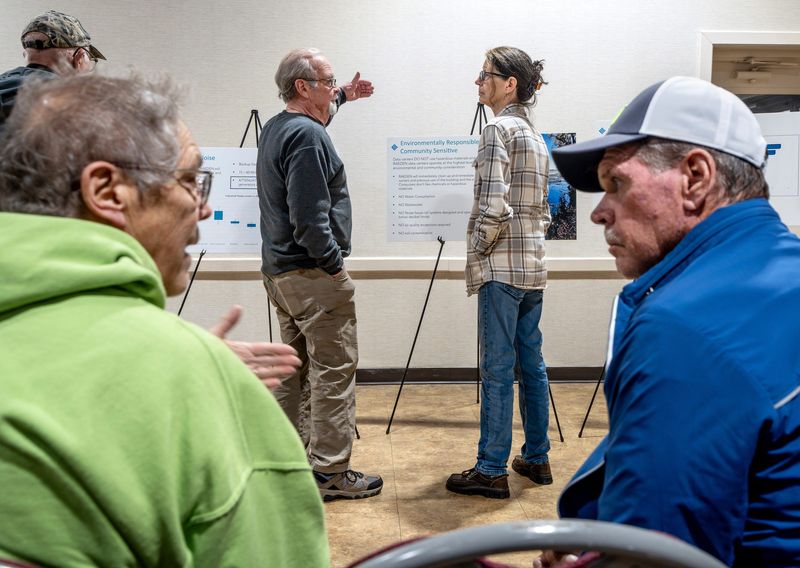
Microsoft held open houses in both Gaines Township and Lowell, where residents were invited to speak with company officials about different design aspects of the planned facilities. In Gaines Township, the March 3 open house resembled a school science fair — stations with posterboards about aspects like the data center’s water usage, construction footprint and even what the night sky would look like when it’s built were docked throughout a local church hall.
In Gibraltar, tech developer Raeden is hoping to redevelop the former McLouth Steel site and operate a data center there. It held a similar community meeting on March 11 where residents could learn more about the project.
“I don’t know who to believe or what to believe to be honest with you,” said Debbie Clements, a Gibraltar resident who attended the meeting. Clements said she’s concerned about how a data center would affect local power supply and energy costs.
Raeden, according to a presentation prepared for residents at the meeting, said the facility’s only noise generators would be backup diesel generators that wouldn’t be used for more than an hour a month. The company has also committed to cleaning up any leftover hazardous materials at the site.
Still, residents like Clements have mixed feelings. The speed at which data center proposals are popping up makes it hard to fully digest, she said.
“Do we believe what they’re saying that it’s not going to be noisy, that it’s not going to be this or that? I don’t know,” she said. “This is all happening so fast. That’s our big issue.”
Raeden will have to wait before its plans can go forward, though. Officials in Gibraltar adopted a moratorium on new data centers through next March. Such moratoria are popping up in other parts of the state. It’s a tool that local communities can enact to delay developments, but local municipalities are generally prohibited under state law from banning certain types of land use, with exceptions for situations where the local community isn’t suited for a type of zoning.
As data centers proliferate, will state weigh in?
A bipartisan state law enacted in 2024 helped pave the way for such developments by offering tax breaks to developers building data centers in Michigan. At the time, data centers were pitched as a way to create jobs in an emerging field.
And Michigan wasn’t alone — an analysis by consulting firm Husch Blackwell found at least 38 states have some form of tax incentive to attract data centers.
But Michigan has seen a proliferation of data center proposals in part due to an abundance of a data center must-have: water. Because a significant number of servers are constantly running in data centers, larger operations emit heat, and water is often used to cool the facilities down.
Two years after enacting bills to spur data center development, the Legislature is considering whether to slow it down instead.
Michigan has nearly 1,800 local governments, and bigger cities like Detroit and Grand Rapids have municipal infrastructures that mirror those of some smaller states. But some townships — of which Michigan has more than 1,200 — operate at a level considered closer to bare bones.
“A lot of the time you’re talking about governments that are by design, by choice of the people who live there, kind of at a minimal service level,” said Erika Rosebrook, director of the Center for Local Government Finance and Policy at Michigan State University.
There is growing debate over whether a statewide moratorium on data center developments, like the ones passed by some local governments, would benefit communities that feel ill-equipped to handle requests.
In February, Michigan lawmakers introduced bills to institute a statewide moratorium on data center development until April 2027. The measures aren’t expected to advance through the Legislature, and it’s unlikely Gov. Gretchen Whitmer would approve them even if they did.
Last year, Whitmer’s office announced a multibillion-dollar data center campus planned for Saline Township, backed by developers Related Digital and Oracle. The campus is expected to power generative artificial intelligence (AI) development for OpenAI, the software company behind ChatGPT program that has become synonymous with AI globally.
When state regulators held a meeting for the public to comment on the Saline Township plan, Whitmer submitted a statement in support of the project, saying in December the state would benefit. “This is a matter of national security and economic competitiveness, and if we do not act, it will cost us thousands of jobs and billions of dollars of investment in our economy,” she said in a Dec. 3 statement.
At an April 8 event in Detroit, Whitmer said Michigan could be a leader among states for how it runs data centers, the Michigan Chronicle reported. A spokesperson for the governor didn’t return a message seeking comment for this article.
Still, some lawmakers argued Michigan could take time to explore how to handle newly pitched data centers from the state level.
“As technology continues to advance, data centers will be needed, and some townships will decide that it’s right for their people, but we need to give them more time to examine these challenges before plunging headfirst into hyperscale projects,” state Rep. Jennifer Wortz, R-Quincy, said in a Feb. 27 news release.
While local officials are generally opposed to ceding the ability to make decisions about their communities, the resource imbalance between large corporations and townships could make it more appealing to have the state step in, Rosebrook said.
“There are lots of communities around the state that just don’t have the resources to fairly evaluate these bigger proposals. So they’re looking for help wherever they can find it,” Rosebrook said.
Local pushback
Los Alamos National Laboratory and the University of Michigan are teaming up for a $1.2 billion data center facility in Ypsilanti Township. The facility will be used by university researchers as well as by top national security officials working with LANL.
In Ypsilanti Township, however, local officials don’t feel as if they’ve had enough — or any, for that matter — input on the project.
“They absolutely feel like they’re, simply put, untouchable,” township attorney Doug Winters said of the project’s backers. He said there hasn’t been discussion between developers and public safety officials in Ypsilanti Township.
Township trustees passed a resolution March 31 “declaring strong opposition” to the facility, although it’s not likely the resolution has any ramifications on the project’s development.
In a statement, U-M spokesperson Paul Corliss refuted the township’s claims. He said a pair of local town halls were held about the project, which is currently being evaluated for two potential locations in Ypsilanti Township. Previously, township officials voiced support for the development, including at a former General Motors property that now houses the American Center for Mobility.
“We value our relationship with the township and respect the role of local officials. At the same time, we have been disappointed by their change in position,” Corliss said.
Winters said the community doesn’t feel equipped to house the data center, pointing to concerns over possible security ramifications of sensitive national research taking place in Ypsilanti Township.
Corliss said the shift in position from the township is accompanied by a “sensational narrative,” adding “the proposed facility is a high-performance computational research center designed to support advanced research in areas such as medicine, climate science, energy and national security.”
On April 22, the Ypsilanti Community Utilities Authority board passed a 12-month moratorium of its own — this time on providing water services to hyperscale and midsize data centers, or any other facility used for AI computing.
When massive companies — Oracle and Microsoft have market caps worth hundreds of billions and trillions of dollars respectively — are following zoning rules and want to open a data center, local governments sometimes don’t have the resources to contend with their requests. And although companies pledge to be good partners in the places where they want to build data centers, they often still plunge through local opposition.
In Saline Township, local trustees initially voted against rezoning the parcel of land where the OpenAI data center campus will be built, but Related Digital sued them and later reached a settlement to allow the project to go forward. A Saline Township attorney previously told the Detroit Free Press the settlement was “the lesser of two evils for us.”
Bruneau, of Saline Township, said there wasn’t ever a clear playbook for her and other similarly concerned residents to voice their opposition to the project.
“How are we supposed to fight this? Nobody had an answer for me,” Bruneau said. She frequented community meetings to raise concerns, but there wasn’t a clear answer as to how — or if — residents could make a difference.
“When we first started asking questions, the only thing that we kept being told was ‘stay going to the meetings, make sure your voice is heard,’” she said.
“All of these things in hindsight (were) good for the rest of the state of Michigan, but it was not great for Saline.”
You can reach Arpan Lobo at alobo@freepress.com
This article originally appeared on Detroit Free Press: Why Michigan communities struggle to block new data centers
Reporting by Arpan Lobo, Detroit Free Press / Detroit Free Press
USA TODAY Network via Reuters Connect