Wouldn’t it be easier and shorter to call it a general strike?
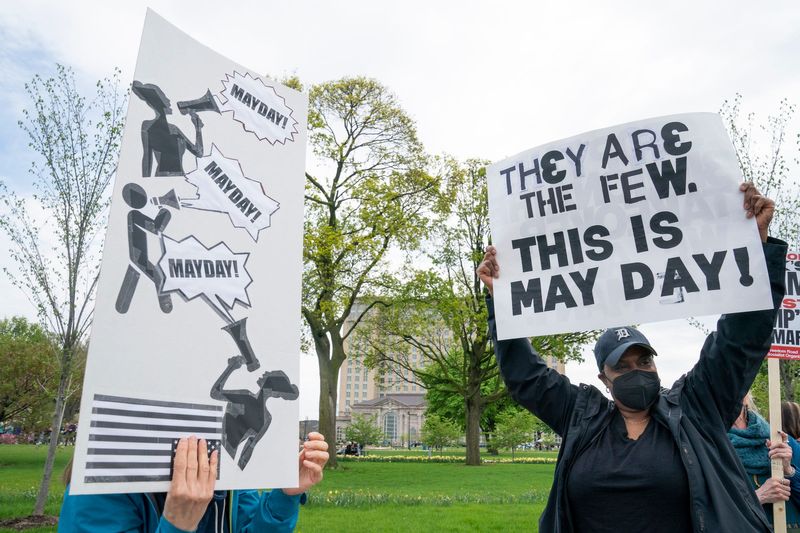
As union leaders and activists geared up for May Day 2026, flyers from the national May Day Strong coalition called for “No work, no school, no shopping” on the big day, Friday, May 1, also known as International Workers’ Day.

There’s a reason why the phrase has been prominent despite the call appearing, in essence, to be one for a general strike. It has to do with how the day of action is being viewed by some organizers, and who they are: union leaders.
May Day 2026 is what union leaders call a “structure test,” said Stacy Davis Gates, president of the Chicago Teachers Union, on a national press call Wednesday, April 29, for the May Day Strong movement.
That is, the periodic ask of a group that both shows their power and assesses the level of commitment, according to Michelle Kaminski, associate professor and associate director of Michigan State University’s School of Human Resources and Labor Relations.
The late labor organizer and scholar Jane McAlevey described these tests as a way to assess the readiness and prepare for a strike.
Davis Gates described it by giving a poignant illustration that also showed the anti-President Donald Trump nature of how the day is being viewed.
She said it’s like “when our president does something more audacious than he did the previous day. … How many people can show up to this year’s May Day more than they showed up to last year’s May Day?”
Her comments were in response to a Free Press question on the choice of language and what’s being asked of workers on May Day, for which the theme is “Workers Over Billionaires.” Davis Gates also said that unions know how to ask for what they want.
A ‘strike’ has legal ramifications for union workers
A reason union leaders wouldn’t want to use the term “general strike” is that it has specific legal implications for union workers, said Kaminiski. It’s not something they’d say casually.
“A general strike would potentially be a violation of labor law,” she said.
Many union contracts don’t allow for a strike while the contract is in place, some only allow for strikes during the contract for narrow health and safety concerns, and general strikes – across industries – take a lot of coordination, she said.
In the best-case scenario, those who strike outside the bounds of a contract could see no consequences, she said. In less ideal scenarios, it could mean discipline or days without pay. In the worst-case scenario, though unlikely, a worker could be fired.
It all depends on specific circumstances and contracts.
Why some are calling May 1 a ‘general strike’ day
For Loren Branch, the possible ramifications for union workers are exactly why those capable of using the term should do so.
Branch, an organizer with the Party for Socialism and Liberation and Asamblea Popular Detroit, or the Detroit Peoples Assembly, is part of a contingent bringing the national call for an economic blackout to Detroit.
It comes as those organizing a May Day rally in the city, the Metro Detroit AFL-CIO, are opting out of the language of “no work, no school, no shopping,” and “general strike.”
The term “general strike” connects to a history that citizens are intentionally not taught, a history in which general strikes were a successful tactic for the working class, Branch said.
His contingent isn’t alone in using the term. On the May Day Strong press call, at least one union leader from Missouri referred to the action as a strike. In places like New Orleans, some workers intend to begin a strike in connection with bargaining concerns. In North Carolina, where public school teachers cannot legally strike, another leader noted that teachers are using personal days to protest.
It will take general strike efforts to get their demands met, Branch said. Those demands range from getting immigration agents out of communities, ending the cost of living crisis, ending the war with Iran and more.
Union-led rally slated for May 1 in Detroit
The Metro Detroit AFL-CIO, hosting a 4 p.m. rally in front of Michigan Central in Detroit, did not call for a general strike and has not pushed the language to skip work.
Executive board member Justin Steenbergh, from IBEW Local 58 Detroit, confirmed his greatest qualm is with the term “strike,” but he also doesn’t love the “no work” callout.
He didn’t want union workers to feel they were “scabbing” or being a strike-breaker if they felt they needed to work.
He believes the effort is a “strategic mistake” that people aren’t ready for. Everybody needs to be on board.
Branch, whose coalition plans to attend the rally to support unions, said he agrees that a mass general strike needs more organizing. The effort on May 1 is a way to build the movement toward that and raise awareness about using a strike as a tactic, he said.
For those who may feel unable to take time off lest it impact their livelihood, Branch said even having conversations with others builds the movement. But, he said, it’s a shame people must weigh that.
“We should be able to stand up for what’s right and not have our entire lives crumble,” he said.
Anti-Trump gatherings in the last year have consistently had detractors from the Republican party and others in a state the president won in the last election. The White House also issued a statement to the Free Press on the May Day actions,
“President Trump has done more than any president in modern history to put American workers first,” White House spokeswoman Taylor Rogers said.
This article originally appeared on Detroit Free Press: Is there a May 1 general strike in 2026?
Reporting by Darcie Moran, Detroit Free Press / Detroit Free Press
USA TODAY Network via Reuters Connect