Even as Gov. Gretchen Whitmer defended her legal reasoning for vetoing nine bills championed by Democrats amid strong pushback from her political allies, she did not say whether she would have signed them had they not hit a procedural roadblock that prompted a dramatic and lengthy legal battle between the two chambers of the Michigan Legislature.
The bills from the 2023-2024 legislative session would have increased public employers’ contributions to employees’ health insurance costs, allowed corrections officers to participate in the Michigan State Police retirement system, protected public assistance benefits from debt collection and allowed Wayne County – with voters’ approval – to levy a millage to fund history museums in Detroit.

Her decision to reject the legislation sparked fury. In a joint statement, the Michigan AFL-CIO, UAW and the Michigan Education Association condemned the governor’s action.
“Gov. Gretchen Whitmer’s veto of these nine bills, following a long legal battle waged by leaders in her own party, betrays democratic values and abandons the very people who have supported her in office. This veto is an insult to every hard-working Michigander fighting for economic justice. We condemn her betrayal of Michigan workers, and call on political leaders who value our state’s working families to do the same,” said the statement issued July 10, the day Whitmer vetoed the bills.
The legislation passed when Democrats held majorities in the previous legislative session, but they did not land on Whitmer’s desk for her signature. Why the bills were never formally presented to the governor remains a mystery that has prompted suspicions in Lansing. The Office of the Clerk of the Michigan House of Representatives has not responded to requests from the Detroit Free Press seeking information on what happened.
Whitmer’s communications director Bobby Leddy described assertions that something fishy happened as false – including the idea that Whitmer may have cut a deal with Michigan House Speaker Matt Hall, R-Richland Township, to not have the bills presented. Hall, for his part, denied ever having a conversation with the governor’s office about the nine bills on a July 17 appearance on WKAR’s “Off the Record.”
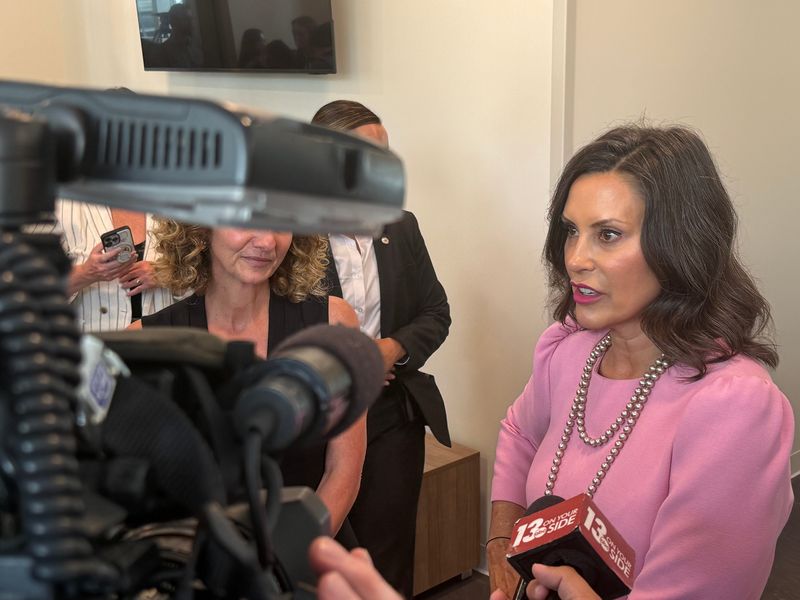
Whitmer, when asked, didn’t say whether she would have signed the bills if they had been presented earlier, reiterating the legal challenges, budget implications and other administrative issues outlined in an earlier letter explaining her veto. “There was just no way in good conscience I could sign those. Had they been presented eighteen months ago, we would be having a different conversation today,” she told reporters in Southfield after approving the state’s next education budget July 21.
Lawyer Mark Brewer, who served as the lawyer for the Michigan Senate in its lawsuit against the Michigan House, blasted the governor’s handling of the vetoes in a recent Facebook post outlining his personal opinion on the matter. “The veto process reflects abysmal governing by her and the veto letter… is full of legal sophistry,” he wrote.
Instead of hastily vetoing the bills, she could have spent more time trying to resolve the alleged issues with the bills, Brewer said. But he pushed back on her assertion that signing the bills would have unleashed chaos, characterizing her justification for the vetoes as “fallacious” and “pure fiction.” The bills did not need to go into effect retroactively as the governor claimed, Brewer said, and conflicts between the bills and the current law or the timing for implementing the legislation could have been worked out in court.
Whitmer stood by her approach when asked about possible alternatives. “I have seen some of the comments, and I recognize there are lawyers with different interpretations,” she told reporters.
Senate Majority Leader Winnie Brinks, D-Grand Rapids, who leads the chamber that brought the lawsuit against the Michigan House in early 2025 said she believes there was a road not taken. “We believe that there were remedies that could have been applied and we would have preferred to see that,” she said. Brinks said she did receive advance notice from Whitmer that the governor planned to veto the bills. “We were called shortly after,” she told reporters.
Hall, who had the bills presented to Whitmer after the Michigan Supreme Court weighed in on the matter, said that if she had signed them, it would have forced a negotiation over how to pay for the policies that would have created an opening to advance GOP priorities. While he said he could have stalled in presenting the bills to Whitmer, he decided not to. “I just said I’m going to send these bills out of the kindness of my heart, I’m going to send them and we’ll see what happens,” he told reporters July 21.
In her veto letter, Whitmer said she was ready to work with lawmakers to advance the legislation again, although it’s not likely the measures garner the support needed to get through the Republican-led House before the end of the year. Still, she expressed optimism, telling reporters in Grand Rapids she believes “there is a will in both chambers on some of the bills to get them done.”
“I know everyone’s home, and they want to stay home and campaign, but because they held onto them for 18 months and the Republicans in the House played games, they owe it to the people of Michigan to come back and try to get something done on all these fronts,” Whitmer said.
Contact Clara Hendrickson at chendrickson@freepress.com or 313-296-5743.
You can reach Arpan Lobo at alobo@freepress.com
This article originally appeared on Detroit Free Press: Whitmer defends veto of stalled bills, despite advocates’ anger
Reporting by Clara Hendrickson and Arpan Lobo, Detroit Free Press / Detroit Free Press
USA TODAY Network via Reuters Connect
By Clara Hendrickson and Arpan Lobo, Detroit Free Press | USA TODAY Network