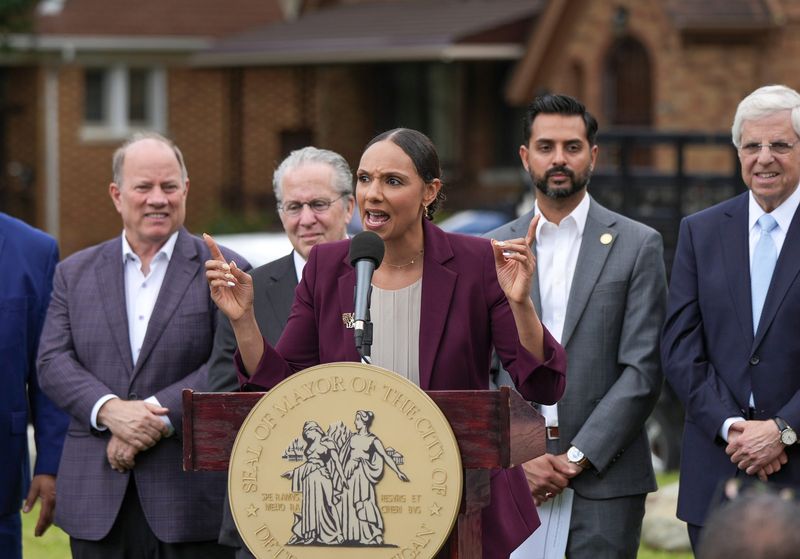
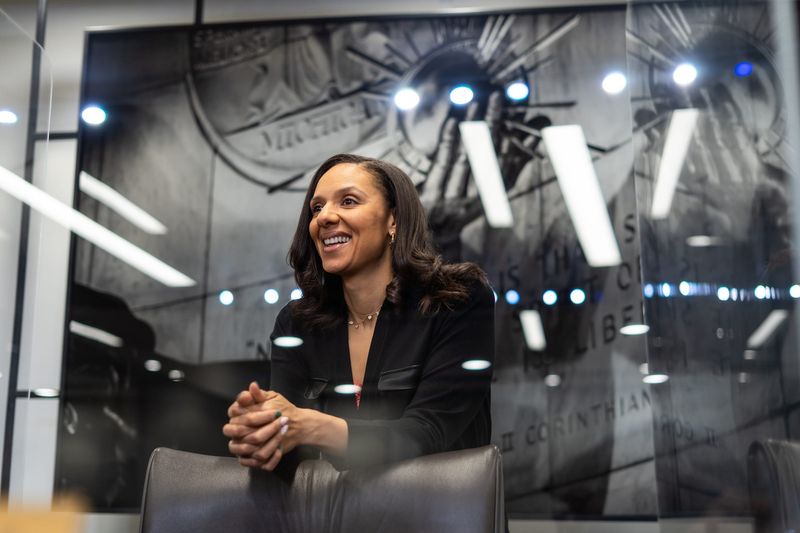
In 2018, with thousands of Detroit households facing water shutoffs or tax foreclosures, a then-31-year-old Councilmember Mary Sheffield stood before city hall to unveil the “People’s Bills,” a sweeping package of housing affordability and other proposals designed to protect the city’s most vulnerable residents.
The headline-grabbing plans were among the boldest from a Detroit city council member in recent memory, according to several political watchers. But they drew swift resistance from Mayor Mike Duggan’s more fiscally conservative regime. With a council majority then in Duggan’s corner, the proposals would yield mixed results, ending in a blend of wins, losses and political compromise.

It was an apt encapsulation of Sheffield’s 12 years as a policymaker on council, where she often aimed high and got some of what she wanted, but was forced to scale back her more ambitious populist visions amid pressure from the mayor’s office. Now, as the frontrunner for the city’s top job in a race against Rev. Solomon Kinloch of Triumph Church, she says that, if she wins, she may revive some of the proposals that previously stalled.
Political observers say Sheffield’s achievements are notable for a council member who was more progressive and radical in her ideas in a city with a strong-mayor form of government and law department that serves both the mayor and the council.
Former Councilmember Raquel Castañeda-López, who served with Sheffield for her first two terms, said Sheffield struck a balance between policy ambition and coalition-building, both on council and in the community.
“She was better and more successful at collaborating than I was,” said Castañeda-López, who has not endorsed a candidate for mayor. “All of us have made promises we couldn’t fulfill. But … sometimes when legislation doesn’t happen, you’re able to make change in other ways.”
Sheffield’s opponent has taken a harsher view of her council tenure, accusing Sheffield of “12 years of failed leadership” and “delivering headlines without delivering progress.” The pastor has said he is better equipped to tackle poverty than Sheffield. He has never elected office and does not have a comparable record to scrutinize.
But councilmembers and grassroots advocates who spoke with the Free Press said Sheffield consistently followed through when possible, and helped elevate visibility around issues she couldn’t legislate.
“She is a person that if she puts something out there she believes in it and I think is willing to die on that sword getting it across the finish line,” said Councilmember Fred Durhal, who ran against Sheffield for mayor in the primary and has since endorsed her.
Sheffield’s achievements include key ordinances to increase housing stability and improve working conditions for those employed by city contractors or certain industries. She also has notched wins with ordinances that required compromise, like a 50% parking ticket rate reduction for Detroiters who pay early.
But Sheffield never introduced promised ordinances to increase Detroit hiring on publicly funded construction projects and tie water rates to household incomes — which she once called her “most crucial” initiative. She also has thus far come up empty handed in her quest to reimburse property owners who were overtaxed by the city.
In response to Free Press questions, the now-council president said she has spearheaded approximately two dozen successful ordinances, resolutions and budget appropriations. Of proposals she could not get off the ground, Sheffield blamed legal obstacles raised by Duggan’s administration, but said they still helped increase awareness of the socioeconomic issues affecting Detroiters.
“When I came to council, these were issues that people didn’t want to talk about,” she said. “I’m very proud we passed a majority of them. And on those we didn’t, we pushed the conversation.”
Wins
Sheffield took office in 2014 as the youngest-ever Detroit councilmember, and in her second term unfurled a grassroots and union activist-guided agenda that put her at odds with budget-conscious and development-friendly Duggan, who was then supported by a council majority. Things shifted in Sheffield’s third term, when a number of newcomers joined the council and voted her president, and an infusion of federal pandemic relief funds made a broad range of initiatives possible. Duggan has since endorsed Sheffield for mayor.
Sheffield has led the passage of two key ordinances to address the drivers of tax foreclosure, including a 2023 measure targeting inflated property assessments and a 2018 measure easing barriers to a property tax exemption for the poor that has helped more than double the number of tax-exempt households in the city.
In 2022, she spearheaded an ordinance to provide free legal representation to Detroiters facing eviction after reporting found 1 in 5 Detroit renters face eviction each year, often by landlords who themselves operate illegally. The Right to Counsel program has since boosted the percentage of those with lawyers from 4% before the pandemic to up to 70% this year, a nonprofit involved said.
Sheffield also led the creation of a 2023 “responsible contracting” ordinance that gives preference to prospective city contractors who offer employee benefits and meet other criteria, and a 2021 “industry standards boards” ordinance aimed to improve conditions for workers employed in certain industries, like the city’s stadiums or arenas.
In 2021, she won an ordinance increasing transparency around surveillance technologies, after at least two men sued the city alleging they were wrongfully arrested by Detroit police using facial recognition software.
Political push-pull
Other proposals fell short of goals, typically through compromise with the administration.
In 2017, Sheffield sought to require developers receiving city incentives to designate a portion of rental units as affordable for households earning as little as 50% of the region’s median income. The Duggan administration, however, won an amendment raising that threshold to 80% — or $56,600 for an individual — far above what the average Detroiter earns.
Sheffield sought to counteract the ordinance’s limitations by attaching an “affordable housing trust fund” for those living at as little as 30% area median income. She has since grown the fund to $15 million by capturing 40% of city commercial land sales. If elected mayor, she says she would raise the percentage collected to at least 90% and revisit the requirements on developers.
Her effort to repay city property owners after a 2020 news report found they were overtaxed by a collective $600 million also has involved some political jockeying. The Duggan administration has interpreted state law to mean they can’t be repaid. Sheffield, in 2022, requested a separate legal opinion from Michigan Attorney General Dana Nessel on the issue. She was rebuffed, and now says she’ll push to change the law in Lansing if elected mayor.
As an alternative to repayment, Sheffield in 2022 led the creation of a package of city programmatic and discount offerings for those who were overtaxed, like half-off Detroit Land Bank Authority homes and first dibs on affordable housing.
The plan represented another political tug of war: Duggan, two years earlier, had proposed a $6 million package that would have applied to those overtaxed from 2010-2013, but Sheffield rejected it, calling its price tag and eligibility years inadequate. The plan Sheffield ultimately helped pass was funded at the same dollar amount, but with eligibility expanded through 2016. (Residents have until the end of the year to apply for the offerings; as of this summer, approximately 700 residents had already done so or were in the process.)
Meanwhile, at least one high-profile Sheffield effort has been stymied without the Duggan factor. A task force Sheffield helped establish to recommend reparations for Detroiters harmed by historic racism is now a year behind schedule after problems involving one of her appointees who helped create the group.
Proposals left behind
While Sheffield’s movements on housing and other issues made headlines, two “People’s Bills” were never introduced.
A marquee plan to tie water rates to household income was dropped after Mayor Duggan said it would violate state law. Sheffield later said she developed a workaround — treating discounted rates as “bad debt” — but was ultimately forced to abandon that too, blaming the same legal concerns. She said the fight then moved to Lansing, where she has supported a state bill she says closely mirrors her original proposal.
Duggan, meanwhile, launched the Lifeline water assistance program in 2022, calling it the city’s “first income-based water affordability” program. The program, however, relied on pandemic relief funds that have since run out. Sheffield says she continues to push for state funding to sustain it.
Sheffield also never introduced an ordinance to expand a Duggan executive order requiring publicly funded construction projects to give a majority of work hours to Detroiters. Her 2018 proposal would have lowered the investment threshold for the requirement to kick in from $3 million to $500,000, but, she said, was ultimately blocked by a legal interpretation that City Council can’t set contracting terms.
Still, Sheffield credited herself with pushing the administration to ensure the hiring mandate applied to demolition projects. If elected mayor, she said she would only revive the majority-Detroit hiring proposal once she can ensure contractors actually comply. According to a recent Bridge Detroit report, none of the 35 tracked projects currently do.
Advocates split; politicos say she excelled
Advocates are divided on Sheffield’s record. Some credit her with keeping critical issues in the spotlight, even when legislation stalled.
“She was good at keeping water affordability in the news,” said Sylvia Orduño, a local organizer with the People’s Water Board Coalition. “Making it part of the ‘People’s Bills’ emphasized that water and sanitation is a human right.”
Others were less convinced.
“She ain’t done nothing,” said Tahira Ahmad, a member of the Detroit Coalition for Property Tax Justice, who said she was overtaxed by $30,000 but can’t benefit from the city’s current compensation offerings. “It’s just all about a political game with her.”
Current and former councilmembers meanwhile said Sheffield brought a rare level of policy focus to her role and that a high-profile agenda an attract undue scrutiny.
“I have watched Mary as a member of council and council president approach the position with a clear intellectual policy structure to her work,” said former Councilmember Sheila Cockrel, who is not endorsing anyone in the mayor’s race. Of the “People’s Bills,” she said Sheffield “actually had a frame of reference for the work she brought forward and she named it and moved to execute.”
Said Castañeda-López, “It’s almost like the more you perform, the more that’s demanded of you. There’s so much pressure and expectation for you to just know everything and fix everything … until you’re in the role, it’s really hard to understand the inner workings.”
Free Press staff writer Nushrat Rahman contributed to this report.
Violet Ikonomova is an investigative reporter at the Free Press focused on government and police accountability in Detroit. Contact her at vikonomova@freepress.com.
This article originally appeared on Detroit Free Press: What Mary Sheffield delivered — and didn’t — for Detroit
Reporting by Violet Ikonomova, Detroit Free Press / Detroit Free Press
USA TODAY Network via Reuters Connect