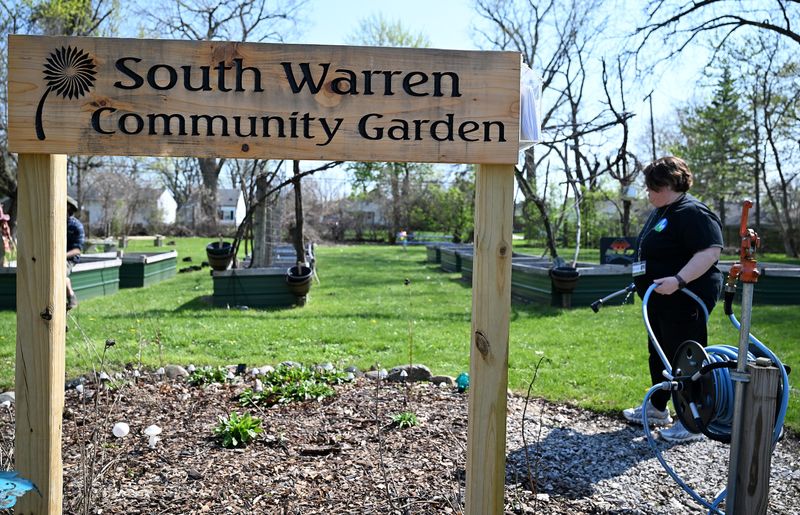
Warren — A community garden in South Warren that faced an uncertain future over its lease got a reprieve this week after the Warren City Council approved a four-year deal for the property to keep being used as a garden.
With a unanimous vote Tuesday, the council passed a four-year initial lease for the garden on Toepfer Road with one-year exits, so the garden would be notified a year before having to move, said Jeff Matheus, one of the garden’s founders. He said the lease also has two three-year renewals, so it could be a 10-year lease.

“This was where they were willing to meet us, and if it secures the garden for a long-term stretch, then, you know, … we’ll have to cross any bridges that come later down the line,” Matheus said, “but this will allow us to do the good that we need to do and to engage and to make it the place it deserves to be.”
The agreement follows months of negotiations between the garden and the city of Warren’s mayor’s office, which had come to a standstill, said Matheus. Ultimately, garden officials struck a deal with the city council, which is sometimes at odds with Mayor Lori Stone.
The garden was established last June. In the summer and fall, volunteers harvested vegetables from the garden every Sunday and offered them to community members for free.
Urban Seed, the nonprofit that supports the South Warren Community Garden, has had a lease for the property that ends in late May, and it has been negotiating with the city about the property since last fall.
Matheus said he and John Hofmann, Urban Seed’s treasurer, met with the Warren City Council’s legal affairs subcommittee on Sunday. He said they walked through the original lease “line-by-line” and revised the terms. He said the new agreement is similar to the lease for the Eastpointe Community Garden.
“Since we’re all volunteer and we have to look for grant funding and outside like revenue streams, having the security in that property very much allows us to get grants that are long-term and apply for things where … these potential entities would be looking for long-term stability,” he said.
He said that all of the restrictions in the original lease that South Warren Community Garden disagreed with “are gone” in the new lease.
“We have free hand to basically act like we are on a residential lot, and we’ll follow the laws and ordinances as they stand in the city, rather than have special things pushed upon us,” he said.
Warren City Council President Angela Rogensues said community and food access are “vital” to every community.
“Urban Seed has a track record of doing both wonderfully,” she said in a statement. “It was a pleasure to support a community, and people-driven solution to localized food access.”
Stone said her office has not been provided with a copy of the contract.
“It was not in the packet available for the public to review before the meeting,” she said in a statement. “I am interested in comparing the contract City Council approved with the contracts that the City of Warren offered Urban Seed that they refused to sign.”
Volunteers want garden to continue
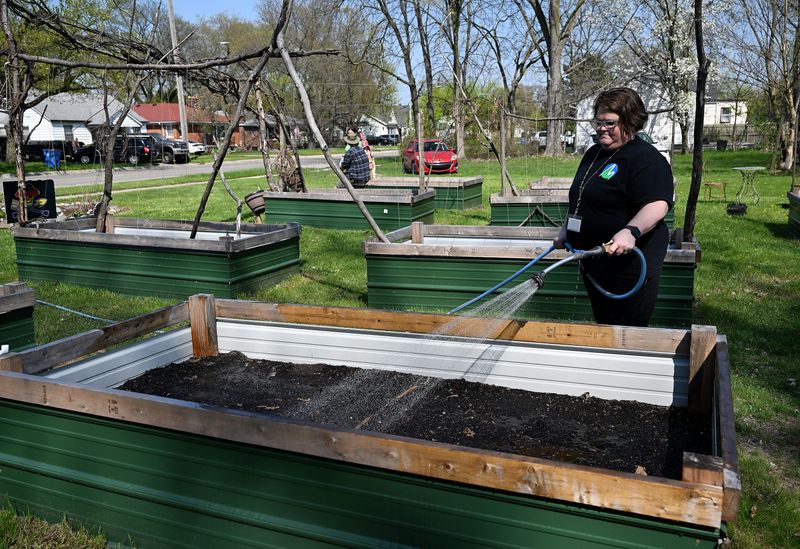
On a sunny day last week, seeds were growing in dark soil in the garden’s metal garden beds as a volunteer watered the beds. Seeds were planted for celery, red cabbage, onion. broccoli and herbs.
A produce station made of wood sat empty at the front of the property, waiting to be stocked with fresh vegetables in the coming months. Nearby, cars rumbled down Toepfer Road.
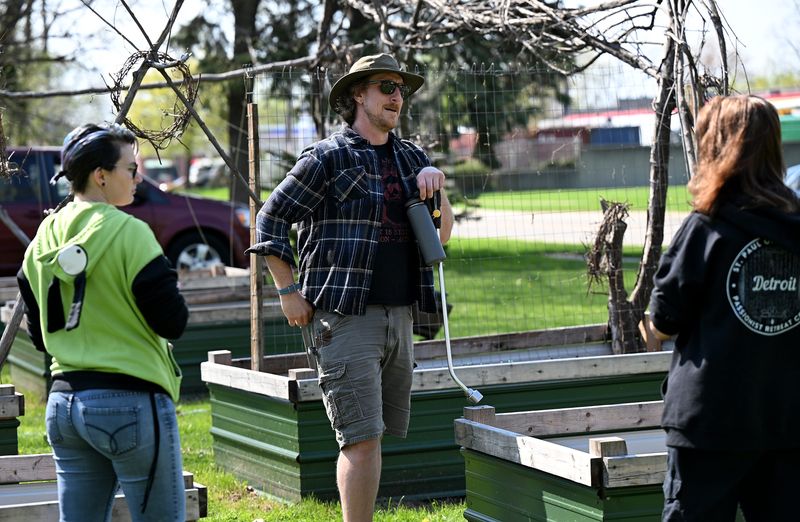
Annie Saintclaire decided to become a garden volunteer last year when she saw it being built. Saintclaire, whose home is about 100 yards from the property, said a community garden provides “some really major benefits.”
“No. 1, it feeds hungry people ― for free,” she said. “We can teach a child how to grow. You know, you feed him and he’s full, but that’s it. You teach him how to grow, and then he teaches others. … The education is huge.”
She added that community involvement is a benefit of the garden. She said she has met neighbors she never knew she had through the garden.
Kat Strong, another garden volunteer, said her parents are part of the Baby Boomer generation, and “we always had gardens.” But the next generation, including her children, doesn’t “really know about gardening,” she said.
Strong, an Eastpointe resident, said it’s important for them to know where their food comes from.
“Kids stop by,” she said. “They’re very excited to be here, and … it gives me a lot of joy.”
Lease negotiations hit roadblocks
The back-and-forth between city officials and garden organizers centered on the city’s interest in possibly developing the land on Toepfer as something else, along with proposed lease restrictions.
Matheus said the city told garden officials this spring that it is updating its zoning ordinance and that the property will be highly developable. A city official said the property could be developed as a triplex or quadplex, he said.
Garden organizers also chafed at some lease restrictions that were originally proposed.
They included no longer allowing garden organizers to have a produce cart, store any produce on the property and no exterior lights, Matheus said. He said the garden organizers decided to “fight back” on the proposals, which would “very much harm our program.”
Over the last few weeks, emails supporting the garden have flooded the inboxes of the mayor, Warren City Council, the media and other city officials. Garden organizers created a feedback form in which people can provide information such as their name, their proximity to the garden and why it matters to them, and that information is sent to those officials and journalists.
Mayor’s office explains its position
Stone said in a statement last week that the city recognizes the positive impact community gardens play in neighborhoods. At the same, the city has been working toward “a broader solution” by developing a Community Garden Ordinance, she said.
“The goal is to create a framework that allows community gardens to operate independently and consistently across the city, rather than relying on one-off agreements,” she said. “The biggest challenge in drafting a community garden ordinance is that our zoning ordinances are written relative to a dwelling. Since vacant lots no longer have dwellings, Warren has no means of enforcing blight or addressing mismanagement.”
She said the language of the Community Garden Ordinance or a contract needs to be consistent with “the application of the zoning ordinance to other parcels.”
Stone noted that the original agreement with the South Warren Community Garden, which was drafted in 2025, was a “pilot project” for the city with the purpose of establishing the necessary ordinance language.
“The City provided a one-year lease for $1 and covered water and sanitation costs to help get the project established,” she said. “This allowed us to learn from the experience while working toward a broader policy framework.”
She said the city and the garden exchanged multiple drafts of a longer-term agreement, and the city “made efforts to accommodate reasonable requests.” But additional requests were introduced that expanded the scope of the agreement beyond “what can be supported under existing standards.”
asnabes@detroitnews.com
This article originally appeared on The Detroit News: Warren community garden will remain in its spot after city OKs lease
Reporting by Anne Snabes, The Detroit News / The Detroit News
USA TODAY Network via Reuters Connect