Forty-four years after Vincent Chin died in Detroit, his story is being remembered at a cermony Saturday, June 20 that will honor the museum curator who came up with the idea to place a street sign in Midtown Detroit named after the man killed in a hate crime that sparked Asian American activism.
Organizers say the event by the Vincent Chin Institute is part of their efforts to highlight how Chin’s case still resonates today amid growing concerns about racism targeting Asian people.

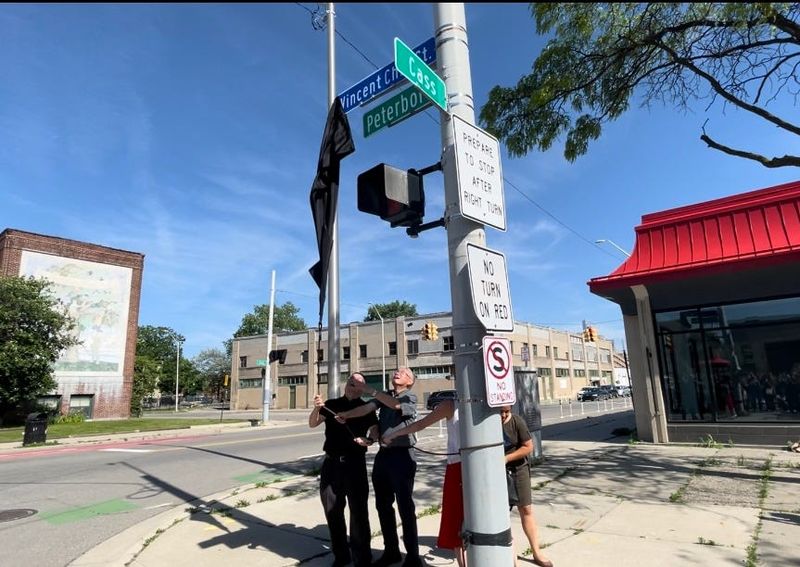
Last year, in 2025, Peterboro Street at the corner at Cass Avenue was renamed as Vincent Chin Street, with an honorary secondary street sign placed above the Peterboro sign. It’s located in what used to be Chinatown in Detroit, which community leaders are hoping can once again be a thriving neighborhood with Chinese and Asian businesses.
On Saturday at 11:30 am, the Vincent Chin Institute will honor with an award Yao-Fen You, the acting director of the Smithsonian Asian Pacific American Center (APAC) and a former curator at the Detroit Institute of Arts. This is the first award ceremony by the institute, which hopes to have future ceremonies to honor those helping their mission of educating the public about how Chin’s case is important to remember.
Yao-Fen came up with the idea for the street sign in 2022 when she and others were discussing plans to mark the 40th anniversary of the death of Chin, a Chinese immigrant assaulted by two white autoworkers in Highland Park who died days later on June 23, 1982. Activists said it was a hate crime driven by anger over Asian people threatening America’s economy and jobs.
“It’s because of you little (expletives) that we’re out of work,” one of the two men yelled at Chin, a witness alleged. The man who clubbed Chin denied he made racial remarks and was acquitted in a federal civil rights trial.
“It was Yao-Fen who originated the idea” for a street sign, Helen Zia, a longtime Asian American acitivst who is founder of the Vincent Chin Institute and the executor of the estate of Vincent and his mother, Lily Chan. “Part of the Vincent Chin legacy is to accurately … remember history and why it is important and relevant today. Why do we remember Vincent Chin? Why does Vincent Chin’s story and the movement that came out of it matter?”
Zia said the case still matters because many of its same issues apply today. Zia moved to Detroit in the late 1970s, working as a large press operator with Chrysler before being laid off along with other workers. She remembers the economic despair in Detroit at the time, with long unemployment lines.
“Vincent Chin was killed … as the unemployment, the pain, the misery, and uncertainty that the people of Detroit were going through gave rise to the tension and the anger and frustration and the scapegoating and the targeting and the hate toward anybody who looked Japanese,” Zia said.
Today, countries such as China have replaced Japan as a threat, leading to fears that sometimes turn into bias against Americans of Chinese descent and other ethnicities. Some students and academics of Chinese descent, including at the University of Michigan, have felt unfairly targeted by government investigations in security and espionage cases.
“Over and over again, it’s emphasized by our political leaders … that China is the existential enemy to America,” Zia said.
Indian Americans have also more recently become targeted amid fears that immigrants from India, such as those on H-1B visas, are taking away jobs. A report in April by Asian Americans Advancing Justice that analyzed FBI data on hate crimes shows that anti-Asian attacks are still above pre-COVID padenmic levels, with white supremacists increasingly targeting “the South Asian community to inspire misinformation and discriminatory rhetoric and policies.”
Vincent Chin Street is located in an area represented in Congress by U.S. House Rep. Shri Thanedar, D-Detroit, an immigrant from India who has faced increasing racial attacks against him on social media. In a statement on June 12, in response to anti-Indian racism in a suburb of Dallas, Thanedar said: “Anti-Indian attacks have spiked on the ground and on social media in the last couple of years, and if you don’t believe me, look at my social media or that of any other Indian elected official. Racism has no place in our country: these horrific actions need to stop.”
Thanedar added: “I came to America in search of the American Dream. … Immigrants make our country stronger. … I am proud to be an Indian American, and I will always stand against hate and racism in every form.”
Arab Americans and Muslims in cities such as Dearborn have also faced renewed hate. You, the museum curator receiving the award Saturday, is planning to visit the Arab American National Museum in Dearborn as part of her visit to Michigan to engage with Middle Eastern communities in Michigan. In the year after the Sept. 11 attacks in 2001, officials with the Japanese American National Museum in California visited Dearborn to meet with Arab American leaders and offer advice on dealing with hate and creating the Arab American National Museum, which opened a few years later in 2005.
The Vincent Chin Institute was founded in 2022 during the Covid-19 pandemic, when anti-Chinese and anti-Asian hate was increasing, to “take the legacy of the Vincent Chin movement of Detroit to a national level through public awareness, education and solidarity,” the institute said.
“Back then, Japan was the enemy,” Zia said of 1982, when Chin was killed. “Now and for the foreseeable future it’s China, and unfortunately hate spills over, whether it’s anti-Asian hate or anti-Semitic or Islamophobic hate or anti-gay hate, it is really all a single thread. When violence and intolerance to any people and hatred and demonization happens, it is not usually restricted to just one group. It’s a poison, a cloud that falls upon a culture, a country, to blame entire groups of people for something that they have nothing to do with, and so we are very concerned that this could happen. It could happen to Asian Americans, but it could happen to any group that gets targeted.”
Contact Niraj Warikoo: nwarikoo@freepress.com
This article originally appeared on Detroit Free Press: Vincent Chin’s death remembered in Detroit as anti-Asian bias rises
Reporting by Niraj Warikoo, Detroit Free Press / Detroit Free Press
USA TODAY Network via Reuters Connect
By Niraj Warikoo, Detroit Free Press | USA TODAY Network