Detroit’s air quality improved considerably over the weekend, dropping out of hazardous territory but remained unhealthy for some residents Sunday as smoke from the Canadian wildfires continued to plague the region.
The city’s air quality index stood at 128, No. 6 worldwide, just below Chicago, by Sunday evening, according to IQAir’s ranking. The U.S. Air Quality Index by the Environmental Protection Agency, lists the the air quality for Detroit at 130, which it labels unhealthy for sensitive groups.

That’s a steep drop from Friday, when Detroit’s index hit 435 in the morning, a hazardous reading, before falling to 245 by that evening. Detroit topped IQAir’s ranking of the world’s most polluted major cities for a chunk of Thursday, when the index reached 724 at one point.
State officials issued another statewide air quality alert for Sunday and Monday, but indicated it wouldn’t be as bad as the conditions that dominated the state Thursday and Friday.
The Southeast Michigan Council of Government issued the region’s third air quality advisory of the season Sunday, citing a new plume of wildfire smoke that has settled over the state.
“Monday looks to continue a trend of slow improvement across the state,” said Jim Haywood, EGLE’s senior meteorologist. “The smoke models are consistent with decreasing smoke concentrations although some smoke is still expected to linger.”
Ozone concentrations are expected to mostly range from good to moderate, according to EGLE.
“In the meantime, it is recommended to avoid strenuous outdoor activities, especially those with heart disease and respiratory conditions like asthma,” Haywood said. “Watch for symptoms including wheezing, coughing, chest tightness, dizziness, or burning in nose, throat, and eyes. You can help reduce air pollution by limiting activities, such as outdoor burning. Keep windows closed overnight to prevent smoke from getting indoors and, if possible, run central air conditioning with MERV-13 or higher rated filters.”
IQAir listed Detroit’s AQI at 141 for PM2.5 Sunday, ranking the city the sixth-worst major city in the world at that time.
The index is a measure of PM2.5 or particulate matter. A PM2.5 level of 101 to 150 is considered “unhealthy for sensitive groups.”
Elevated levels of fine particulate caused by wildfire smoke are expected to have concentrations that will range from unsafe for sensitive groups across the Lower Peninsula to unhealthy in the Upper Peninsula, which would be an improvement for the U.P. from Saturday’s conditions.
“We are expecting some of the smoke to improve tomorrow as we get wind shifting to the south,” Megan Varcie, a meteorologist at the National Weather Service, said. “But … any time we get a wind from the north, until the wildfires are put out, we’re going to continue to have potential for smoke and air quality issues.”
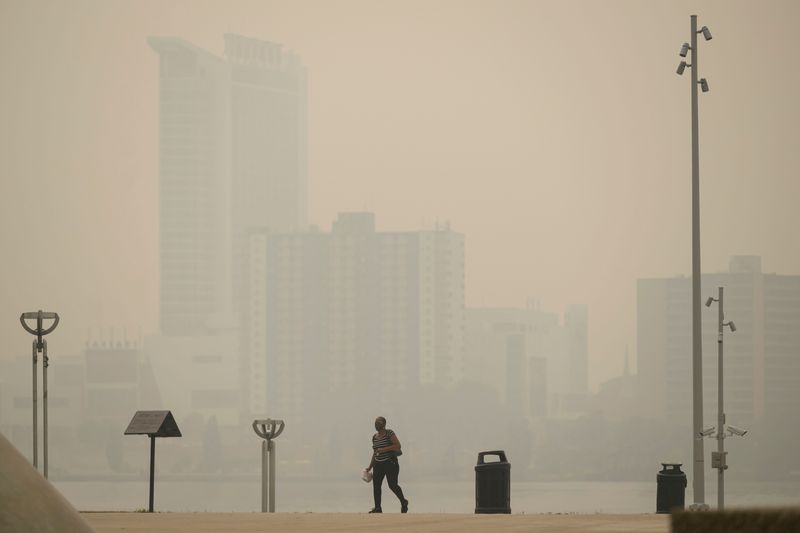
Skies will be hazy and smoky impacting visibility. The weather service reported visibility reduced to 2 miles over the last four days.
Unhealthy air returned to the Metro Detroit on Saturday night as the Upper Peninsula dealt with the worst air quality in Michigan, with the western U.P.’s particulate matter considered hazardous, according to a state index.
Detroit’s air improved to moderate air quality levels for much of Saturday, but a shift in the front brought lower levels of wildfire smoke back to the Motor City and much of the Lower Peninsula, with Detroit’s 136 in PM2.5 ranked seventh worth in the world at 11 p.m. and second worst in the United States behind Chicago’s 160, according to IQAir.
The worst air was in the Upper Peninsula, which is closest to the wildfire smoke of Canada and Minnesota. The west UP’s index of 346 is considered hazardous, while the eastern UP’s index of 293 at 11 p.m. is considered very unhealthy for everyone, AirNow reported.
By contrast, Grand Rapids had an index of 184, or unhealthy, while Lansing was at 156 and Flint was at 112, a particulate matter condition that is considered unhealthy for sensitive groups.
The National Weather Service canceled an air quality alert for Saturday in the following counties: Genesee, Lapeer,St. Clair, Livingston, Oakland, Macomb, Shiawassee, Washtenaw, Wayne, Lenawee and Monroe.
Detroit’s air quality index, or AQI, hit 435 on Friday morning, which is considered hazardous to everyone’s health, IQAir said.
Detroit had an air quality index of 724 at one point on Thursday, earning it first place for a good part of the day on IQAir’s ranking of the most polluted global major cities.
AirNow is a partnership of the U.S. Environmental Protection Agency, National Oceanic and Atmospheric Administration, the U.S. National Park Service, the National Aeronautics and Space Administration, the Centers for Disease Control and local air quality agencies.
mjohnson@detroitnews.com
This article originally appeared on The Detroit News: UP air remains unhealthy, while Detroit has smog. What expert expects Monday
Reporting by Myesha Johnson, The Detroit News / The Detroit News
USA TODAY Network via Reuters Connect
By Myesha Johnson, The Detroit News | USA TODAY Network