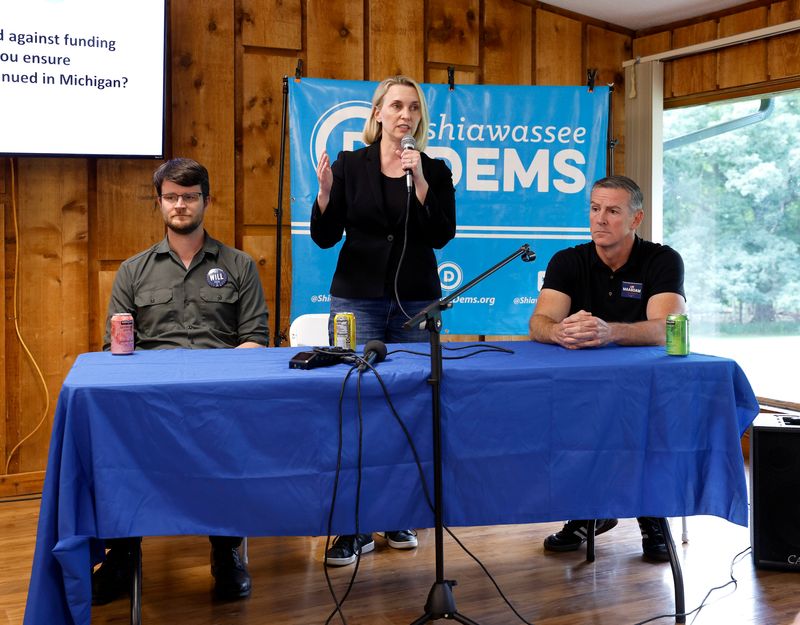
Lansing — In a basement filled with creaky metal folding chairs, old arts and crafts supplies and the pervasive smoke of Canadian wildfires, the three candidates seeking the Democratic nomination for Michigan’s 7th Congressional District made their case to voters.
The humble setting for the Thursday candidate forum in an old church basement on Lansing’s east side belied the growing national attention on the mid-Michigan primary election, which has morphed from what one political expert called a “sleepy” congressional contest to another test of the viability of the progressive ticket in Michigan.

The fight for Michigan’s 7th District, a seat held by Republican U.S. Rep. Tom Barrett of Charlotte that Democrats hope to flip in November, has slowly evolved from a race between well-funded former U.S. Ambassador Bridget Brink and former U.S. Navy SEAL Matt Maasdam, to one where progressive community organizer William Lawrence appears to be gaining ground toward the nomination.
“It was a surprisingly sleepy race for a long time,” said Matt Grossmann, a political science professor at Michigan State University. “There were multiple candidates but not a ton of differentiation or national attention. But there never was a consolidated front-runner, and that really has left things open.”
Lawrence has been boosted by the tailwinds of the U.S. Senate Democratic primary, where progressive Abdul El-Sayed is waging a fight against U.S. Rep. Haley Stevens for the nomination — a ballot-box battle that pits the party’s establishment against an insurgent left wing. Both Lawrence and El-Sayed have endorsed each other and have the backing of U.S. Sen. Bernie Sanders of Vermont, a self-described democratic socialist.
But Lawrence’s progressive credentials and grassroots appeal have been dinged by the resurrection of past social media and podcast comments he made criticizing Democratic leaders, including Black Democratic leaders whom he accused of defanging White liberals.
Lawrence has said he regrets his word choice, but his comments were enough for the Congressional Black Caucus PAC recently to call on Democratic voters to condemn his candidacy.
Over the final two weeks of the race, Lawrence’s chances to win the primary will hinge on support from young voters and affluent college-educated graduates who, historically, have been more likely to vote for progressive candidates, said Adrian Hemond, a Democrat and CEO of the firm Grassroots Midwest.
Hemond said the task becomes difficult in an August primary with Michigan State University’s hordes of young voters not back on campus in East Lansing, which is in the heart of the district.
The two more Democratic Party establishment-aligned candidates, Maasdam and Brink, could be left to split the remaining primary vote, Hemond said.
If Lawrence pulls off a primary victory, it might be the incumbent Barrett’s best chance at keeping the 7th District seat, said Hemond, a supporter of Maasdam.
“Most voters don’t know what the Sunrise Movement is,” said Hemond, referring to a progressive climate advocacy group Lawrence helped start. “But Tom Barrett and the national Republicans will certainly educate them about what that Marxist movement was formed to do.”
Lawrence’s campaign rejected the idea that the Sunrise Movement was Marxist.
The Sunrise Movement supports the Green New Deal, a set of progressive policies aimed at cutting greenhouse gas emissions to zero, championed by U.S. Rep. Alexandria Ocasio-Cortez, D-New York, who campaigned Sunday at an event with Sanders and Lawrence in Lansing.
Ocasio-Cortez hasn’t endorsed Lawrence. She left the stage at the end of the event on Sunday inside a Lansing convention center before Lawrence walked on to make a final appearance with Sanders and El-Sayed.
El-Sayed told reporters that he and Lawrence want to fight against the influence of “big money” and were facing pushback in the form of heavy campaign spending as a result. Outside groups are slated to spend more than $50 million against El-Sayed in his Senate primary.
“We’ve got to decide as a Democratic Party — this is a Democratic Party primary — if we are actually committed to the democratic process,” El-Sayed said. “Because I don’t know what you say about $50 million, but it seems hella anti-democratic to me.”
A battleground seat for Congress
The Lansing-based 7th District includes all of Ingham, Clinton, Shiawassee and Livingston counties and parts of Genesee, Eaton and Oakland counties.
The area, before redistricting, was represented by U.S. Rep. Elissa Slotkin, D-Holly, before she ran and won a seat in the U.S. Senate in 2024. That same year, Barrett beat former state Sen. Curtis Hertel, D-East Lansing, by 3.7 percentage points to flip the seat for Republicans.
This year, as Republicans face economic headwinds and President Donald Trump’s low approval polling numbers in the midterms, Democrats are hoping to flip the seat to their side of the aisle.
Barrett’s seat is among 45 districts where House Democrats see an opportunity to flip the seat from GOP control on their way to retaking the majority, and their campaign arm is betting that affordability and inflation will be at the core of their messaging to win.
“That’s the No. 1 issue we hear about across the country, and the public is increasingly blaming Republicans for it,” said Rep. Suzan DelBene of Washington state, who chairs the Democratic Congressional Campaign Committee.
Linda Appling, a longtime Lansing Democrat who helped organize Thursday’s forum, recognizes the race is attracting national attention, but she hopes residents will do their own research on each of the potential nominees.
“More money will be coming into this district on both sides,” Appling said. “It’s all right. But people in the district need to be able to make up their own minds. And some people are not necessarily being accurate in the statements they make, particularly in some of the advertisements I’ve seen.”
Democratic candidates make a play for the 7th District
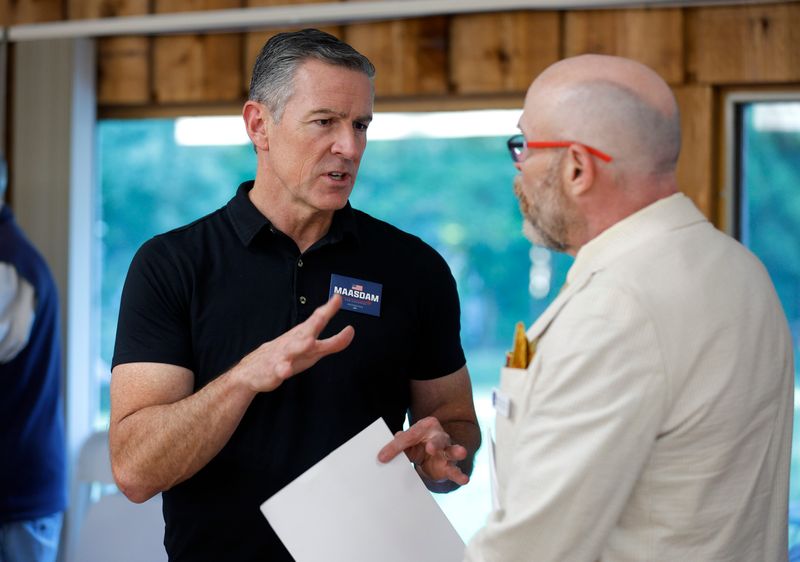
Maasdam, who recently relocated to Genoa Township near Brighton in the district from Ann Arbor Township, grew up in Nebraska but graduated from the University of Michigan before spending 20 years in the U.S. Navy as a SEAL. He served as a military aide under Barack Obama, carrying the nuclear codes for the former president, and later went into business. He moved back to Michigan in 2019 and moved into the district this month.
He’s earned the backing of several labor unions and Slotkin.
Maasdam is running on a platform that seeks to uphold the Constitution, tackle high costs and combat corruption, he said. But he also said it will “take a veteran to get a veteran out of this seat.”
“He has run on a veteran platform thus far, and I appreciate his veteran status and the things he did for the country, but I don’t think he’s doing a good job as a congressman,” Maasdam said of Barrett, a former Army helicopter pilot.
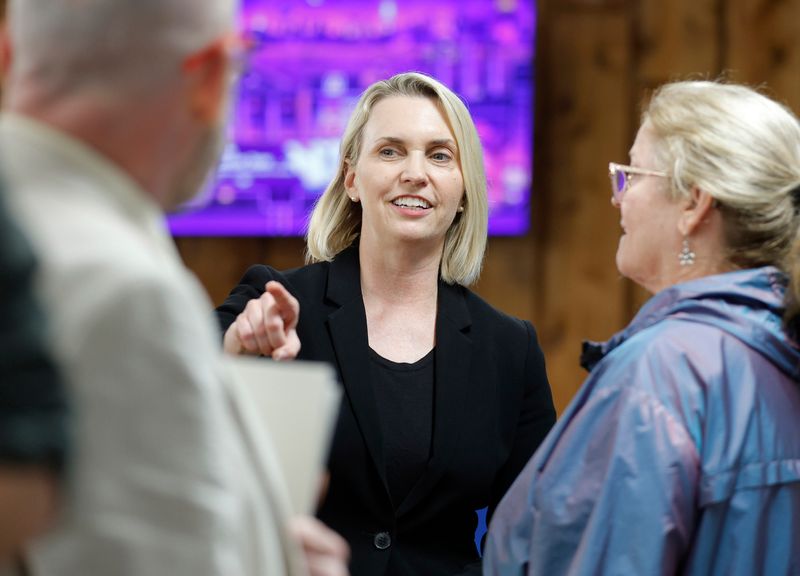
Brink moved to Lansing last year after serving 28 years as a diplomat, most recently as U.S. ambassador to Ukraine, a post from which she resigned in 2025 due to disagreements with Trump’s policy and actions. She has served in a variety of public service roles under five presidents, and was the first American female ambassador to serve in a war zone.
She’s named health care affordability, lower costs and defending democracy as her policy goals. Brink has received endorsements from a handful of labor groups, including the Michigan Education Association, the influential teachers’ union.
Maasdam has sought to portray Brink as Trump-friendly because she served under the Republican president during his first term. In one of Maasdam’s mail advertisements, it says, “Donald Trump Trusted Bridget Brink to Carry Out His Agenda — and She Did.”
Brink has cited her resignation as evidence that she has fought the president’s policies.
“We need leaders in Congress who will stand up to Trump, and I’m the only one in this race who has actually done that,” Brink said. “And it’s exactly what I will do in Congress.”
Lawrence, a community organizer from Lansing, co-founded the youth-led Sunrise Movement for climate action. In recent years, he’s focused on housing affordability, founding the Michigan Rent Is Too Damn High Coalition to advocate for renters and tenants’ protections.
Lawrence has focused his messaging on opposition to U.S. support of the Middle East wars, pushback on data center development, and access to housing and health care. He has advocated for universal health care.
“I think, around the country, you’re seeing that people are voting for change because they’re tired of the status quo of corporate-funded Democrats and corporate-funded Republicans,” Lawrence said.
Money, ads roll in
Fundraising among the primary candidates has been competitive. Brink reported Wednesday that she had raised $642,416 in the second quarter of 2026 and has $1.1 million on hand. Lawrence reported raising $418,112 over the same quarter and has roughly $570,000 on hand, while Maasdam reported raising $353,818 over the second quarter with $548,000 left over.
Barrett, by comparison, raised $1.1 million in the second quarter and has nearly $3 million on hand.
Outside spending for and against the candidates also has been significant.
Michigan Values PAC has gone on the attack against Brink, accusing her of being Trump’s “hand-picked” ambassador. VoteVets has run ads in support of Maasdam, but Brink has accused him of outsourcing jobs.
Maasdam’s campaign rejected Brink’s attack as a desperate effort to gain ground in the race and argued as soon as Maasdam “was CEO of a company and in charge of supply chain decisions, every product his company sold was 100% made in America.”
Two Democratic groups have gone on the offense against Lawrence over old social media and podcast comments, including ones that called Slotkin and Vice President Kamala Harris “warmongers,” and accused Gov. Gretchen Whitmer of sabotaging the 2023-24 Democratic control of state government in Lansing.
A Congressional Black Caucus-aligned PAC recently rolled out a new ad attacking Lawrence for supporting the Uncommitted Movement, which urged a vote for uncommitted in the Democratic primary when President Joe Biden initially ran for reelection, and calling Black political leaders in a podcast a “big problem” that sought to “defang the White left.” The comments were first reported by HuffPost.
“Here’s a reminder for William Lawrence,” the ad said. “The same leaders, black leaders, that have fought and bled for this country and this party are not a big problem. Except now, maybe, for you.”
Lawrence has said he regrets his choice of words, which he said “did not accurately convey the point that I was intending to make, which is about the need for a strong, multiracial, progressive, antiwar movement that we all build from the bottom up in order to change our country’s disastrous foreign policy and bring our money home to invest in housing and health care for everybody in mid-Michigan.
“That requires the diligent work of having conversations across race and thinking about how we can all come together and be united in the cause of peace,” Lawrence said.
eleblanc@detroitnews.com
Staff Writers Craig Mauger and Melissa Nann Burke contributed.
This article originally appeared on The Detroit News: Mid-Michigan U.S. House primary poses new test of progressive ticket
Reporting by Beth LeBlanc, The Detroit News / The Detroit News
USA TODAY Network via Reuters Connect



By Beth LeBlanc, The Detroit News | USA TODAY Network